What Is Commerce Media? How It Works and Why It Matters
Retail media used to be easy to picture.
A shopper searched for coffee on a retailer’s website. A sponsored product appeared near the top of the results. The brand gained visibility, the retailer earned advertising revenue, and the shopper found another product to consider.
That model still matters. But the idea has grown far beyond a sponsored product on a retailer’s search page.
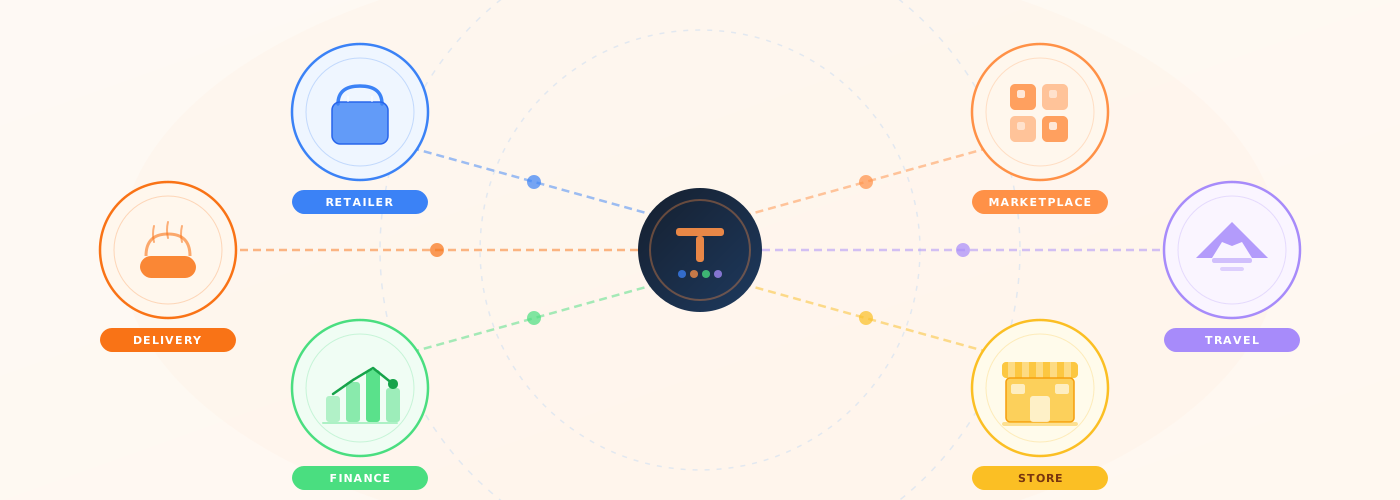
Marketplaces now help sellers promote listings. Delivery apps feature sponsored restaurants. Travel platforms can promote hotels and experiences. Financial platforms can surface sponsored credit cards, insurance products, or loans. Commerce businesses can also extend campaigns into social, programmatic, connected TV, physical stores, and emerging AI-assisted shopping experiences.
The broader term for this is commerce media.
What is commerce media?
Commerce media is advertising powered by commerce data and activated across shopping-related environments to influence product or service discovery and connect media activity to measurable business outcomes.
Commerce media can appear on a company’s own website or app, across external media channels, inside physical stores, or within AI-assisted product discovery experiences.
What makes it different from general digital advertising is the connection to commerce. The system can work with products, services, listings, sellers, search intent, categories, availability, prices, campaign budgets, and transaction events—not only audiences and impressions.
It can also help answer the question advertisers ultimately care about:
What happened after the ad?
That outcome might be a product view, an add-to-cart event, an order, a booking, a qualified lead, a purchase, or measurable incremental revenue.
At Topsort, we view commerce media as part of the commerce infrastructure itself. The placement is only the visible layer. Underneath it, the system needs to coordinate data, eligibility, auctions, relevance, budgets, events, attribution, reporting, and optimization.
What makes an ad “commerce media”?
An ad does not become commerce media simply because it appears on an ecommerce page.
A generic banner placed on a shopping website may still be ordinary display advertising. Commerce media becomes more valuable when the advertising system understands the commercial context around the placement.
Three characteristics usually define it.
It appears within or around a commerce journey
The person is discovering, comparing, considering, ordering, booking, applying for, or purchasing a product or service.
It uses commerce signals
Those signals may include search queries, product views, category context, listing data, availability, price, seller information, basket activity, bookings, purchases, or other first-party commerce events.
It connects media activity to commerce outcomes
Advertisers can see more than impressions and clicks. The platform can connect campaigns to outcomes such as orders, bookings, attributed revenue, ROAS, conversion lift, or incremental sales.
That combination is what makes commerce media useful: advertising is brought closer to the decisions people are already making.
Why commerce media extends beyond retail media
Retail media remains one of the most important parts of commerce media. It describes advertising businesses built around retailer inventory, shopper relationships, and retail transaction data.
But the same operating model now appears in businesses that are not traditional retailers.
A food delivery app has high-intent ordering sessions. A hotel marketplace has travel searches and booking data. A financial comparison platform knows which products people are evaluating. A classifieds platform connects buyers and sellers around cars, homes, jobs, or services.
These businesses may look different, but they often share the same ingredients:
- An audience with commercial intent
- Products, services, listings, or sellers competing for attention
- Owned digital surfaces
- First-party commerce data
- Measurable transactions or conversions
- Commercial partners willing to pay for relevant visibility
Commerce media gives these businesses a broader way to think about monetization. It is not limited to retailers selling digital shelf space. It can apply anywhere product or service discovery leads to a measurable commercial action.
Commerce media vs retail media
The terminology is still evolving, and companies do not always use it in exactly the same way. A practical distinction is that retail media is a major branch of the broader commerce media category.
The categories share the same foundation. Both depend on relevance, measurable outcomes, advertiser trust, and a customer experience that does not feel overloaded with ads.
The main difference is scope. Retail media begins with retail. Commerce media extends the model across a wider range of transaction-oriented businesses.
For a closer look at channel strategy, see Onsite vs Offsite Retail Media.
Examples of commerce media
Commerce media looks different depending on the business operating it.
A retailer promotes a sponsored product
A shopper searches for shampoo on a retailer’s website. Eligible brands participate in an auction. A relevant sponsored product appears in the results, and the retailer tracks whether the shopper later buys it.
This is a common use case for retailers building their own media businesses.
A marketplace helps sellers promote listings
A marketplace allows sellers to sponsor selected products or listings. Promoted results appear naturally within search and browse experiences. Sellers can review impressions, clicks, orders, and return on ad spend.
Topsort’s marketplace monetization infrastructure is designed around programmable auctions, seller advertising, relevance controls, and operator reporting.
A delivery app features sponsored restaurants or products
A customer searches for lunch or opens a grocery category. Restaurants, merchants, or brands with active campaigns can compete for relevant placements based on bid, availability, budget, distance, category, and expected performance.
See how commerce media can work for delivery platforms.
A travel platform promotes hotels or experiences
A traveler searches for a hotel in Boston. The platform can include relevant sponsored properties while considering dates, availability, destination, price, ratings, and traveler intent.
Topsort supports commerce media for travel and hospitality platforms, including sponsored placements for hotels, airlines, experiences, and travel brands.
A financial platform promotes relevant products
A user compares credit cards, loans, insurance, or other financial products. Eligible providers can promote relevant options inside comparison or recommendation experiences, subject to the platform’s eligibility and compliance rules.
Topsort has a dedicated solution for commerce media on financial platforms.
A classifieds platform promotes a listing
A seller pays to improve the visibility of a car, property, job, or service listing. The platform balances promotion with relevance so sponsored results remain useful to buyers.
Learn more about monetization for classifieds and listing-based networks.
Different industries require different data, safeguards, and success metrics. But the underlying idea is consistent: give a commercial partner relevant visibility and measure what happens next.
Where does commerce media appear?
Commerce media can run across several connected environments.
Onsite commerce media
Onsite commerce media appears within a company’s owned digital properties.
Common placements include:
- Search results
- Category or browse pages
- Product detail pages
- Recommendation modules
- Homepages and feeds
- Apps
- Checkout or post-purchase experiences
- Email and owned messaging channels
Sponsored listings are a common onsite format because they can fit naturally into search, browse, recommendation, and discovery experiences.
Offsite commerce media
Offsite commerce media reaches audiences outside the commerce company’s owned website or app.
It may include:
- Paid social
- Programmatic display
- Connected TV
- Video
- Search advertising
- Publisher partnerships
- Audience extension
- Digital out-of-home
The commerce company can use first-party audiences, product data, and transaction signals to support activation and measurement while maintaining appropriate privacy controls.
Topsort’s offsite advertising infrastructure is designed to extend commerce media into external channels while connecting campaigns back to commerce workflows and reporting.
In-store commerce media
In-store commerce media brings advertising into physical commerce environments.
Formats can include digital screens, shelf media, checkout displays, audio, sampling, sponsored signage, smart carts, or app experiences triggered inside a store.
The measurement can be more complex than online measurement, but the goal remains the same: connect media exposure to meaningful commerce outcomes. Read the full guide to in-store retail media or explore Topsort’s in-store media product.
AI-assisted commerce media
This is still an emerging area.
As shoppers use conversational search and AI shopping assistants, sponsored products may appear within recommendations, comparisons, shopping lists, or AI-generated results.
The interface may change, but the infrastructure requirements remain familiar: product data, campaign eligibility, relevance, ranking, attribution, reporting, and clear sponsored labeling.
For a deeper look, read Agentic AI and Retail Media.
How does commerce media work?
A typical commerce media flow looks like this:
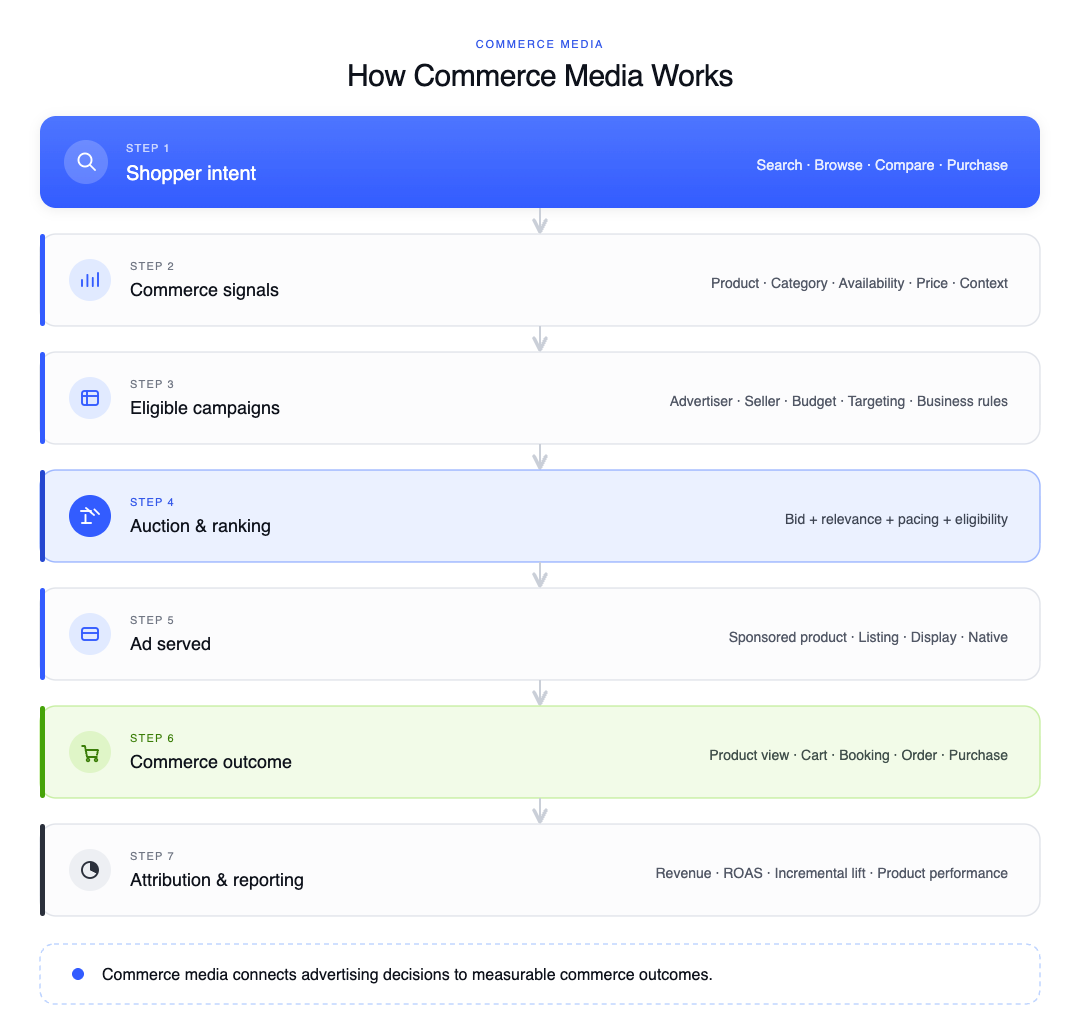
Here is what happens behind that flow.
1. A shopper creates a commerce signal
The shopper may search for a product, browse a category, view a listing, enter travel dates, compare financial products, or open a delivery app.
That activity creates context for the advertising decision.
2. The platform identifies eligible campaigns
The system checks which advertisers, sellers, products, listings, or services are allowed to participate.
Eligibility can depend on category, inventory, location, campaign status, budget, targeting, seller rules, and placement requirements.
3. An auction or ranking system evaluates the options
The system may consider:
- Bid
- Relevance
- Remaining budget
- Product or service availability
- Campaign pacing
- Placement rules
- Seller eligibility
- Predicted engagement or conversion
- Marketplace or retailer business rules
The highest bidder should not automatically win. A strong system balances monetization with relevance and customer experience.
Read more about how retail media auctions rank and price sponsored products.
4. The selected ad is served
The winning sponsored product, listing, banner, video, or native placement appears inside the experience.
It should feel connected to what the customer is doing rather than pasted onto the page.
A modern commerce ad server such as T-Zero can provide programmable ad serving, auctions, ranking rules, sponsored listings, and decision-level control. When a business needs more advanced pacing, quality scoring, relevance, and attribution-aware optimization, an intelligent decisioning layer such as T-Engine becomes more appropriate.
5. The platform records media and commerce events
The system may track impressions, clicks, product views, add-to-cart events, bookings, applications, orders, and purchases.
These events create the foundation for measurement.
6. Results are attributed, reported, and optimized
Advertisers can review campaign performance. Operators can understand which placements, products, sellers, and campaigns are creating value.
The system can then improve ranking, pacing, budget allocation, and campaign strategy over time.
The core components of a commerce media platform
Running a real commerce media business takes more than adding an ad unit to a page.
A complete platform usually needs several connected components.
Commerce data
The platform needs access to the commercial context surrounding an ad decision.
That may include catalog information, search queries, product attributes, prices, availability, seller data, bookings, transactions, and campaign events.
Ad serving and decisioning
The system needs to decide which ad should appear, where it should appear, and whether it is eligible.
This is where ad serving, auctions, ranking, relevance, pacing, quality, and business rules come together.
Advertiser and seller tools
Brands, sellers, and other partners need a practical way to create campaigns, choose products, set budgets, review performance, and make changes.
Self-service workflows can help a program support more advertisers without turning every campaign into a manual ad-operations project.
Measurement and attribution
Advertisers need to understand what happened after exposure or engagement.
The platform should connect media events to commerce outcomes using clear and consistent methodology. See Closed-Loop Attribution for Retail Media and Retail Media Attribution Models Explained for more detail.
Reporting
Different users need different levels of information.
Advertisers may want spend, delivery, attributed revenue, ROAS, product performance, and budget pacing. Operators may also need media revenue, fill rate, inventory utilization, seller participation, and placement-level performance.
Demand
A commerce media program also needs advertisers willing to participate.
That demand may come from existing brands, sellers, agencies, direct sales, programmatic partners, or broader demand networks.
Technology can make the program easier to operate, but it cannot replace a clear advertiser value proposition.
Topsort’s T-Platform brings ad serving, real-time auctions, advertiser workflows, campaign management, analytics, attribution, APIs, and AI optimization into one retail media infrastructure layer.
Why brands invest in commerce media
Commerce media can put advertisers close to moments of real consideration.
A shopper browsing a category, comparing hotels, searching for a restaurant, or evaluating a financial product is already expressing useful intent. The advertiser does not have to manufacture that intent from scratch.
Commerce media can give brands and commercial partners:
- Relevant product or service visibility
- Access to high-intent moments
- Product-, listing-, and placement-level reporting
- A clearer connection between advertising and outcomes
- Support for launches, promotions, category growth, and customer acquisition
- More ways to reach customers across onsite, offsite, and in-store channels
But proximity to purchase is not enough by itself.
A campaign can report strong attributed sales while mostly reaching people who were already likely to convert. That is why mature commerce media measurement should look at both attribution and incrementality.
Attribution shows which outcomes were connected to the campaign. Incrementality helps determine which outcomes were actually caused by it.
Why commerce businesses build media programs
For retailers and commerce platforms, media can create a new revenue stream from assets the business already owns.
Those assets may include:
- Customer traffic
- Search and discovery surfaces
- Product or listing data
- Seller and brand relationships
- Physical locations
- Transaction data
- Audience insights
- Customer-facing technology
A strong program can also create value beyond advertising revenue. It can help sellers grow, improve product discovery, fund better customer experiences, deepen commercial partnerships, and give the platform more control over how demand is activated.
There is an important trade-off, however.
Too little monetization leaves useful advertiser demand untapped. Too much monetization can make the experience feel crowded, biased, or unhelpful.
The best commerce media programs do not treat every available space as an ad slot. They choose moments where sponsored content can genuinely improve discovery while creating sustainable commercial value.
Commerce media is not automatically good media
Commerce media has a natural advantage because it sits close to commercial signals and outcomes.
That advantage can still be wasted.
Poorly designed programs can produce irrelevant ads, unclear reporting, duplicated attribution, overloaded pages, frustrated customers, and advertisers who do not understand what they are paying for.
A trustworthy program needs:
- Clear sponsored labeling
- Strong relevance controls
- Transparent attribution rules
- Reliable event tracking
- Appropriate privacy and data governance
- Useful advertiser reporting
- Guardrails for customer experience
- Incrementality testing where possible
The objective should not be to squeeze the highest possible revenue from every impression.
It should be to build a media business that advertisers want to keep buying and customers barely need to think about.
How should commerce media be measured?
Commerce media measurement works best when metrics are organized into three layers.
No single metric tells the whole story.
CTR can show engagement but not sales. ROAS can show attributed efficiency but not causation. Incrementality can show true lift but may require more complex experimentation.
Good reporting makes these distinctions clear instead of presenting one number as the final answer. See Retail Media Measurement in 2026 for a deeper measurement framework.
What is a commerce media network?
A commerce media network, or CMN, is the advertising business operated by a retailer, marketplace, delivery platform, travel company, financial platform, classifieds business, or another commerce company.
The network brings together:
- Owned or connected media inventory
- Commerce data
- Advertiser demand
- Campaign products
- Measurement
- Sales and operational workflows
The network is the business and channel advertisers buy from.
What is a commerce media platform?
A commerce media platform is the technology used to build and operate that network.
It may include:
- Ad serving
- Auctions and ranking
- Campaign management
- Advertiser self-service
- Budget pacing
- Attribution
- Reporting
- APIs
- AI optimization
- Onsite, offsite, or in-store activation
The distinction is straightforward:
The commerce media network is the business. The commerce media platform is the infrastructure that runs it.
A company can build that infrastructure internally, work with a technology provider, or use a combination of both.
For a practical implementation guide, read How to Build a Retail Media Network.
Commerce media vs Commerce AI
Commerce media and Commerce AI are related, but they are not the same thing.
Commerce media is the advertising and monetization model. It connects commercial partners, customer intent, media inventory, commerce data, and measurable outcomes.
Commerce AI is the intelligence layer that can make those systems more automated, adaptive, and connected.
Commerce AI can help with:
- Relevance scoring
- Auction ranking
- Bid and budget optimization
- Campaign recommendations
- Product discovery
- Advertiser workflows
- Forecasting
- Reporting insights
- Intent understanding
- AI-assisted shopping experiences
Commerce media creates the commercial system. Commerce AI helps that system make better decisions.
Topsort’s POV: commerce media is an infrastructure problem
A banner is easy to place.
A good commerce decision is harder.
The system needs to understand what the customer is doing, which products or services are relevant, which advertisers are eligible, how much budget remains, what business rules apply, whether the promoted item is available, and how the final outcome will be measured.
That is why Topsort does not see commerce media as an advertising layer pasted onto a storefront.
It is part of the commerce infrastructure itself.
From the operator’s side, the difficult work happens underneath the placement:
- Connecting catalogs and commerce data
- Managing advertisers and sellers
- Running auctions
- Balancing bids with relevance
- Pacing budgets
- Tracking events
- Attributing purchases or conversions
- Reporting outcomes
- Expanding into new formats and channels
- Preparing for AI-driven discovery
When these functions live in separate systems, the operator becomes the integration layer. Teams spend their time moving data, reconciling reports, configuring tools, and fixing workflows.
Commerce media infrastructure should do the opposite. It should make the system easier to operate as it grows.
Topsort was built around a simple idea: commerce companies should be able to own their customer experience, advertiser relationships, data, business rules, and monetization strategy without having to build every ad-serving and auction component from scratch.
How Topsort supports commerce media
Topsort provides AI-powered retail media and commerce monetization infrastructure for retailers, marketplaces, delivery apps, travel platforms, financial platforms, classifieds, and other commerce businesses.
Its stack supports different levels of maturity:
- T-Zero provides lightweight, programmable commerce ad serving, auctions, ranking rules, and sponsored placements.
- T-Engine adds intelligent decisioning, including pacing, quality scoring, relevance, attribution-aware optimization, and full-funnel performance controls.
- T-Platform provides a complete retail media operating layer with ad serving, auctions, advertiser workflows, campaign management, analytics, attribution, APIs, and AI optimization.
This gives commerce operators a path to launch a first sponsored placement, scale an existing media network, expand into offsite or in-store channels, and prepare for AI-assisted commerce experiences.
The goal is not simply to serve more ads.
It is to help commerce businesses create relevant discovery, measurable advertiser value, and sustainable monetization while retaining control of the underlying experience.
How to start building a commerce media program
A commerce media program does not need to launch with every format and channel at once.
A more practical path is to begin with one valuable commerce moment and build from there.
1. Identify who will advertise
That may be brands, sellers, restaurants, hotels, service providers, financial institutions, or other commercial partners.
2. Choose a high-intent starting point
Search results, category pages, recommendation modules, and promoted listings are often easier to explain and measure than a broad collection of display placements.
3. Define the customer-experience rules
Decide where sponsored content belongs, how it will be labeled, which advertisers are eligible, and how relevance will be protected.
4. Instrument commerce events
Track impressions, clicks, product or listing views, cart activity, bookings, applications, orders, purchases, and revenue as appropriate for the business.
5. Build clear advertiser reporting
Give advertisers a practical view of delivery and business outcomes. Make the attribution rules understandable.
6. Expand after the foundation works
Once activation, measurement, and advertiser workflows are stable, the program can expand into display, offsite, in-store, video, new advertiser types, or AI-assisted discovery.
A smaller program with clear value is a stronger starting point than a large collection of disconnected ad products.
Final takeaway
Commerce media connects advertising with commerce.
It uses commercial intent, commerce data, media inventory, advertiser demand, and measurement to help products and services gain relevant visibility throughout the buying journey.
Retail media is a major part of that category, but commerce media reaches further. It can support retailers, marketplaces, delivery apps, travel companies, financial platforms, classifieds, and other businesses built around commercial discovery and transactions.
The opportunity is not simply to create more places for ads.
It is to build a system where customers discover relevant options, advertisers understand the value they receive, and commerce operators can grow revenue without losing control of the experience.
That takes more than inventory.
It takes commerce-native infrastructure.
Frequently asked questions
What is commerce media?
Commerce media is advertising built around commercial intent, commerce data, and measurable outcomes. It helps commerce businesses connect advertisers with people while they are discovering, comparing, choosing, or buying products and services.
What is a commerce media network?
A commerce media network is an advertising business operated by a retailer, marketplace, delivery app, travel company, financial platform, classifieds business, or another commerce company using its inventory and commerce data.
What is the difference between commerce media and retail media?
Retail media focuses primarily on retailers, retail marketplaces, and shopper data. Commerce media is the broader category and can also include delivery, travel, financial services, classifieds, hospitality, and other transaction-oriented businesses.
What are examples of commerce media?
Examples include sponsored products on a retailer’s website, promoted listings in a marketplace, sponsored restaurants in a delivery app, hotel promotions on a travel platform, and sponsored products in financial comparison experiences.
Is commerce media only digital?
No. Commerce media can appear onsite, offsite, and in physical environments. In-store screens, shelf media, checkout displays, sampling, and sponsored signage can all be part of a commerce media program.
How does commerce media work?
A commerce media system uses customer context to identify eligible campaigns, rank or auction ads, serve a relevant placement, record media and commerce events, and report outcomes to advertisers.
What data does commerce media use?
Commerce media may use first-party signals such as search queries, product views, categories, listings, prices, availability, cart events, bookings, applications, purchases, and other commercial activity, subject to appropriate privacy controls.
How is commerce media measured?
Commerce media can be measured through delivery metrics, attributed commerce outcomes, and business-impact metrics such as incremental revenue, conversion lift, new customers, category growth, basket impact, or advertiser retention.
What is the difference between a commerce media network and a commerce media platform?
The network is the advertising business and inventory that advertisers buy from. The platform is the technology used to operate that business, including ad serving, auctions, campaign tools, attribution, reporting, and optimization.
How is Commerce AI related to commerce media?
Commerce AI is the intelligence layer that helps automate and improve commerce media decisions, including relevance, ranking, bidding, budget allocation, campaign workflows, reporting, and product discovery.
Ready to build a commerce media business on infrastructure designed for products, sellers, transactions, and measurable outcomes? Book a demo with Topsort.
Build commerce media on infrastructure designed for products, sellers, transactions, and measurable outcomes. Explore Topsort’s commerce media platform.
.png)