
Retail Media Attribution Models Explained: Click, View, SKU, Basket, and Incrementality
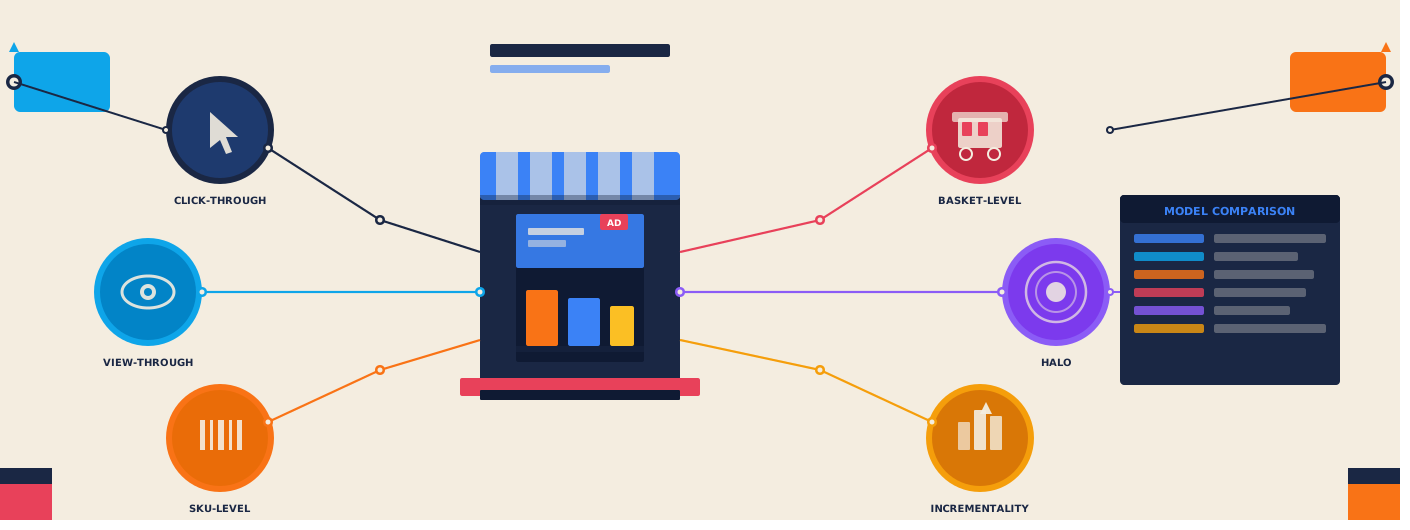
Retail media is growing fast because it gives advertisers something many other channels cannot: the ability to connect ads to shopping behavior and sales.
A shopper searches for a product. They see a sponsored listing. They click. They view the product page. They purchase. The retailer or marketplace can connect those events and report performance back to the advertiser.
But there is an important question behind every retail media report:
How should credit be assigned to the ad?
That is where retail media attribution models matter.
Attribution models define how a platform connects ad exposure or engagement to downstream outcomes such as purchases, revenue, orders, or basket activity. The model a platform uses can affect reported ROAS, campaign performance, advertiser trust, and budget decisions.
For retail media networks, attribution is not just a reporting detail. It is a core part of the advertiser experience.
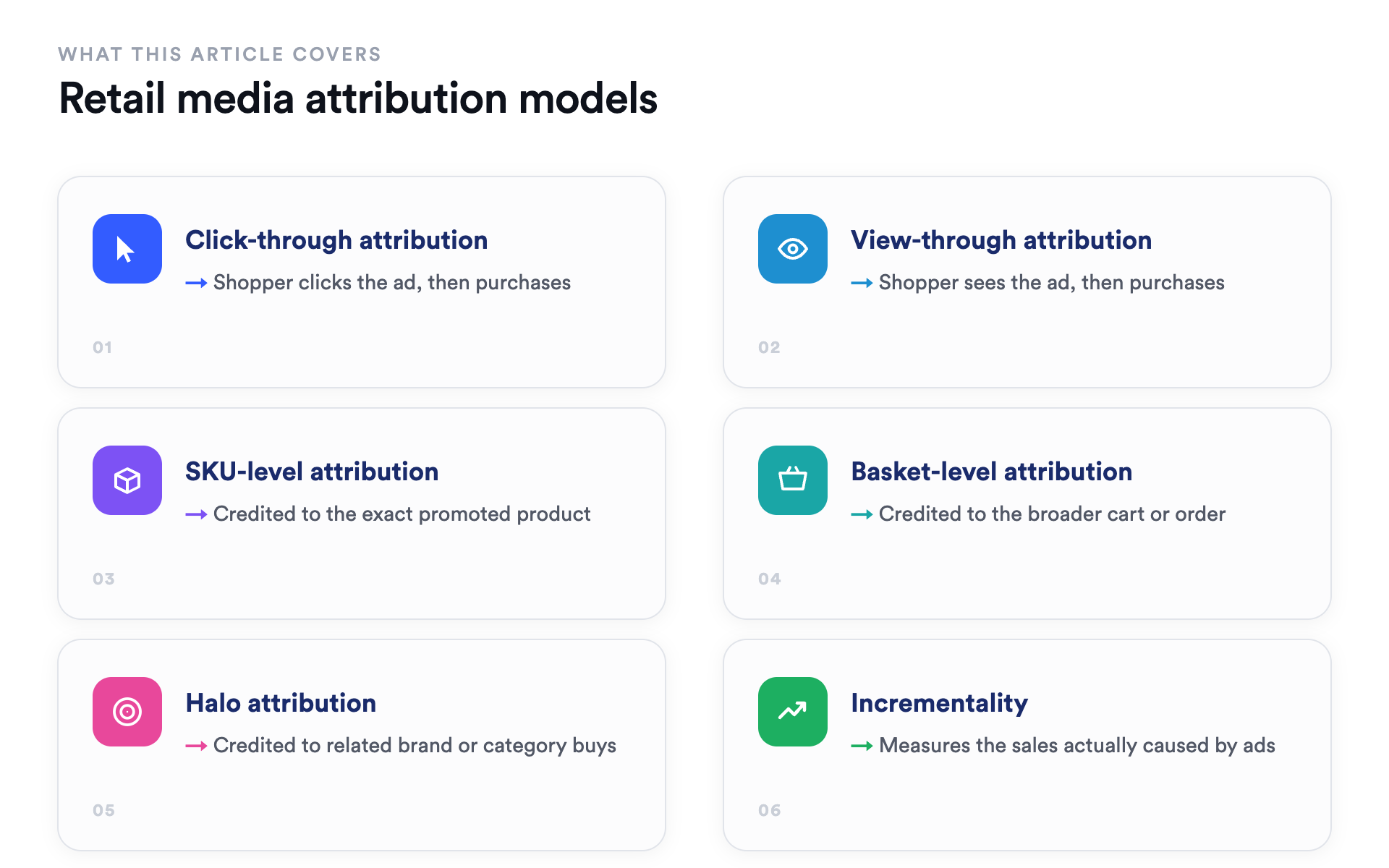
This guide explains the most important retail media attribution models, how they work, when to use them, and how they relate to incrementality.
What are retail media attribution models?
Retail media attribution models are methods used to assign credit for a purchase or conversion to a retail media campaign.
In simple terms, attribution models answer:
Which ad interaction should receive credit for a sale?
For example, if a shopper clicks a sponsored product and buys it within a defined time window, the platform may attribute that sale to the campaign. If a shopper sees a display ad but does not click, then later purchases the product, the platform may use a different model to decide whether the campaign should receive credit.
Retail media attribution models help advertisers understand:
- Which campaigns are driving attributed sales
- Which products or placements are performing
- Which sellers or brands are getting results
- How much revenue is connected to ad activity
- Which media investments should be increased, reduced, or optimized
Attribution is especially important in retail media because campaigns often run close to the point of purchase. That makes measurement powerful, but it also makes methodology important.
Why attribution models matter in retail media
Attribution models matter because they shape how campaign performance is reported.
If the attribution model is too broad, it may over-credit ads for sales that would have happened anyway. If the model is too narrow, it may under-credit campaigns that influenced shoppers earlier in the journey.
This affects advertiser trust.
A good retail media attribution model should be:
- Clear
- Consistent
- Transparent
- Connected to commerce outcomes
- Easy for advertisers to understand
- Flexible enough for different campaign types
Retail media teams need attribution models that support both day-to-day campaign reporting and long-term advertiser confidence.
Click-through attribution
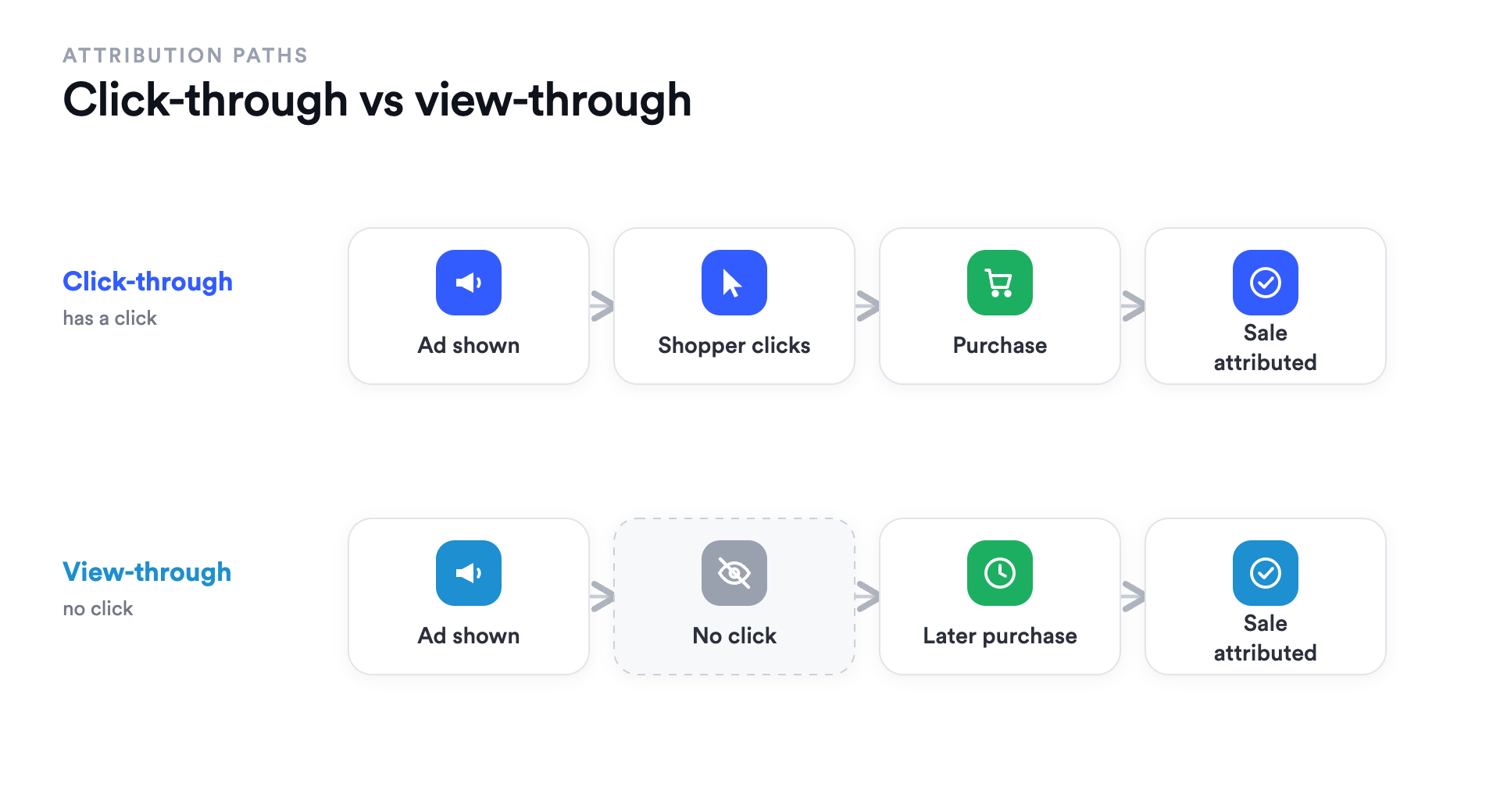
Click-through attribution gives credit to an ad when a shopper clicks the ad and later completes a qualifying purchase within the attribution window.
For example:
A shopper clicks a sponsored product ad, views the product page, and buys the item later that day. The campaign receives credit for the sale.
Click-through attribution is one of the most common retail media attribution models because it captures clear shopper intent. A click shows that the shopper actively engaged with the ad.
When click-through attribution is useful
Click-through attribution is useful for:
- Sponsored products
- Sponsored listings
- Search ads
- Product detail page placements
- Marketplace seller ads
- Lower-funnel campaigns
It is especially helpful when advertisers want to understand which ads are directly driving shopping actions.
Limitations of click-through attribution
Click-through attribution can miss the value of ads that influence shoppers without generating clicks. For example, a shopper may see a display ad, remember the brand, and purchase later without clicking.
This is why many retail media platforms also use view-through attribution.
View-through attribution
View-through attribution gives credit to an ad when a shopper sees the ad and later completes a qualifying purchase, even if they did not click the ad.
For example:
A shopper sees a banner ad for a product on a retailer’s homepage. They do not click the ad. Later, they search for the product and buy it. Depending on the platform’s rules, the campaign may receive view-through attribution.
View-through attribution is useful because not every ad influence results in a click. Some ads build awareness, remind shoppers of a product, or influence consideration before purchase.
When view-through attribution is useful
View-through attribution is useful for:
- Display ads
- Video ads
- Awareness campaigns
- Upper-funnel retail media
- Homepage placements
- Category page placements
- Offsite retail media campaigns
It helps advertisers understand the influence of media beyond direct clicks.
Limitations of view-through attribution
View-through attribution can be more difficult to interpret than click-through attribution. Seeing an ad does not always mean the ad caused the purchase.
If view-through attribution windows are too long or too broad, campaigns may receive credit for sales that were only loosely connected to the ad.
That is why transparency matters. Advertisers should understand how view-through attribution is defined and what attribution window is being used.
Last-touch attribution
Last-touch attribution gives credit to the final qualifying ad interaction before a purchase.
For example:
A shopper sees a display ad, later clicks a sponsored listing, and then purchases the product. Under a last-touch model, the sponsored listing click may receive credit because it was the final qualifying interaction before conversion.
Last-touch attribution is simple and easy to explain. It is often used because advertisers and platforms can quickly understand which interaction happened closest to purchase.
When last-touch attribution is useful
Last-touch attribution is useful when:
- The buying journey is short
- Campaigns are lower-funnel
- Advertisers want simple reporting
- The platform needs an easy-to-understand model
- Teams want to avoid assigning credit to too many touchpoints
Limitations of last-touch attribution
Last-touch attribution can undervalue earlier interactions. A display ad, video ad, or offsite ad may have influenced the shopper before the final click, but the last-touch model may give all credit to the final interaction.
This makes last-touch attribution practical, but not always complete.
Multi-touch attribution
Multi-touch attribution assigns credit across multiple ad interactions in the shopper journey.
For example:
A shopper sees an offsite ad, later sees an onsite display ad, clicks a sponsored product, and then purchases. A multi-touch model may distribute credit across these interactions instead of giving all credit to one touchpoint.
Multi-touch attribution can provide a more complete picture of the shopper journey.
When multi-touch attribution is useful
Multi-touch attribution is useful for:
- Longer consideration cycles
- Multi-format campaigns
- Omnichannel retail media
- Campaigns with onsite and offsite touchpoints
- Brands that want to understand the full path to purchase
Limitations of multi-touch attribution
Multi-touch attribution is more complex. Advertisers need to understand how credit is distributed and why. If the model is not transparent, it can create confusion.
For many retail media networks, the best approach is to start with clear click-through and view-through attribution, then add more advanced models as reporting maturity increases.
SKU-level attribution
SKU-level attribution connects ad activity to purchases of specific products or SKUs.
For example:
A brand promotes Product A. A shopper clicks the ad and purchases Product A. The sale is attributed at the SKU level.
This model is especially important in retail media because advertisers often care about specific promoted products, not just overall brand revenue.
When SKU-level attribution is useful
SKU-level attribution is useful for:
- Sponsored products
- Product launch campaigns
- Marketplace seller campaigns
- Product-level budget decisions
- SKU-level ROAS reporting
- Retail media reporting for vendors and brands
SKU-level attribution helps advertisers understand which promoted products are driving performance.
Limitations of SKU-level attribution
SKU-level attribution can be too narrow if it only credits purchases of the exact advertised product. In many retail environments, an ad may influence a shopper to buy a related product, another product from the same brand, or a higher-value item in the same category.
That is where basket-level and halo attribution can add value.
Basket-level attribution
Basket-level attribution looks beyond the promoted product and considers broader basket activity.
For example:
A shopper clicks an ad for a sponsored product, then purchases that product along with related items. Basket-level attribution can help advertisers understand the campaign’s impact on total order value or broader shopping behavior.
This is important because retail media often influences more than one item.
When basket-level attribution is useful
Basket-level attribution is useful for:
- Measuring total order impact
- Understanding cross-sell behavior
- Evaluating category growth
- Measuring brand-level influence
- Analyzing basket size or average order value
- Understanding broader commerce outcomes
Basket-level attribution is especially helpful for advertisers that care about total revenue impact, not only promoted SKU sales.
Limitations of basket-level attribution
Basket-level attribution needs clear rules. If the model credits too much basket activity to a single ad, it may overstate performance.
Retail media networks should explain whether basket attribution includes only related products, same-brand products, category-level purchases, or the full basket.
Halo attribution
Halo attribution measures the broader impact of an ad beyond the exact product that was promoted.
For example:
A shopper sees an ad for one product from a brand but purchases another product from the same brand. Halo attribution may connect that purchase back to the campaign.
This is useful because advertising can influence brand consideration, not just one SKU.
When halo attribution is useful
Halo attribution is useful for:
- Brand campaigns
- Product discovery
- New product launches
- Category-level campaigns
- Measuring brand-level impact
- Understanding cross-product influence
Halo attribution can help advertisers see how retail media affects broader brand or catalog performance.
Limitations of halo attribution
Halo attribution can become too broad if not clearly defined. Advertisers should know whether the halo includes:
- Same SKU
- Same parent product
- Same brand
- Same category
- Related products
- Entire basket
Clear definitions are essential for trust.
Attribution windows
An attribution window is the time period in which a purchase can be credited to an ad interaction.
For example, if a platform uses a 7-day click-through attribution window, a purchase may be attributed to a campaign if it happens within seven days after the shopper clicks the ad.
Attribution windows are important because they directly affect reported performance.
A longer attribution window may capture more purchases, but it may also increase the chance of crediting sales that were less directly influenced by the ad. A shorter attribution window may be more conservative, but it could miss delayed purchases.
Common attribution windows in retail media
Retail media attribution windows vary by platform and campaign type. Common examples include:
- Same-session attribution
- 1-day attribution
- 7-day attribution
- 14-day attribution
- 30-day attribution
The right attribution window depends on the product category, purchase cycle, campaign objective, and advertiser expectations.
For example, grocery purchases may happen quickly, while electronics or travel-related purchases may have a longer consideration cycle.
Attribution vs incrementality
Attribution and incrementality are related, but they are not the same.
Attribution answers:
Which sales were connected to an ad?
Incrementality answers:
Which sales were caused by an ad?
This distinction is critical in retail media.
A campaign may receive attribution for a purchase because the shopper clicked an ad before buying. But that does not always mean the ad caused the purchase. The shopper may have already intended to buy the product.
Incrementality helps estimate true lift by comparing exposed shoppers with a control group or by using another measurement method.
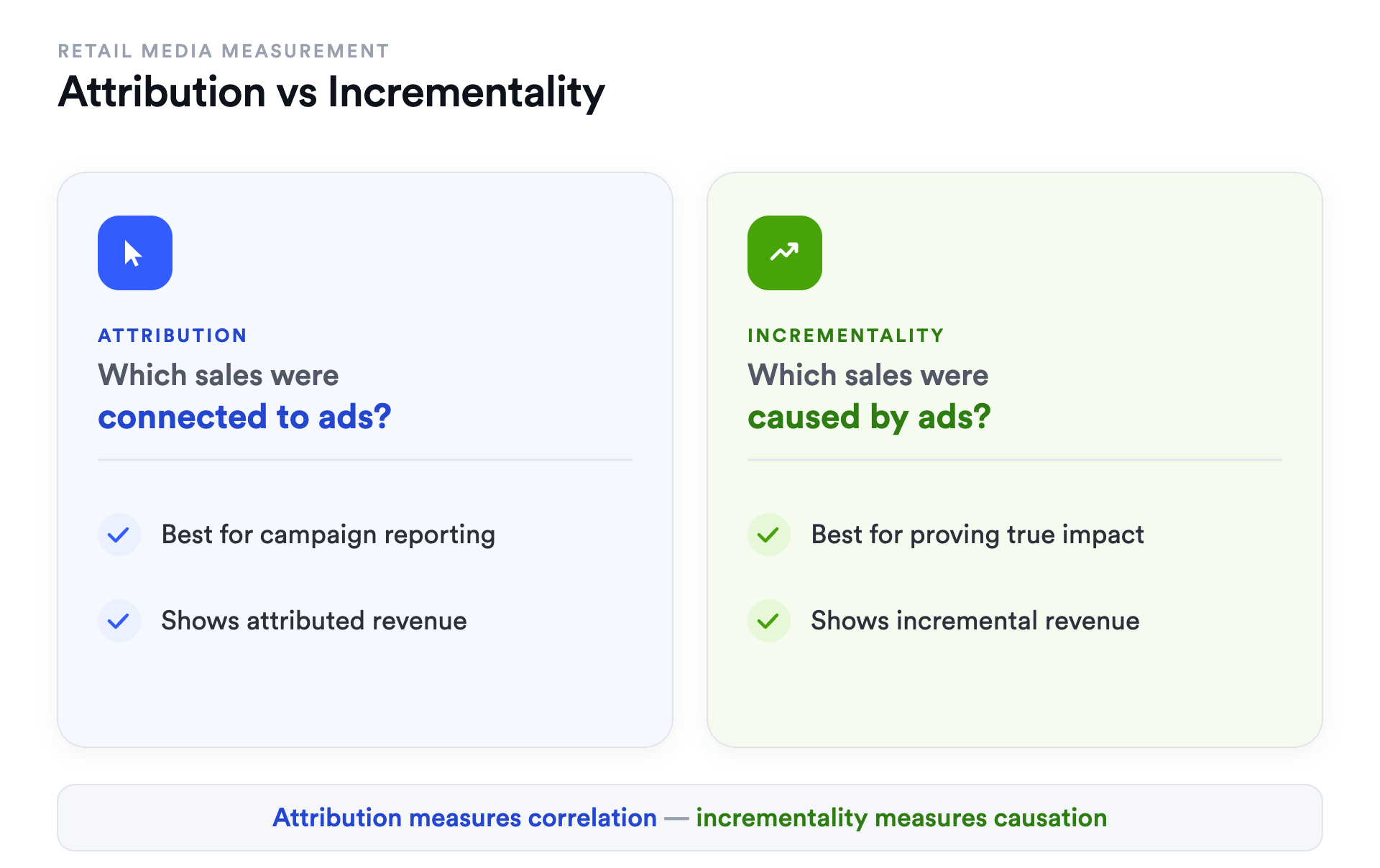
Retail media teams should use attribution for day-to-day reporting and incrementality to validate true business impact.
Which retail media attribution model is best?
There is no single best attribution model for every retail media campaign.
The right model depends on the campaign goal.
For sponsored products
Click-through and SKU-level attribution are often most useful because they connect direct shopper engagement to product purchases.
For display or video ads
View-through attribution may be important because these formats often influence consideration without generating clicks.
For brand campaigns
Halo attribution and basket-level attribution can help measure broader impact beyond one promoted SKU.
For budget decisions
Incrementality is more useful because it helps advertisers understand whether campaigns created true lift.
For daily reporting
Attributed ROAS, click-through attribution, and product-level reporting are often easier to monitor and act on.
The strongest retail media measurement strategy uses multiple models together, with clear definitions and transparent reporting.
How retail media networks can build better attribution
Retail media networks can improve attribution quality by focusing on transparency, flexibility, and commerce-specific data.
Here are key best practices.
1. Define attribution rules clearly
Advertisers should understand how sales are credited, what attribution window is used, and whether reporting includes click-through, view-through, SKU-level, basket-level, or halo attribution.
2. Use commerce-native signals
Retail media attribution should connect to product IDs, seller IDs, campaign IDs, search behavior, purchase events, basket data, and revenue outcomes.
3. Avoid double-counting
When multiple campaigns influence the same purchase, platforms need clear rules to avoid inflated reporting.
4. Support different campaign objectives
A sponsored product campaign and a display campaign should not always be measured the same way. Attribution models should reflect the campaign objective.
5. Pair attribution with incrementality
Attribution helps explain campaign performance. Incrementality helps prove whether advertising created true lift. Together, they create a more trustworthy measurement strategy.
6. Make reporting actionable
Attribution should help advertisers decide what to do next. Strong reports show performance by campaign, placement, product, seller, brand, and time period.
How Topsort supports retail media attribution
Topsort helps retailers, marketplaces, delivery apps, travel platforms, and commerce businesses build retail media programs with API-first ad serving, auctions, sponsored listings, attribution, reporting, and AI optimization.
Because Topsort is built for commerce media, it helps connect ad delivery to the commerce signals that matter most: products, sellers, bids, budgets, placements, shopper behavior, purchase events, and revenue outcomes.
This gives retail media teams the foundation to build more transparent attribution and reporting for advertisers.
With the right infrastructure, teams can:
- Launch commerce-native sponsored placements
- Track ad impressions, clicks, and purchase events
- Connect campaigns to product-level outcomes
- Support clearer advertiser reporting
- Optimize campaigns based on performance signals
- Build trust with brands, sellers, and media buyers
Retail media attribution should not feel like a black box. Advertisers need to understand how performance is measured, and platforms need infrastructure that can support transparent, outcome-driven reporting.
Final takeaway
Retail media attribution models define how credit is assigned when ads are connected to purchases.
Click-through attribution helps measure direct engagement. View-through attribution captures influence without clicks. SKU-level attribution connects ads to specific product sales. Basket-level and halo attribution show broader commerce impact. Incrementality helps prove whether ads caused true lift.
No single model answers every question.
The best retail media programs use clear attribution models for campaign reporting and incrementality measurement for proving real impact.
As retail media grows, advertisers will expect more transparency, better methodology, and stronger proof of value. Platforms that can explain attribution clearly will be better positioned to earn trust, grow budgets, and build durable media businesses.
FAQ
What are retail media attribution models?
Retail media attribution models are methods used to assign credit for purchases, revenue, or conversions to retail media campaigns.
What is click-through attribution in retail media?
Click-through attribution gives credit to an ad when a shopper clicks the ad and later completes a qualifying purchase within the attribution window.
What is view-through attribution in retail media?
View-through attribution gives credit to an ad when a shopper sees the ad and later purchases, even if they did not click the ad.
What is SKU-level attribution?
SKU-level attribution connects ad activity to purchases of specific products or SKUs. It is especially useful for sponsored products and product-level reporting.
What is basket-level attribution?
Basket-level attribution measures broader cart or order impact beyond the promoted product. It helps advertisers understand total order value and related product purchases.
What is halo attribution?
Halo attribution measures the broader impact of an ad beyond the exact promoted product, such as purchases of related products or other products from the same brand.
What is an attribution window?
An attribution window is the time period in which a purchase can be credited to an ad interaction, such as a click or impression.
What is the difference between attribution and incrementality?
Attribution shows which sales were connected to ads. Incrementality shows which sales were caused by ads.
Which attribution model is best for retail media?
There is no single best model. Sponsored products often use click-through and SKU-level attribution, while display campaigns may use view-through attribution. Incrementality is best for proving true lift.
Why does attribution matter for retail media networks?
Attribution matters because it affects advertiser trust, campaign reporting, ROAS, budget decisions, and the perceived value of retail media inventory.
.png)
.png)