




Agentic AI and Retail Media: How AI Shopping Assistants Will Change Product Discovery

Retail media is entering a new phase.
For years, retail media has been built around search results, product pages, category pages, sponsored listings, display placements, and closed-loop measurement. Shoppers searched, browsed, clicked, compared, and bought. Retail media helped brands appear inside those commerce moments.
But AI shopping assistants could change how product discovery works.
Instead of typing a keyword and scrolling through dozens of results, shoppers may ask an AI assistant for help:
- “Find me the best protein powder under $40.”
- “What should I buy for a new apartment?”
- “Compare these skincare products.”
- “Build a grocery list for a high-protein meal plan.”
- “Find a gift for a 10-year-old who likes science.”
These are not just search queries. They are shopping tasks.
This shift is often described as agentic AI or agentic commerce: AI systems that help shoppers research, compare, decide, and potentially take action across the buying journey.
For retail media, this creates an important question:
What happens when product discovery moves from search results to AI-driven recommendations?
At Topsort, we believe the future of retail media will not be only about buying placements. It will be about building commerce media infrastructure that can serve, rank, measure, and optimize ads across both traditional shopping surfaces and AI-assisted product discovery experiences.
What is agentic AI in retail media?
Agentic AI in retail media refers to AI systems that can help shoppers complete commerce-related tasks, such as discovering products, comparing options, building carts, evaluating recommendations, or deciding what to buy.
In a retail media context, agentic AI could influence:
- Which products are recommended
- Which sponsored products appear in AI-assisted results
- How brands are discovered
- How shopper intent is interpreted
- How ads are ranked
- How product relevance is evaluated
- How measurement connects AI-driven recommendations to purchases
In simple terms, agentic AI could turn product discovery from a keyword-based experience into a goal-based experience.
Instead of matching ads to a search term, retail media systems may need to understand the shopper’s broader intent, context, constraints, and desired outcome.
What are AI shopping assistants?
AI shopping assistants are digital assistants that help shoppers research, compare, and choose products.
They can support tasks such as:
- Product discovery
- Product comparison
- Personalized recommendations
- Shopping list creation
- Gift recommendations
- Budget-based suggestions
- Category education
- Cart building
- Reordering
- Cross-category planning
For example, a traditional shopping experience might start with a search query like “running shoes.”
An AI shopping assistant experience might start with:
“I need running shoes for flat feet, mostly for treadmill workouts, under $120.”
That query contains more intent than a keyword. It includes use case, constraint, context, and preference.
This changes how retail media needs to think about relevance.
How AI shopping assistants change product discovery
Traditional product discovery often depends on search, filters, categories, recommendations, and product ranking.
AI shopping assistants may change discovery in several ways.
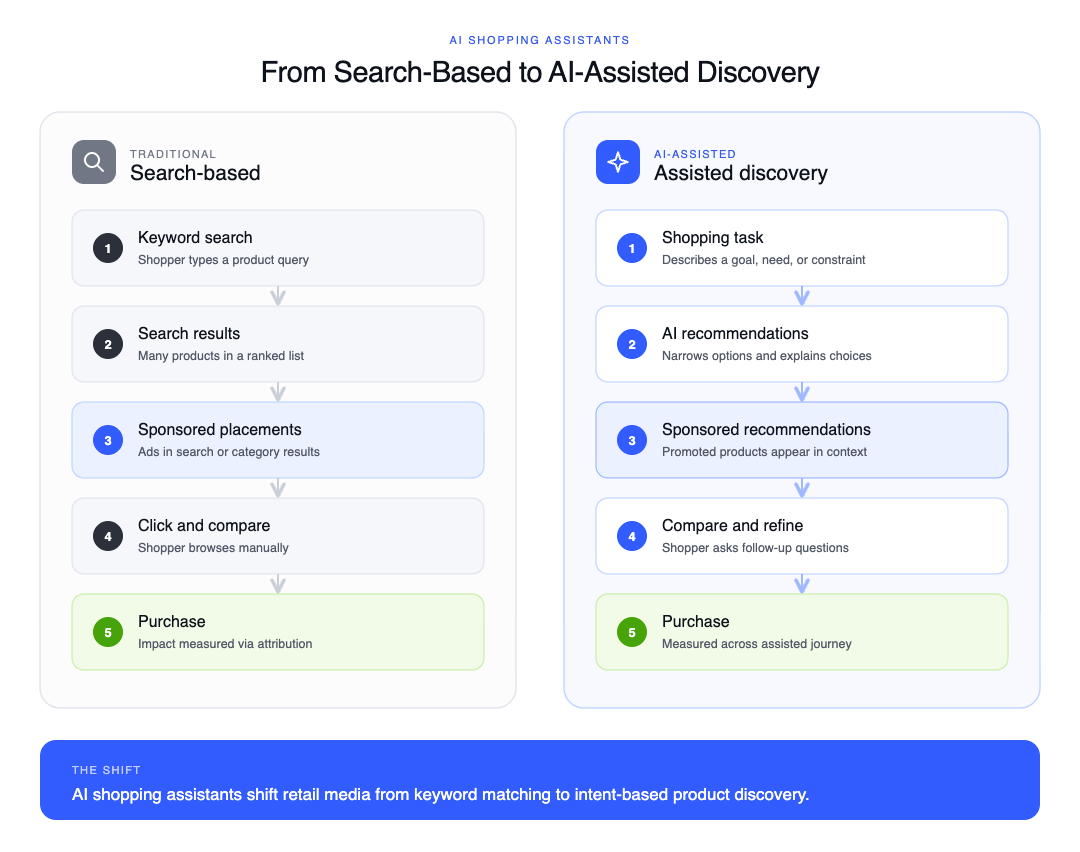
From keywords to shopping intent
A shopper may not search for a product name. They may describe a need, a problem, or a goal.
For example:
- “I need a better lunch option for work.”
- “Find affordable skincare for sensitive skin.”
- “What should I buy for a camping trip?”
- “Which laptop is best for video editing?”
Retail media systems need to understand intent, not just keywords.
From browsing to guided decisions
Instead of scrolling through pages of results, shoppers may receive a smaller set of recommendations.
This means visibility could become more concentrated. If an AI assistant shows five options instead of fifty results, ranking and relevance become even more important.
From product ads to recommendation influence
Sponsored products may need to fit into recommendation experiences. The ad cannot feel disconnected from the assistant’s answer.
A sponsored recommendation should still be useful, relevant, transparent, and measurable.
From single-session search to multi-step journeys
AI shopping assistants may support longer shopping sessions. A shopper may compare, refine, ask follow-up questions, save products, build a cart, and return later.
Retail media measurement will need to account for these multi-step interactions.
Why this matters for retail media networks
Retail media networks are built on product discovery and purchase intent.
If AI changes how shoppers discover products, it will also change how brands compete for visibility.
Retail media networks may need to answer new questions:
- How should sponsored products appear in AI-assisted results?
- How should ad auctions work when the shopper asks a natural-language question?
- How should relevance be scored when the shopper describes a goal?
- How should advertisers optimize for AI-driven discovery?
- How should retailers measure ad impact across assistant-led journeys?
- How should sponsored recommendations be disclosed?
- How can platforms protect shopper trust?
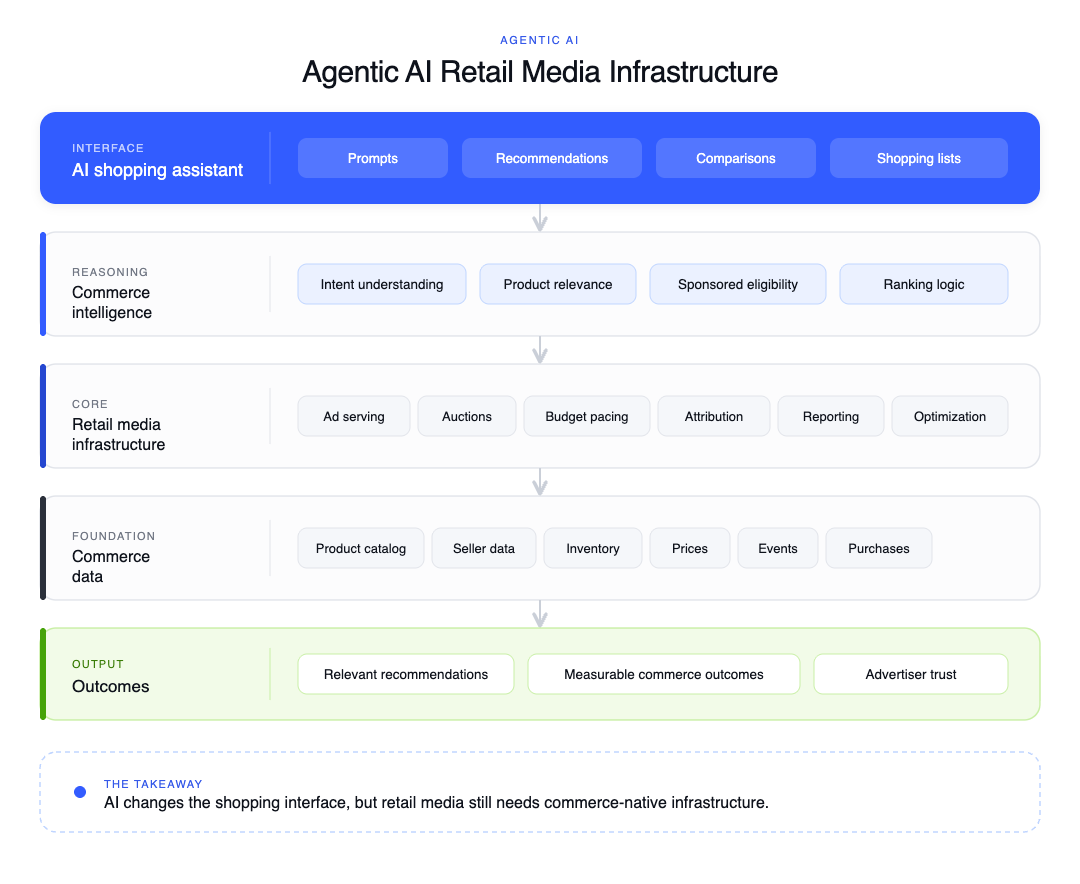
The winners will likely be the platforms that can connect AI experiences to commerce-native infrastructure: product data, ad serving, auctions, attribution, reporting, and optimization.
The shift from search-based ads to intent-based ads
Search-based retail media is usually built around keywords, categories, and placements.
Intent-based retail media goes deeper.
It tries to understand what the shopper is trying to accomplish.
For example, a shopper searching “baby stroller” gives a keyword.
A shopper asking “What stroller should I buy for city living and small apartments?” gives a richer intent signal.
That richer signal can improve:
- Product relevance
- Sponsored recommendation quality
- Ranking logic
- Campaign targeting
- Measurement
- Personalization
- Shopper experience
But it also increases complexity.
Retail media infrastructure needs to evaluate more than bids and keywords. It may need to understand product attributes, category context, shopper constraints, availability, historical performance, and conversion outcomes.
How sponsored products could work with AI shopping assistants
Sponsored products will not disappear. But they may appear in new forms.
In AI shopping experiences, sponsored products could show up as:
- Sponsored recommendations
- Promoted products inside comparison lists
- Sponsored alternatives
- Sponsored bundles
- Sponsored items in AI-generated carts
- Sponsored products in shopping guides
- Sponsored results after assistant follow-up questions
For example, if a shopper asks for “healthy snacks for kids,” an assistant might recommend a mix of organic fruit snacks, protein bars, and lunchbox items. Some promoted products could be included if they match the shopper’s intent and the retailer’s relevance rules.
The key is relevance.
A sponsored product should not win only because of bid. It should also match the shopper’s need, product context, budget, availability, and expected performance.
Why relevance becomes more important
AI shopping assistants can increase shopper trust if recommendations feel useful. But they can also damage trust if recommendations feel biased, irrelevant, or overly commercial.
That means retail media systems need strong relevance controls.
Relevant AI-powered retail media should consider:
- Shopper intent
- Product attributes
- Search or conversation context
- Category fit
- Price range
- Availability
- Seller eligibility
- Campaign bids
- Budget pacing
- Historical performance
- Conversion likelihood
- Measurement outcomes
At Topsort, our POV is that AI-driven retail media should not be a black box. Commerce platforms need infrastructure that can balance monetization and relevance while giving advertisers clear performance reporting.
How auctions may change in agentic commerce
Retail media auctions today often evaluate bids, budgets, eligibility, placement rules, and relevance.
In AI-assisted commerce, auctions may need to evaluate additional signals.
For example:
- Does the product match the shopper’s stated goal?
- Does the product fit the assistant’s recommendation context?
- Is the product a good match for the generated shopping list?
- Is the product available and eligible?
- Is the sponsored recommendation likely to convert?
- Should the ad appear as a recommendation, alternative, or comparison item?
- How should the system balance organic and sponsored results?
This does not mean auctions become less important. It means auction logic may need to become more commerce-aware.
Retail media auctions will need to work with AI ranking systems, product data, and measurement infrastructure.
Measurement challenges in AI shopping journeys
AI shopping assistants may create new measurement challenges.
Traditional retail media measurement often connects:
- Impression
- Click
- Product view
- Purchase
- Attributed sale
- ROAS
AI-assisted shopping journeys may include more steps:
- Prompt
- Recommendation
- Follow-up question
- Comparison
- Save
- Cart addition
- Purchase
- Later reorder
- Cross-channel purchase
This raises important questions:
- What counts as an impression?
- What counts as engagement?
- How should assisted recommendations be attributed?
- How should sponsored and organic recommendations be separated?
- How should multi-step assistant journeys be measured?
- How should incrementality be tested?
- How should advertisers understand impact?
Retail media networks will need clear methodology. Without transparent measurement, advertisers may not trust AI-driven results.
Why closed-loop attribution still matters
Even as AI changes discovery, closed-loop attribution remains important.
Brands still need to know whether media activity influenced sales. Retailers still need to connect ads to purchases. Marketplaces still need to help sellers understand performance.
AI shopping assistants may change the interface, but the business questions remain familiar:
- Did the campaign drive revenue?
- Which products performed best?
- Which recommendations influenced purchase?
- What was the ROAS?
- Was the impact incremental?
- How should budget be optimized?
This is why AI retail media needs to be connected to attribution and reporting from the beginning.
How retailers should prepare for agentic AI retail media
Retailers and marketplaces do not need to rebuild everything overnight. But they should start preparing their retail media infrastructure for AI-driven discovery.
Important steps include:
1. Strengthen product data
AI shopping assistants need rich product data to make relevant recommendations. Product attributes, categories, availability, pricing, descriptions, images, reviews, and seller data all matter.
2. Build commerce-native ad serving
Retail media ad serving needs to understand products, campaigns, placements, bids, budgets, relevance, and purchase outcomes.
3. Connect auctions to relevance
Bids alone are not enough. Auctions need to account for shopper intent and product fit.
4. Improve attribution and reporting
AI-driven discovery needs transparent measurement, including attributed sales, ROAS, product-level performance, and incrementality where possible.
5. Design for shopper trust
Sponsored recommendations should be relevant, clearly labeled, and useful.
6. Support API-first flexibility
AI shopping experiences may appear across websites, apps, assistants, chat interfaces, and embedded commerce flows. Flexible APIs help platforms adapt.
What advertisers should expect
For advertisers, agentic AI could change how campaigns are planned and optimized.
Instead of only bidding on keywords or placements, advertisers may need to think about:
- Product attributes
- Use cases
- Shopper problems
- Category relevance
- Product feed quality
- Creative and messaging
- AI recommendation context
- Sponsored alternatives
- Incrementality
- Product-level reporting
This could make retail media more strategic. Brands will need to optimize not only for visibility, but for relevance inside AI-assisted decisions.
Agentic AI does not replace retail media infrastructure
It may be tempting to think AI assistants will replace traditional retail media systems.
They will not.
AI interfaces still need infrastructure behind them.
To make AI shopping assistants work for retail media, commerce platforms still need:
- Product catalog integration
- Campaign management
- Ad serving
- Auction logic
- Budget pacing
- Sponsored product eligibility
- Event tracking
- Attribution
- Reporting
- Incrementality measurement
- API integration
- Optimization
AI changes the interface and decision layer. It does not remove the need for reliable retail media infrastructure.
How Topsort helps
Topsort helps retailers, marketplaces, delivery apps, travel platforms, and commerce businesses build API-first retail media infrastructure.
Topsort supports commerce-native ad serving, auctions, sponsored listings, attribution, reporting, and AI optimization. This foundation helps platforms serve relevant ads, measure commerce outcomes, and scale advertiser investment.
As AI shopping assistants change product discovery, commerce platforms will need infrastructure that can adapt to new surfaces and new shopper behaviors.
Topsort’s POV is simple: the future of retail media will be AI-assisted, but it still needs to be measurable, transparent, and commerce-native.
Final takeaway
Agentic AI and AI shopping assistants could reshape product discovery.
Shoppers may move from keyword searches to goal-based shopping tasks. Product recommendations may become more conversational, personalized, and decision-oriented. Sponsored products may appear inside AI-assisted recommendations, comparisons, bundles, and shopping lists.
For retail media, this creates both opportunity and complexity.
The platforms that succeed will be those that can connect AI-driven discovery to strong retail media infrastructure: product data, ad serving, auctions, relevance, attribution, reporting, and optimization.
AI may change how shoppers discover products. But the core retail media challenge remains the same:
Serve relevant ads, protect shopper trust, and prove measurable commerce outcomes.
FAQ
What is agentic AI in retail media?
Agentic AI in retail media refers to AI systems that help shoppers complete commerce tasks, such as discovering products, comparing options, building carts, or choosing what to buy.
How will AI shopping assistants change retail media?
AI shopping assistants may shift retail media from keyword-based search ads to intent-based recommendations, where sponsored products need to match shopper goals, context, and product relevance.
Will AI shopping assistants replace sponsored products?
No. Sponsored products may still be important, but they may appear inside AI-assisted recommendations, comparison lists, bundles, carts, or shopping guides.
Why does relevance matter in AI retail media?
Relevance matters because AI shopping assistants depend on shopper trust. Sponsored recommendations must be useful, transparent, and aligned with shopper intent.
How should retailers measure AI-driven retail media?
Retailers should connect AI-driven recommendations to impressions, engagement, product views, cart actions, purchases, attributed sales, ROAS, and incrementality where possible.
What infrastructure is needed for agentic AI retail media?
Commerce platforms need product data, ad serving, auctions, campaign management, budget pacing, event tracking, attribution, reporting, APIs, and optimization.
How can brands prepare for AI shopping assistants?
Brands should improve product data quality, understand shopper use cases, optimize for relevance, track product-level performance, and evaluate how sponsored products appear in AI-assisted discovery.
Ready to build retail media for the next era of AI-driven commerce? See how Topsort helps commerce platforms connect ad serving, auctions, attribution, reporting, and AI optimization through API-first infrastructure.