




Retail Media Auctions: How Sponsored Products Are Ranked and Priced
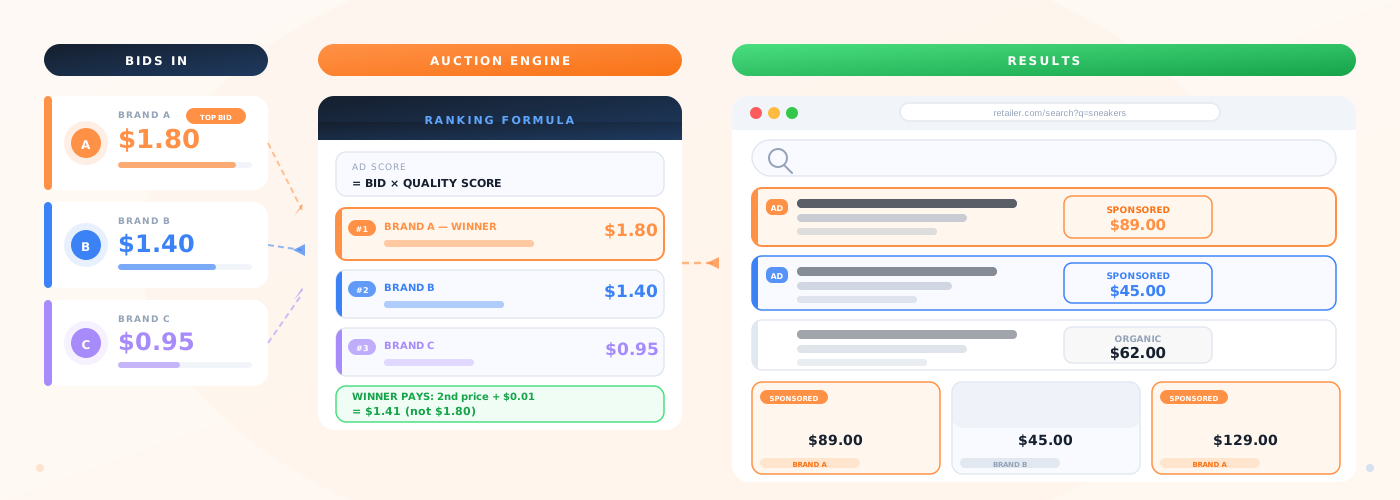
Retail media auctions are one of the most important parts of a retail media network.
They help decide which sponsored product, sponsored listing, or ad placement appears when a shopper searches, browses, or engages with a commerce platform.
But retail media auctions are not only about who pays the most.
A strong retail media auction needs to balance advertiser bids, budget availability, product relevance, shopper intent, placement rules, campaign goals, and user experience. If auctions only maximize short-term ad revenue, they can show irrelevant ads and damage shopper trust. If auctions only optimize for organic relevance, they may fail to create meaningful advertising revenue.
The best retail media auctions balance monetization and relevance.
At Topsort, we see auction infrastructure as a core part of commerce media. Retail media works best when auctions, ad serving, attribution, and reporting operate together, so platforms can serve relevant ads and prove measurable outcomes to advertisers.
What is a retail media auction?
A retail media auction is a system that determines which eligible ad wins a retail media placement.
In simple terms, a retail media auction answers:
- Which advertisers are eligible?
- Which products or listings can appear?
- What bids are available?
- Which campaigns have budget?
- Which ads are relevant to the shopper?
- Which ad should be ranked highest?
- What price should the advertiser pay?
- How should the result be tracked and reported?
Retail media auctions are commonly used for sponsored products, sponsored listings, and other performance-oriented ad placements inside commerce environments.
How retail media auctions work
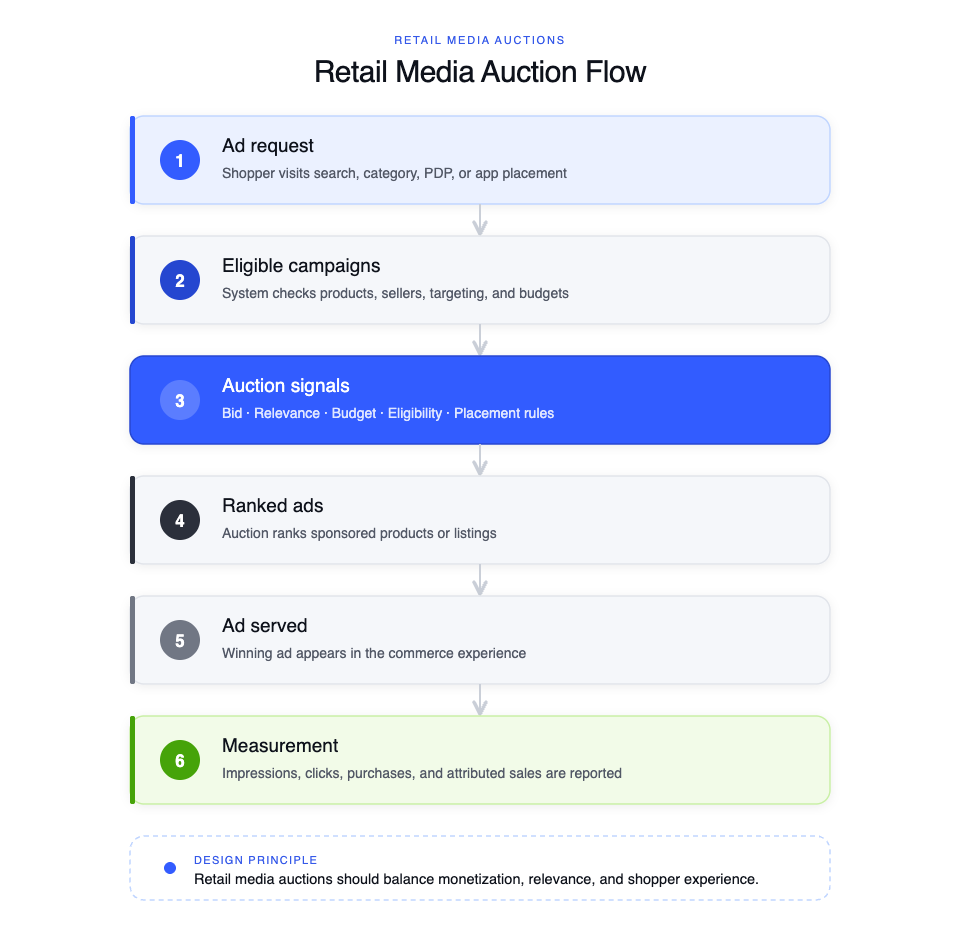
A simplified retail media auction works like this:
- A shopper visits a search page, category page, product page, or app placement.
- The commerce platform sends an ad request.
- The ad server identifies eligible campaigns.
- The auction evaluates bids, budgets, targeting, relevance, and rules.
- The system ranks eligible ads.
- The winning ad is shown to the shopper.
- The platform tracks impressions, clicks, and downstream purchase events.
- Results are reported back to advertisers.
This process happens in milliseconds, but the logic behind it can be complex.
A good auction system does not just choose the highest bid. It chooses an ad that can create value for the advertiser, the shopper, and the marketplace.
Why retail media auctions are different from generic ad auctions
Retail media auctions are different because they happen in commerce environments.
A generic display auction may focus heavily on audience targeting, bid price, and media delivery. A retail media auction must also understand product discovery, search intent, product relevance, inventory, seller eligibility, and purchase outcomes.
Retail media auctions need to consider:
- Search query relevance
- Product category
- SKU or listing data
- Seller or brand eligibility
- Product availability
- Bid amount
- Campaign budget
- Placement rules
- Shopper intent
- Historical performance
- Conversion likelihood
- Attribution and reporting requirements
This makes retail media auctions more commerce-native than traditional media auctions.
Sponsored products auctions
Sponsored products are one of the most common retail media ad formats.
In a sponsored products auction, brands or sellers bid to promote specific products in commerce placements such as search results, category pages, or product recommendation modules.
For example, if a shopper searches for “protein powder,” eligible brands may bid for their products to appear in sponsored placements.
The auction may evaluate:
- Product relevance to the query
- Bid amount
- Budget availability
- Product availability
- Campaign targeting
- Seller or brand eligibility
- Historical click or conversion performance
- Placement rules
The goal is to show promoted products that are useful to shoppers and valuable to advertisers.
Sponsored listings auctions
Sponsored listings auctions are especially important for marketplaces.
Marketplaces may promote:
- Products
- Restaurants
- Hotels
- Services
- Jobs
- Real estate listings
- Travel options
- Local businesses
- Marketplace sellers
In these environments, sponsored listings must feel native to discovery.
For example, a delivery app may promote restaurants in search or category results. A travel platform may promote hotels. A classifieds marketplace may promote service providers.
A strong sponsored listings auction should balance seller monetization with buyer relevance. If the promoted result does not match the buyer’s intent, performance and trust can decline.
How sponsored products are ranked
Sponsored products can be ranked using several signals.
Common ranking inputs include:
Bid
The amount an advertiser is willing to pay for a click, impression, or conversion.
Relevance
How well the promoted product matches the shopper’s query, category, or context.
Budget
Whether the campaign has enough remaining budget to serve.
Eligibility
Whether the product, seller, or campaign is allowed to appear in the placement.
Quality
Product quality, conversion rate, availability, ratings, or historical performance may influence ranking.
Placement context
A search results page may require different ranking logic from a product page or homepage placement.
Business rules
The retailer may apply rules related to category restrictions, inventory, sponsored labeling, or marketplace policy.
The best ranking systems do not rely on one signal alone. They combine bidding and relevance so ads can perform without hurting the shopper experience.
How retail media auction pricing works
Retail media auctions can use different pricing models.
Cost per click
In a CPC model, advertisers pay when a shopper clicks the ad.
Cost per mille
In a CPM model, advertisers pay for impressions.
Cost per acquisition
In a CPA model, advertisers pay when a conversion happens.
First-price auction
In a first-price auction, the winner pays the amount they bid.
Second-price auction
In a second-price auction, the winner pays based on the next highest eligible bid, often with an increment.
Hybrid models
Some retail media platforms may use variations or hybrid pricing depending on format, placement, and campaign goal.
The right pricing model depends on the platform’s strategy, advertiser expectations, and measurement capabilities.
Why bid alone is not enough
A retail media auction that only rewards the highest bid can create problems.
It may show ads that are:
- Irrelevant to the shopper
- Poorly matched to the search query
- Out of stock or unavailable
- Less likely to convert
- Bad for the marketplace experience
- Misaligned with advertiser performance goals
This can reduce trust. Shoppers may ignore ads. Advertisers may see poor performance. The platform may earn short-term revenue but lose long-term value.
Retail media auctions should balance bid and relevance. The highest bidder should not always win if another ad is more useful and more likely to drive a commerce outcome.

Why relevance matters in retail media auctions
Relevance is critical because retail media happens inside product discovery moments.
When shoppers search or browse, they expect useful results. Ads need to support that experience.
Relevant ads can improve:
- Click-through rate
- Conversion rate
- Shopper trust
- Advertiser performance
- Marketplace quality
- Long-term media revenue
At Topsort, our POV is that retail media auctions should be commerce-aware. The auction should understand what the shopper is doing, what products or listings are eligible, what advertisers are bidding, and which result is likely to create measurable value.
Budget pacing in retail media auctions
Budget pacing helps campaigns spend at the right speed.
Without pacing, a campaign may spend too quickly early in the day or fail to spend enough before the campaign ends.
Retail media auction systems need to consider:
- Daily budget
- Lifetime budget
- Campaign start and end dates
- Bid limits
- Delivery goals
- Available inventory
- Performance trends
- Advertiser objectives
Good pacing helps advertisers avoid wasted budget and helps platforms maintain stable campaign delivery.
Attribution and auction optimization
Auctions should not exist separately from measurement.
If a retail media platform can connect ad exposure to clicks, product views, add-to-cart events, purchases, and revenue, it can better understand which ads are actually driving outcomes.
This supports better optimization over time.
Measurement can help answer:
- Which campaigns perform best?
- Which placements convert?
- Which products deserve more budget?
- Which bids are too high or too low?
- Which ads are driving attributed sales?
- Which ads may be creating incremental value?
Retail media auctions become more powerful when connected to closed-loop attribution and reporting.
Auction infrastructure for retailers and marketplaces
Retailers and marketplaces building auction infrastructure need to think beyond basic bidding.
A strong retail media auction system should support:
- Real-time ad requests
- Sponsored products and listings
- Campaign eligibility
- Bid evaluation
- Budget pacing
- Relevance scoring
- Product and seller data
- Placement-level rules
- Event tracking
- Attribution
- Reporting
- API integration
- Optimization
This is why retail media auctions are infrastructure, not just a pricing mechanism.
Common mistakes in retail media auctions
Prioritizing bid over relevance
This can hurt shopper experience and reduce long-term performance.
Ignoring product availability
Promoting unavailable products creates wasted impressions and poor user experience.
Weak measurement
Without attribution and reporting, advertisers cannot understand auction value.
No budget pacing
Poor pacing can cause campaigns to overspend or underdeliver.
Generic ad logic
Retail media auctions need commerce-native logic, not only generic display ad decisioning.
Lack of transparency
Advertisers need to understand how campaigns are delivered and measured.
How Topsort helps
Topsort helps retailers, marketplaces, delivery apps, travel platforms, and commerce businesses power retail media programs with API-first infrastructure.
Topsort supports real-time auctions, ad serving, sponsored listings, attribution, reporting, and AI optimization. This helps commerce platforms build auction systems that connect products, sellers, bids, budgets, placements, impressions, clicks, and purchases.
For marketplaces and retailers, auction infrastructure should do more than decide who wins. It should help create relevant shopper experiences, measurable advertiser outcomes, and scalable media revenue.
Final takeaway
Retail media auctions are essential to sponsored products, sponsored listings, and commerce media monetization.
But successful auctions are not just about the highest bid. They need to balance bidding, relevance, eligibility, budget pacing, product data, shopper experience, and measurement.
Retailers and marketplaces that build commerce-native auction infrastructure can serve better ads, protect shopper trust, and give advertisers clearer proof of performance.
FAQ
What is a retail media auction?
A retail media auction is a system that determines which eligible ad wins a retail media placement based on signals such as bid, budget, relevance, eligibility, and placement rules.
How do sponsored products auctions work?
Sponsored products auctions evaluate eligible product ads, bids, budgets, relevance, and campaign rules to decide which promoted products appear in commerce placements.
Are retail media auctions based only on bids?
No. Strong retail media auctions should consider bids, relevance, budget, eligibility, product availability, shopper intent, and performance signals.
What is retail media bidding?
Retail media bidding is the process advertisers use to set how much they are willing to pay for ad placements, clicks, impressions, or conversions in retail media campaigns.
Why does relevance matter in retail media auctions?
Relevance matters because retail media ads appear inside shopping experiences. Relevant ads improve shopper trust, advertiser performance, and long-term marketplace value.
What infrastructure is needed for retail media auctions?
Retail media auctions need ad serving, real-time decisioning, product data, seller data, bids, budgets, eligibility rules, attribution, reporting, and optimization.
Need commerce-native auction infrastructure? See how Topsort helps retailers and marketplaces power sponsored listings with real-time auctions, attribution, and reporting.