
Retail Media Measurement in 2026: What Metrics Actually Matter?

Retail media measurement is entering a new phase.
For years, retailers, marketplaces, and commerce platforms could show brands basic campaign results: impressions, clicks, spend, attributed sales, and ROAS. Those metrics still matter. They help advertisers understand whether campaigns are delivering, whether shoppers are engaging, and whether sales are being connected to media activity.
But in 2026, brands are asking for more.
They do not only want to know whether a campaign received credit for a sale. They want to know whether the campaign created real business impact. They want to understand which dollars drove incremental growth, which placements deserve more budget, which campaigns brought in new customers, and whether retail media is performing better than other channels.
At Topsort, we see retail media measurement moving from campaign reporting to business proof. Brands do not only want to know what was attributed to a campaign; they want to understand what changed because of the campaign.
That means retail media measurement needs to move beyond activity metrics and basic attribution.
The most important retail media metrics in 2026 are the ones that help answer three questions:
- Did the campaign reach and engage shoppers?
- Did the campaign connect to commerce outcomes?
- Did the campaign create measurable incremental value?
This guide explains the retail media metrics that actually matter in 2026 and how retailers, marketplaces, and commerce platforms can use them to build advertiser trust.
Why retail media measurement matters more in 2026
Retail media is no longer an experimental revenue channel. For many retailers and marketplaces, it is becoming a strategic business line. For brands, it is becoming a major part of commerce and performance marketing budgets.
As budgets grow, expectations rise.
Brands want better answers to questions like:
- Which campaigns drove sales?
- Which placements worked best?
- Which products should receive more budget?
- Which audiences converted?
- Did the campaign create incremental revenue?
- Did retail media drive new customers?
- How does performance compare across onsite, offsite, and in-store channels?
- Can we trust the methodology?
This is why measurement has become one of the most important differentiators in retail media.
Retailers and marketplaces that can provide clear, transparent, commerce-connected reporting will be better positioned to win and retain brand budgets. Platforms that only report impressions and clicks will struggle to prove value.
The problem with relying only on impressions and clicks
Impressions and clicks are still useful. They show whether a campaign delivered and whether shoppers engaged.
But they do not prove business impact.
A campaign can generate many impressions but few purchases. A campaign can receive clicks but fail to drive profitable outcomes. A campaign can show high engagement but little incremental revenue.
That is why impressions and clicks should be treated as activity metrics, not success metrics.
They help answer:
- Was the campaign delivered?
- Did shoppers see the ad?
- Did shoppers engage?
- Which placements generated attention?
They do not fully answer:
- Did the campaign drive sales?
- Did it increase revenue?
- Did it create incremental lift?
- Did it bring in new customers?
- Did it improve category performance?
- Did it justify more budget?
In 2026, brands need a measurement framework that connects campaign activity to commerce outcomes and real business value.
The four layers of retail media measurement
A strong retail media measurement strategy should include four layers:
- Activity metrics
- Attribution metrics
- Incrementality metrics
- Growth metrics
Each layer answers a different question.
Measurement layerExample metricsMain questionActivityimpressions, clicks, CTR, spendDid the campaign deliver and engage shoppers?Attributionattributed sales, attributed ROAS, product-level salesWhich sales were connected to ads?Incrementalityincremental revenue, incremental ROAS, conversion liftWhich sales were caused by ads?Growthnew-to-brand customers, basket size, category lift, omnichannel salesDid the campaign grow the business?
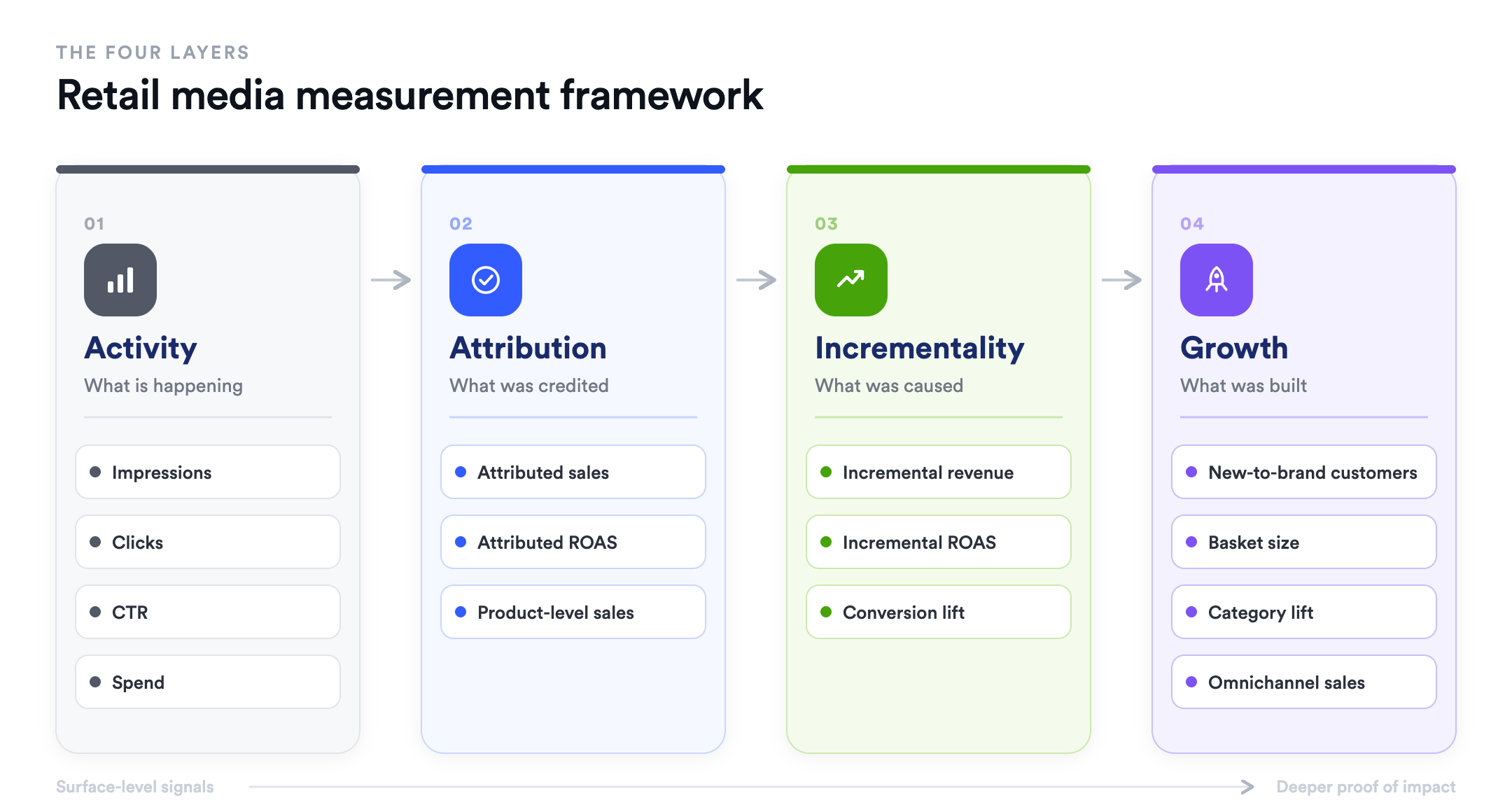
Retail media teams should avoid treating one metric as the full answer. The strongest reporting combines all four layers.
For commerce platforms, this is why measurement needs to be built into the ad infrastructure itself. Ad serving, auctions, event tracking, attribution, reporting, and optimization should work together instead of living in disconnected systems.
Activity metrics: still necessary, but not enough
Activity metrics show whether a campaign is running properly and whether shoppers are engaging with ads.
Important activity metrics include:
- Impressions
- Clicks
- Click-through rate
- Spend
- Cost per click
- Cost per thousand impressions
- Campaign pacing
- Fill rate
- Win rate
- Placement delivery
These metrics are useful for campaign operations. They help teams monitor delivery, troubleshoot performance, and compare engagement across placements.
For example, if a campaign has low impressions, the issue may be budget, bids, targeting, inventory, or campaign setup. If a campaign has strong impressions but low clicks, the issue may be creative, placement relevance, product fit, or shopper intent.
Activity metrics matter because they help explain what happened at the media level.
But they are only the first layer.
A retail media network cannot prove ROI to brands with impressions and clicks alone.
ROAS: useful, familiar, and incomplete
ROAS, or return on ad spend, is one of the most common retail media metrics.
The formula is:
ROAS = attributed revenue / ad spend
For example, if a brand spends $10,000 and the platform attributes $80,000 in sales to the campaign, the campaign has an 8x ROAS.
ROAS is useful because it is simple and familiar. Brands understand it. Sellers understand it. Retail media operators can use it to compare campaign efficiency across products, placements, or advertisers.
ROAS is helpful for:
- Campaign reporting
- Budget pacing
- Seller and vendor reporting
- Comparing campaign efficiency
- Monitoring short-term performance
- Understanding attributed sales
But ROAS has a major limitation: it measures attributed revenue, not necessarily incremental revenue.
A campaign can have high ROAS because it reached shoppers who were already likely to buy. In that case, the campaign receives credit, but the true business impact may be lower than the attributed number suggests.
That is why ROAS is still important in 2026, but it should not be treated as the only measure of success.
Attributed sales and attributed revenue
Attributed sales show which purchases were connected to an ad interaction within a defined attribution window.
For example, a shopper clicks a sponsored product, buys the product within seven days, and the sale is credited to the campaign.
Attributed revenue is useful because it connects media activity to commerce outcomes. It helps brands understand which campaigns, products, and placements are associated with purchases.
Retail media teams should report attributed sales and revenue by:
- Campaign
- Product
- SKU
- Seller
- Brand
- Category
- Placement
- Audience
- Time period
- Channel
This level of detail helps advertisers optimize campaigns and understand where performance is coming from.
However, attributed revenue is not the same as incremental revenue. It tells advertisers which sales were connected to ads, not which sales were caused by ads.
Closed-loop attribution: connecting ads to sales
Closed-loop attribution is one of retail media’s biggest advantages.
It connects ad exposure or engagement to downstream commerce outcomes such as purchases, orders, revenue, or basket activity.
A simple closed-loop attribution flow looks like this:
Ad shown → shopper engages → product viewed → purchase happens → sale attributed to campaign
This is powerful because retailers and marketplaces often own the shopping environment, product catalog, and transaction data. That gives them a stronger ability to connect media activity to real sales outcomes.
Closed-loop attribution helps answer:
- Which campaigns drove attributed revenue?
- Which products converted?
- Which placements worked best?
- Which audiences responded?
- Which sellers or brands saw the strongest return?
- Which channels influenced purchase behavior?
This is where API-first retail media infrastructure matters. Platforms need to connect impressions, clicks, product IDs, campaign IDs, sellers, placements, and purchase events in a clean data flow. Without that foundation, closed-loop reporting becomes difficult to scale.
In 2026, closed-loop attribution should be a core part of every retail media measurement framework.
But attribution alone is not enough to prove true impact. For that, brands increasingly need incrementality.
Incrementality: the metric brands increasingly trust
Incrementality measures the additional conversions, revenue, or orders caused by advertising.
In simple terms:
Attribution asks: which sales were connected to ads?
Incrementality asks: which sales were caused by ads?
This distinction matters.
A shopper may click a sponsored product and buy it. The sale can be attributed to the campaign. But if the shopper was already planning to buy that product, the campaign may not have created much incremental value.
Incrementality helps separate true lift from baseline demand.
For retail media teams, this distinction changes the budget conversation. Instead of only telling brands what revenue was credited to ads, platforms can start showing which campaigns created measurable lift and deserve more investment.
Retail media teams can measure incrementality using methods such as:
- Test and control groups
- Holdout testing
- Geo or store-level experiments
- Time-based analysis
- Modeled incrementality
- Conversion lift analysis
The goal is to compare what happened with advertising against what likely would have happened without advertising.
Incrementality is especially important for:
- Budget decisions
- Premium placement evaluation
- Onsite vs offsite comparisons
- New customer acquisition
- Brand trust
- Long-term retail media investment
In 2026, incrementality is one of the most important retail media metrics because it helps brands understand true business impact.
Incremental ROAS: measuring true return
Incremental ROAS is one of the clearest ways to show whether retail media investment created real value.
The formula is:
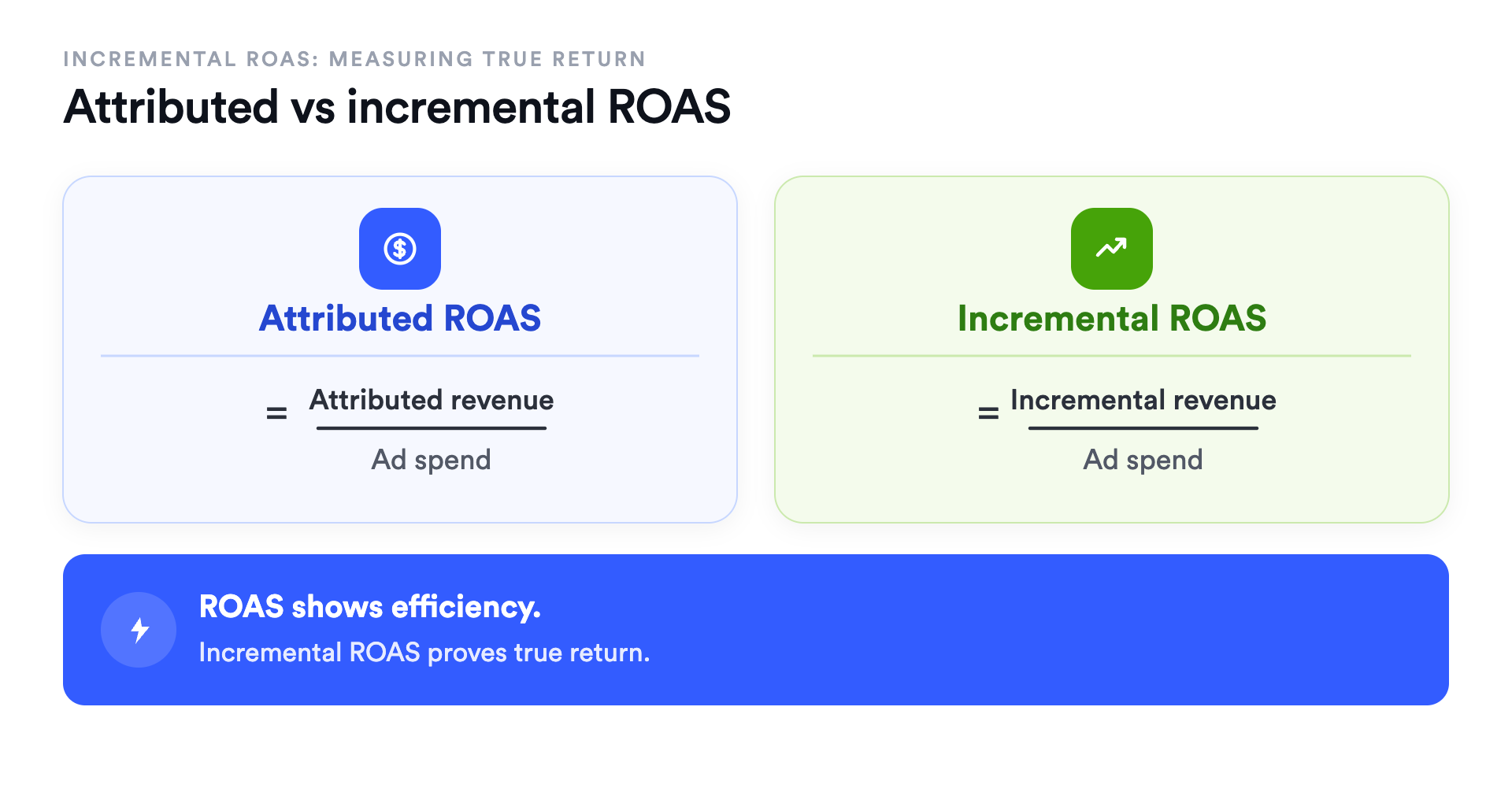
Incremental ROAS = incremental revenue / ad spend
Regular ROAS shows revenue credited to a campaign. Incremental ROAS shows revenue caused by a campaign.
This difference is important.
A campaign may show a 10x attributed ROAS but only a 2x incremental ROAS if most of the credited revenue came from shoppers who were already likely to buy.
Another campaign may show a lower attributed ROAS but stronger incremental performance because it brought in new customers, shifted category demand, or influenced shoppers who would not otherwise have purchased.
Retail media teams should explain both metrics clearly.
MetricMain questionBest useAttributed ROASHow much revenue was credited to the campaign?Campaign reportingIncremental ROASHow much revenue was caused by the campaign?Proving true return
Brands need both. ROAS helps with day-to-day reporting. Incremental ROAS helps with strategic budget decisions.
New-to-brand customers
New-to-brand customers are another important retail media metric in 2026.
Many brands do not only want more purchases from existing customers. They want to acquire new buyers, expand household penetration, and grow long-term value.
New-to-brand measurement helps answer:
- Did the campaign bring in first-time buyers?
- Did it reach shoppers who had not purchased the brand before?
- Did it expand the customer base?
- Did it support product discovery?
- Did it create growth beyond loyal customer demand?
This metric is especially useful for:
- Product launches
- Challenger brands
- Category expansion
- Seasonal campaigns
- Marketplace sellers
- Brands trying to grow share
Retail media platforms should make it clear how they define new-to-brand. For example, the definition may depend on whether the shopper has purchased from the brand within the past 6 months, 12 months, or another lookback window.
Clear definitions build trust.
Basket impact and average order value
Retail media can influence more than the promoted product.
A shopper may click a sponsored product and buy related items. A display campaign may increase category consideration. A sponsored placement may increase total basket size.
That is why basket impact is an important metric.
Basket-level measurement can include:
- Total order value
- Average order value
- Related product purchases
- Cross-sell behavior
- Category-level impact
- Brand-level halo effect
Basket impact is especially valuable for brands that want to understand broader commerce outcomes, not just SKU-level sales.
However, basket-level attribution needs clear rules. If a platform credits too much basket activity to a single ad, it can overstate performance.
Retail media networks should explain whether basket impact includes:
- Only the promoted SKU
- Related products
- Same-brand products
- Same-category products
- Full basket value
The more transparent the methodology, the more credible the reporting.
Category lift and share growth
Brands increasingly want to know whether retail media is helping them grow in a category.
Category lift can help answer:
- Did the campaign increase sales in a category?
- Did the brand gain share?
- Did the campaign influence competitor switching?
- Did the campaign grow demand beyond one product?
- Did the campaign support a seasonal or category-level objective?
This is especially useful for brands that invest in retail media as part of broader category strategy.
For retailers and marketplaces, category-level reporting can also help strengthen strategic conversations with brands. Instead of only discussing clicks and ROAS, media teams can discuss growth, category behavior, and future investment opportunities.
Placement-level performance
Not all retail media placements perform the same way.
Search placements, homepage placements, product detail page placements, category page placements, offsite ads, and in-store media all play different roles.
Placement-level measurement helps advertisers understand where performance is coming from.
Important placement-level metrics include:
- Impressions by placement
- Click-through rate by placement
- Conversion rate by placement
- Attributed sales by placement
- ROAS by placement
- Incremental lift by placement
- New-to-brand impact by placement
- Basket impact by placement
This helps brands decide which surfaces deserve more budget.
It also helps retail media networks optimize inventory, pricing, and packaging.
Product-level and SKU-level performance
Product-level measurement is one of retail media’s biggest advantages.
Brands and sellers want to know which products are driving results, which products need more support, and which promoted SKUs are producing the strongest return.
Product-level reporting can include:
- Product impressions
- Product clicks
- Product purchases
- SKU-level attributed sales
- SKU-level ROAS
- Product-level conversion rate
- Product-level incremental lift
- Out-of-stock impact
- Price and promotion context
This is especially important for sponsored products and marketplace advertising.
Retail media measurement should connect ads to the product catalog, not just campaign-level totals.
Omnichannel and in-store measurement
Retail media is no longer only onsite search ads and sponsored listings. Brands are increasingly looking at onsite, offsite, in-store, and omnichannel campaigns together.
That means measurement needs to expand beyond online purchases.
Omnichannel retail media measurement can include:
- Online sales
- In-store sales
- Buy online, pick up in-store behavior
- Store-level sales lift
- Regional performance
- Loyalty-linked transactions
- In-store media exposure
- Offline conversion impact
This is especially important for grocery, pharmacy, beauty, home improvement, convenience, and other categories where many purchases still happen in physical stores.
In-store measurement can be more complex than online measurement, but it is becoming more important as physical retail becomes part of the media network.
Retail media teams should be transparent about what can be measured directly, what is modeled, and what limitations exist.
Measurement transparency and standardization
In 2026, brands are not only asking for more data. They are asking for more trustworthy data.
That means retail media networks need to be clear about methodology.
Advertisers should understand:
- Attribution windows
- Click-through attribution rules
- View-through attribution rules
- Product-level attribution logic
- Basket-level attribution logic
- How duplicate credit is handled
- Whether results are attributed or incremental
- What data is included
- What data is modeled
- What limitations exist
Transparency does not weaken the measurement story. It makes it stronger.
Brands are more likely to trust results when they understand how the numbers were calculated.
What metrics actually matter most in 2026?
The most important retail media metrics in 2026 are not just the ones that look good in a dashboard. They are the ones that help brands make better decisions.
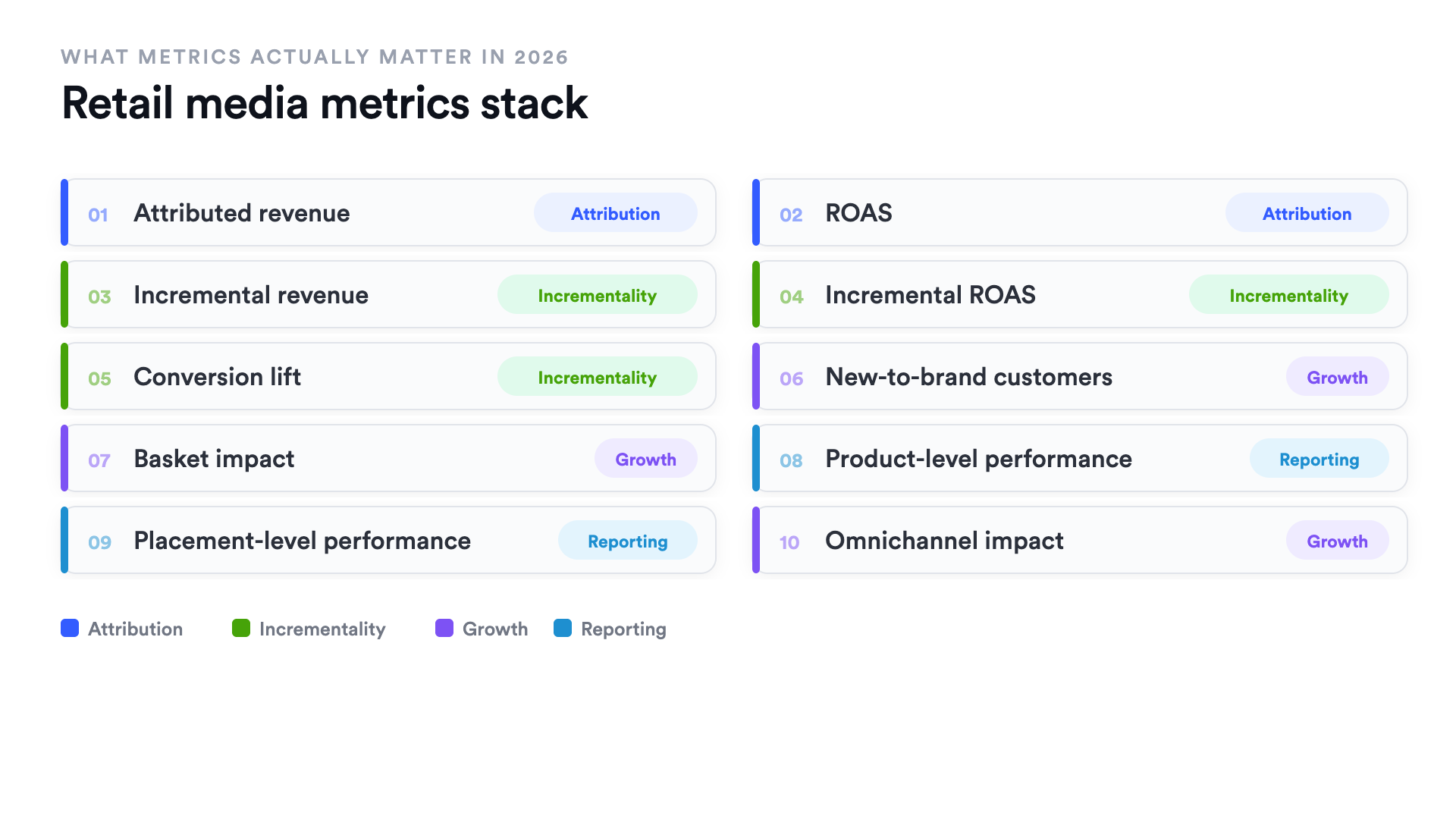
Here are the metrics that matter most:
1. Attributed revenue
Shows which sales were connected to campaigns.
2. ROAS
Shows campaign efficiency based on attributed revenue.
3. Incremental revenue
Shows the additional revenue caused by advertising.
4. Incremental ROAS
Shows true return based on incremental impact.
5. Conversion lift
Shows whether exposed shoppers converted at a higher rate than a comparable control group.
6. New-to-brand customers
Shows whether campaigns expanded the customer base.
7. Basket impact
Shows whether campaigns increased order value or influenced broader shopping behavior.
8. Product-level performance
Shows which promoted products or SKUs drove results.
9. Placement-level performance
Shows which ad surfaces created the most value.
10. Omnichannel impact
Shows whether campaigns influenced both online and offline outcomes.
Together, these metrics create a stronger retail media measurement framework.
How to build a retail media measurement framework
Retailers and marketplaces should not treat measurement as an afterthought. It should be designed into the retail media program from the beginning.
A practical measurement framework should include five steps.
1. Define the campaign objective
Start with the business question.
Is the brand trying to drive immediate sales, launch a new product, grow category share, acquire new customers, or increase basket size?
The objective determines which metrics matter.
2. Choose the right attribution model
Different campaigns need different attribution models.
Sponsored products may rely heavily on click-through and SKU-level attribution. Display or video may require view-through attribution. Brand campaigns may need halo or basket-level measurement.
3. Report attributed outcomes clearly
Brands need timely reporting on spend, impressions, clicks, attributed sales, attributed revenue, and ROAS.
This helps them monitor campaign performance.
4. Add incrementality where possible
To prove true impact, retail media teams should support incrementality measurement through experiments, holdouts, geo tests, or modeled lift.
This helps brands understand whether campaigns created new value.
5. Turn insights into action
Measurement should help brands decide what to do next.
Reports should answer:
- What worked?
- Why did it work?
- What should scale?
- What should change?
- Which products need more budget?
- Which placements deserve investment?
- Which audiences should be tested next?
The best measurement systems do not just report performance. They improve future performance.
How Topsort helps retail media teams measure what matters
Topsort helps retailers, marketplaces, delivery apps, travel platforms, and commerce businesses build retail media programs with API-first ad serving, auctions, sponsored listings, attribution, reporting, and AI optimization.
Because Topsort is built for commerce media, it helps connect the key pieces of retail media measurement: ad requests, auctions, placements, impressions, clicks, products, sellers, campaigns, purchase events, and revenue outcomes.
This gives media teams the foundation to report on the metrics brands care about most, including attributed sales, ROAS, product-level performance, placement-level performance, and outcome-driven optimization.
With the right infrastructure, teams can:
- Launch commerce-native ad placements
- Track impressions, clicks, and purchase events
- Connect campaigns to product-level outcomes
- Report attributed performance clearly
- Support stronger measurement workflows
- Optimize campaigns using commerce signals
- Help brands understand ROI and growth impact
For commerce platforms, the goal is not only to serve ads. The goal is to build a trusted media business where brands can understand performance, prove ROI, and confidently increase investment.
Retail media measurement should not feel like a black box. Advertisers need clear answers, and commerce platforms need infrastructure that can support trusted reporting at scale.
Final takeaway
Retail media measurement in 2026 is about more than impressions, clicks, and attributed ROAS.
Those metrics still matter, but they are only part of the story.
Brands want to know whether retail media is creating real business impact. They want transparent attribution, closed-loop reporting, incrementality, new customer growth, basket impact, placement-level insights, and omnichannel measurement.
The retail media networks that win more budget will be the ones that can answer the questions brands care about most:
- Did the campaign drive sales?
- Did it create incremental revenue?
- Did it bring in new customers?
- Did it improve category or basket performance?
- Can we trust the measurement?
- What should we do next?
In 2026, the best retail media measurement strategies will connect media activity to commerce outcomes and turn reporting into a growth engine.
FAQ
What is retail media measurement?
Retail media measurement is the process of tracking and evaluating how retail media campaigns perform, including impressions, clicks, attributed sales, ROAS, incrementality, new customers, basket impact, and omnichannel outcomes.
What retail media metrics matter most in 2026?
The most important retail media metrics in 2026 include attributed revenue, ROAS, incremental revenue, incremental ROAS, conversion lift, new-to-brand customers, basket impact, product-level performance, placement-level performance, and omnichannel impact.
Why is ROAS not enough for retail media measurement?
ROAS measures attributed revenue compared with ad spend, but it does not always prove that advertising caused new sales. Brands also need incrementality and incremental ROAS to understand true impact.
What is incrementality in retail media?
Incrementality measures the additional revenue, conversions, or orders caused by advertising. It helps brands understand what happened because of a campaign, not just what was connected to it.
What is closed-loop attribution in retail media?
Closed-loop attribution connects ad exposure or engagement to downstream commerce outcomes such as purchases, orders, revenue, or basket activity.
What is incremental ROAS?
Incremental ROAS is incremental revenue divided by ad spend. It measures return based on revenue caused by advertising, not just revenue attributed to advertising.
Why are new-to-brand customers important in retail media?
New-to-brand customers help brands understand whether campaigns are expanding the customer base instead of only reaching shoppers who already buy from the brand.
What is basket impact in retail media?
Basket impact measures how a campaign influences broader cart or order behavior, such as average order value, related product purchases, or category-level sales.
Why does measurement transparency matter?
Measurement transparency helps brands trust retail media results. Advertisers need to understand attribution windows, reporting rules, incrementality methods, and any limitations in the data.
How can retailers improve retail media measurement?
Retailers can improve measurement by connecting ads to commerce outcomes, reporting both attributed and incremental results, using clear attribution rules, supporting product-level and placement-level reporting, and making methodology transparent.
Suggested CTA
Ready to build retail media measurement brands can trust? See how Topsort helps retailers and marketplaces connect ad serving, attribution, reporting, and optimization through API-first retail media infrastructure.
.png)
.png)