Build vs Buy: The True Five-Year Cost of Retail Media Infrastructure
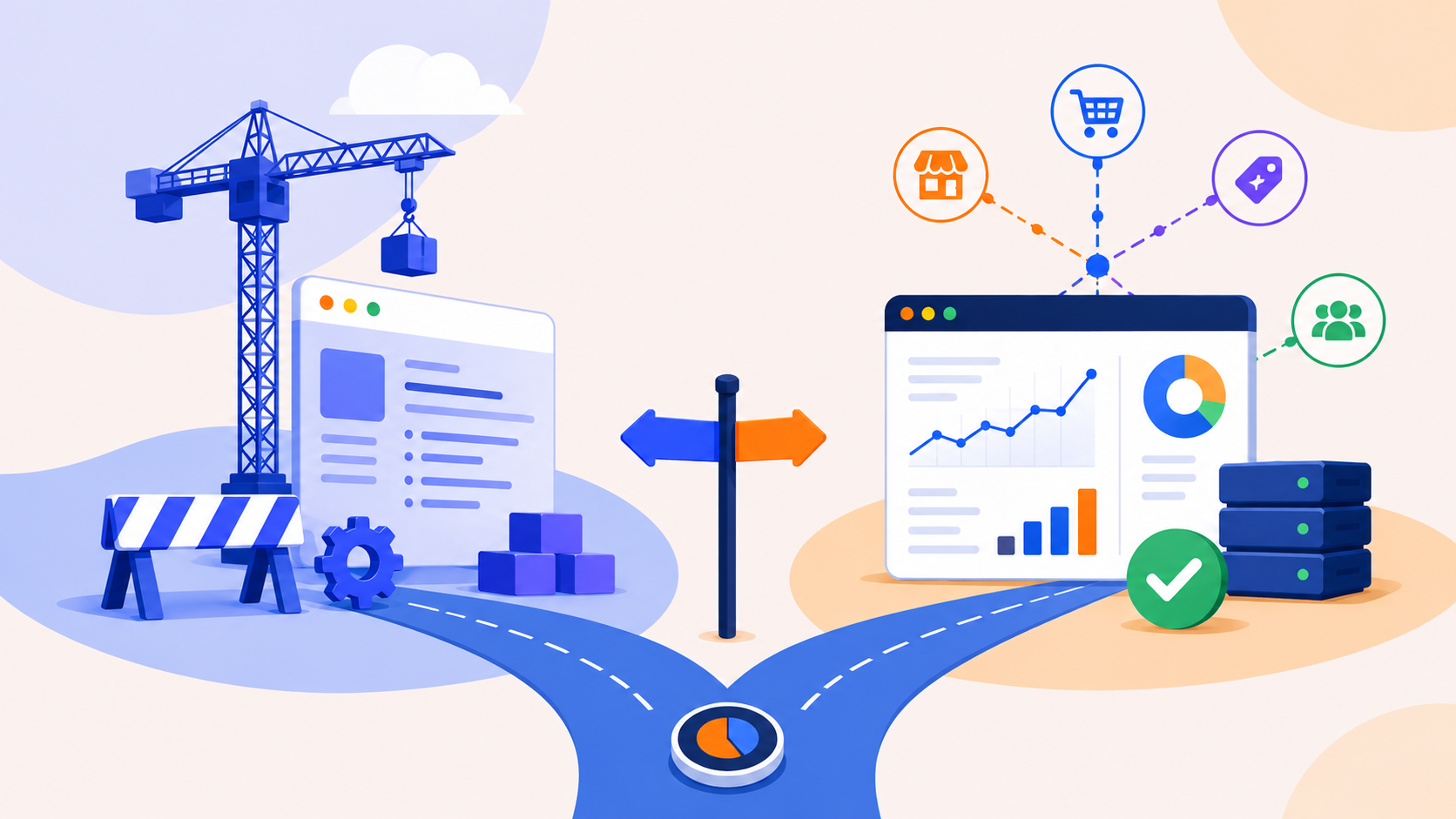
A practical framework for evaluating the real cost of owning retail media technology over time
Retailers and marketplaces evaluating retail media infrastructure often start with the wrong question:
How much would it cost us to build an ad server?
A better question is:
What will it cost us to operate, improve, and scale retail media infrastructure for the next five years?
That distinction matters because retail media infrastructure is not a one-time software project. It is the underlying technology for auctions, campaign delivery, budget pacing, measurement, advertiser workflows, and optimization.
A retail media ad server is one part of that broader infrastructure layer. As the media business grows, the system around it also has to support reporting, attribution, self-service, integrations, and increasingly sophisticated monetization decisions.
Building the first version is only the beginning.
A serious build-vs-buy analysis should therefore compare the full five-year cost of internal ownership against the full cost of buying infrastructure—not an MVP budget against a vendor fee.
The short answer
For most retailers and marketplaces, buying becomes attractive when the platform replaces a permanent internal commitment across engineering, data, infrastructure, and ad operations.
Building can still make sense when advertising technology is itself a core strategic competency, requirements are genuinely unique, and the company has the scale and resources to support the system indefinitely.
The right comparison is: Five-year internal TCO + opportunity cost + execution risk vs. Five-year platform cost + integration + internal operating cost
That usually produces a very different answer from comparing annual software fees with engineering salaries.
What are you actually building?
A production retail media platform has to do far more than place an ad on a page.
It needs to manage the core mechanics of monetization: auctions and pricing, campaign delivery and budget pacing, targeting and relevance, reporting and attribution, advertiser workflows, and integrations with the retailer's catalog and storefront.
As the program grows, the infrastructure also has to support more complex requirements such as self-service, multiple markets and currencies, privacy controls, experimentation, and optimization—all while operating reliably at commerce-scale traffic.
So the real decision is not whether your team can build a few ad features. It is whether your company wants to become the permanent owner of an advertising technology stack.
The true five-year cost of building retail media infrastructure
1. Initial product development
The most visible cost is the first build. That usually includes engineering, product, data, infrastructure, storefront integrations, campaign tooling, reporting, and measurement.
But the first release should not be confused with the finished product.
A useful starting equation is: Initial build cost = people + infrastructure + integrations + launch overhead
The harder question is what happens after launch.
2. Ongoing engineering and maintenance
Retail media infrastructure never becomes “done.”
Advertisers will ask for better reporting, new campaign types, more automation, improved targeting, and new measurement capabilities. At the same time, the original platform still needs reliability work, performance improvements, and support.
The real engineering cost is therefore new capabilities plus continuous maintenance. And that cost persists every year.
3. Cloud, data, and operational infrastructure
Retail media creates large volumes of auctions, impressions, clicks, conversions, campaign updates, and reporting queries.
As the program scales, the business may need low-latency services, event pipelines, storage, monitoring, analytics infrastructure, redundancy, and disaster recovery.
The question is not simply whether the existing stack can technically serve ads. It is whether it can do so economically and reliably without degrading the underlying commerce experience.
4. Ad operations and manual work
When software does not automate a workflow, people absorb the gap.
Campaign setup, troubleshooting, reporting, budget adjustments, advertiser access, reconciliation, and billing can all become recurring operating costs.
These costs are easy to miss because they often sit outside engineering. But if employees spend meaningful time compensating for platform limitations, that effort belongs in the technology TCO.
5. Opportunity cost
This is often the largest hidden cost.
Every engineer assigned to ad infrastructure is not working on another commerce priority, and every month spent building may delay retail media revenue.
A simple model is: Launch-delay opportunity cost = expected monthly media contribution × additional months to launch
For example, if a marketplace expects $250,000 in monthly media revenue and an internal build adds nine months before launch, that represents $2.25 million in delayed gross revenue.
That figure is illustrative, not a benchmark. It is meant to show why time-to-market belongs in the calculation.
A complete five-year build model should capture:
- Initial build and integration
- Ongoing engineering and maintenance
- Cloud, data, and operational overhead
- Manual ad operations
- Opportunity cost and launch delay
An illustrative five-year model
Consider a marketplace evaluating an internal build.
Assume $2.0M in initial development, then $1.4M per year for ongoing engineering and product, $250K per year for infrastructure and data, and $350K per year for incremental operations.
Now add a nine-month launch delay at $250,000 in estimated monthly media revenue:
9 × $250K = $2.25M in delayed gross revenue
These numbers are illustrative rather than industry benchmarks.
The point is the shape of the calculation: a project initially framed as a $2 million build can become a much larger multi-year commitment once maintenance, operations, and time-to-market are included.
This is also where proprietary data can make the analysis significantly stronger. Actual time-to-launch, engineering effort, migration outcomes, or operating benchmarks should replace illustrative assumptions whenever reliable internal data is available.
Why “we already have engineers” is not a free-build argument
Existing headcount still has an opportunity cost.
An engineer building budget pacing cannot work on search. A data engineer maintaining attribution cannot work on personalization. A product manager managing advertiser workflows cannot focus on another commerce product.
The relevant question is not whether those people are already on payroll.
It is: What is the highest-value use of their capacity?
For many retailers and marketplaces, the strongest argument for buying infrastructure is the ability to redirect scarce technical resources toward areas where the company can differentiate.
When building can make sense
Building deserves serious consideration when advertising technology itself is strategically important to the business, not simply because an internal team is capable of building it.
The case is strongest when:
- Ad tech is a core competency
- Requirements are genuinely unique
- The business has significant scale
- A dedicated team can own it long term
The last point matters most. Building is not a one-time engineering project. It means accepting responsibility for maintaining and evolving the platform for years.
When buying usually makes more sense
Buying becomes more attractive when the company's real differentiation lies in the commerce business itself—its customer experience, first-party data, assortment, merchant ecosystem, advertiser relationships, or marketplace scale.
In those cases, auction infrastructure, campaign delivery, pacing, and measurement are essential, but they do not necessarily need to be proprietary.
A retailer can still own its media business while buying the infrastructure underneath it. That means retaining control of the customer experience, advertiser relationships, pricing strategy, data, placements, and commercial model without rebuilding every layer of ad technology internally.
Build vs buy is really a question of where to differentiate
The traditional framing is too binary: Build everything or outsource retail media.
A more useful framing is: Which parts of the stack create strategic advantage, and which parts are infrastructure?
That distinction matters because modern retail media systems increasingly need to do more than deliver ads.
They need to decide which commercial opportunity to show, which advertiser should win, what price should be clear, how to protect relevance, how to pace budgets, and how to optimize toward business outcomes.
This is where the category is moving beyond the traditional ad server. Traditional ad servers primarily deliver ads. AI-powered commerce monetization infrastructure increasingly determines how commercial surfaces should create value.
That raises the bar for an internal build. The organization is not only committing to today's functionality. It is also committing to keeping its monetization technology competitive as automation, auction optimization, measurement, and AI evolve.
Five questions to answer before you build
- What will the platform cost in Years 1 through 5, not just Year 1?
- How much engineering and operational capacity will it require permanently?
- How much revenue could be delayed while the system is being built?
- Which commerce priorities will lose resources because of the project?
- Which parts of the technology genuinely create proprietary advantage?
If the business case still works after answering those questions, building may be rational.
If it only works when maintenance, staffing, infrastructure, and opportunity cost are excluded, the comparison is incomplete.
How Topsort approaches the build-vs-buy problem
Topsort provides AI-powered retail media and commerce monetization infrastructure for retailers and marketplaces that want to own their media business without building the underlying advertising stack from scratch.
The goal is not to remove internal ownership. It is to move engineering effort upward.
Instead of recreating foundational auction, delivery, measurement, and advertiser infrastructure, internal teams can focus on the parts of commerce that differentiate their business.
That makes the most useful comparison:
What does each architecture allow the business to launch, learn, and monetize over the next five years?
The answer may differ by company. What matters is evaluating both options against the same economic and strategic framework.
Frequently asked questions
How much does it cost to build a retail media platform?
There is no universal number. Costs depend on team size, feature scope, integrations, traffic, markets, measurement requirements, and reliability needs.
A realistic estimate should include both initial development and at least five years of engineering, infrastructure, operations, and maintenance.
What is the biggest hidden cost of building retail media internally?
Often, it is ongoing engineering capacity and opportunity cost.
The platform needs permanent maintenance, while the same technical resources cannot be used elsewhere in the commerce roadmap.
Is buying retail media technology the same as outsourcing a retail media network?
No. A retailer or marketplace can buy underlying infrastructure while retaining control of advertisers, customer experience, inventory, first-party data, pricing, and commercial strategy.
What should be included in a retail media TCO calculation?
At minimum, include initial development, ongoing engineering, infrastructure, data processing, integrations, ad operations, reporting, measurement, maintenance, vendor fees, time-to-market, and execution risk.
Should large retailers build their own retail media platform?
Sometimes. Scale makes building easier to justify, but the stronger test is whether owning the technology creates enough strategic or financial advantage to justify operating and evolving it indefinitely.
The bottom line
The decision is not whether your engineering team can build a retail media ad server.
Many can. The question is whether owning and continuously developing that infrastructure is the highest-value use of your people, capital, and time for the next five years.
Include maintenance. Include operations. Include opportunity cost. Include the roadmap of capabilities advertisers will expect next. Then compare that full economic picture with buying infrastructure.
The right build-vs-buy question is not: “What is cheaper this year?”
It is: “Which approach gives us the stronger retail media business five years from now?”
.png)
.png)