In-Store Retail Media: How Retailers Can Monetize and Measure Physical Stores
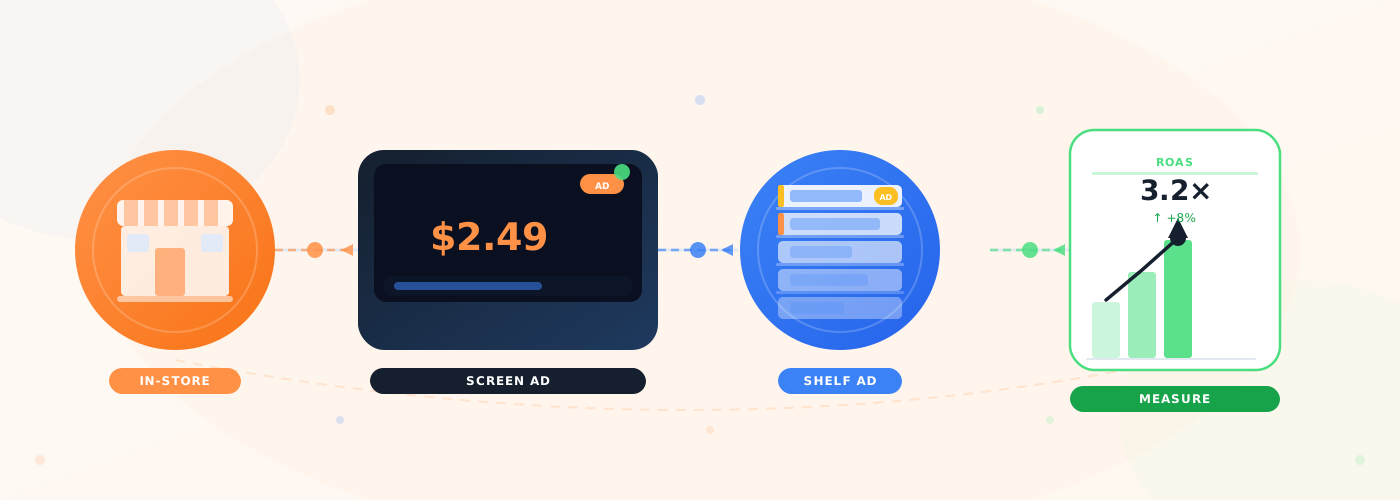
Retail media is expanding beyond websites and apps.
As retailers build more mature media businesses, physical stores are becoming an important part of the retail media opportunity. Stores have foot traffic, shopper attention, product discovery moments, purchase intent, and transaction data. For many retailers, the store is still one of the most valuable media environments they own.
This is why in-store retail media is becoming a bigger priority.
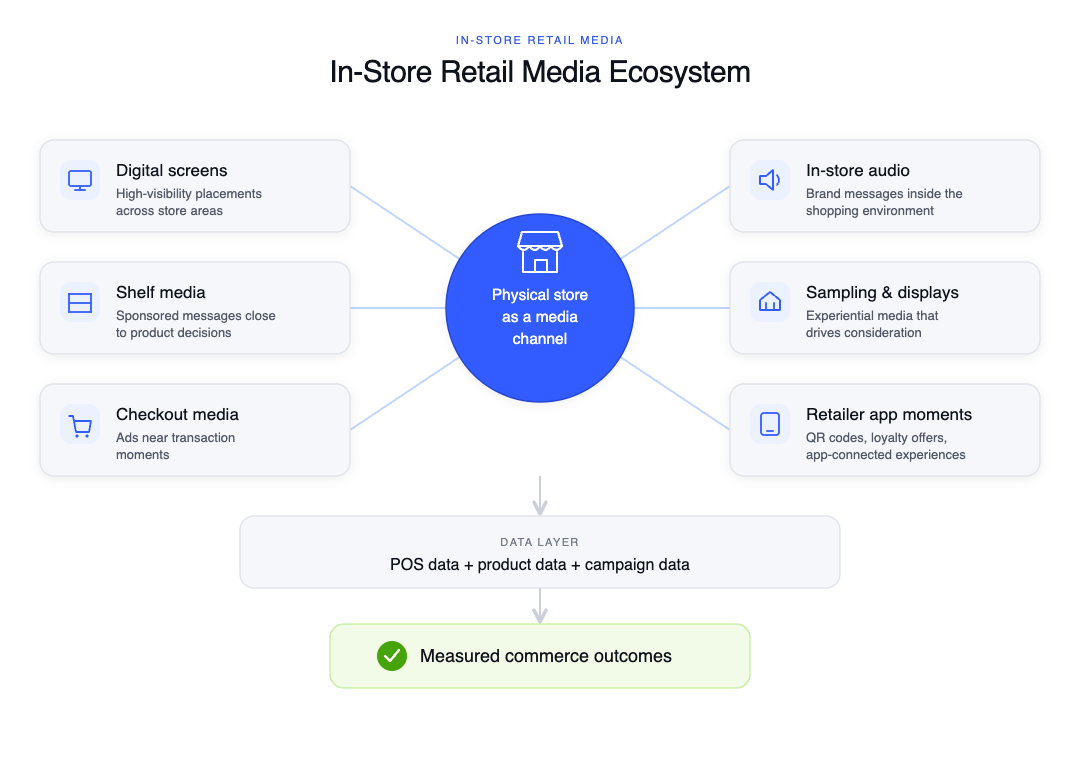
In-store retail media helps retailers monetize physical store environments through ads, screens, shelf media, audio, sampling, digital displays, and other sponsored experiences. But to create real value for brands, retailers need more than in-store placements. They need measurement that connects in-store media to commerce outcomes.
At Topsort, we see in-store retail media as part of a broader commerce media system. The future is not only online retail media or physical store advertising. It is measurable, omnichannel retail media that connects campaigns, shopper behavior, and sales across channels.
What is in-store retail media?
In-store retail media refers to advertising or sponsored experiences that appear inside physical retail locations.
Examples include:
- Digital screens
- Shelf displays
- Endcap displays
- In-store audio ads
- Checkout screens
- Sampling stations
- Smart carts
- Digital price tags
- In-store kiosks
- Sponsored signage
- QR-code shopping experiences
- Retailer app experiences triggered in-store
In simple terms, in-store retail media helps brands reach shoppers while they are physically inside the store.
This can be valuable because shoppers in stores often have high purchase intent. They are close to the shelf, comparing products, making decisions, and completing transactions.
Why in-store retail media matters
Physical stores are powerful media environments.
They offer:
- Real shopper attention
- High purchase intent
- Product proximity
- Category context
- Transaction data
- Omnichannel influence
- Opportunities for brand storytelling
- Opportunities for last-mile conversion
For retailers, in-store retail media can create a new revenue stream from owned physical assets. For brands, it can influence shoppers at the moment of decision.
In-store media is especially relevant for:
- Grocery
- Pharmacy
- Convenience
- Beauty
- Electronics
- Home improvement
- Department stores
- Specialty retail
- Big-box retail
As retail media networks grow, physical stores can help retailers offer brands a more complete view of the shopper journey.
How in-store retail media works
In-store retail media usually involves three components:
- Ad inventory inside physical stores
- Campaign buying or activation tools
- Measurement and reporting
A brand may buy a campaign across digital screens, shelf placements, checkout displays, or in-store audio. The retailer then needs to report whether the campaign influenced sales, category performance, store traffic, basket size, or other business outcomes.
The challenge is that physical store measurement can be harder than digital measurement. Online, retailers can often track impressions, clicks, product views, and purchases in one environment. In-store, the connection between exposure and purchase may be less direct.
That is why measurement design is critical.
Common in-store retail media formats
Digital screens
Digital screens can appear at store entrances, aisles, checkout areas, pharmacy counters, or category zones.
Shelf media
Shelf media places brand messages close to products and purchase decisions.
Endcaps and sponsored displays
Brands can sponsor high-visibility displays in key store locations.
In-store audio
Retailers can use audio placements to promote brands, categories, or offers.
Checkout media
Checkout screens or payment terminal placements can reach shoppers near transaction moments.
Sampling and experiential media
Brands can use product sampling, demos, or interactive displays to drive consideration and purchase.
App-connected in-store media
Retailer apps can support location-aware offers, QR codes, loyalty messages, or personalized promotions.
In-store retail media vs digital retail media
In-store retail media and digital retail media share the same goal: helping brands reach shoppers in commerce environments.
But they differ in execution and measurement.
Digital retail media often includes:
- Sponsored products
- Search placements
- Category page ads
- Product page ads
- Display ads
- App placements
- Offsite media
In-store retail media often includes:
- Screens
- Shelf displays
- Audio
- Signage
- Sampling
- Physical placements
- Checkout media
Digital retail media is usually easier to track at the user-event level. In-store retail media may require store-level sales analysis, loyalty data, POS data, exposure estimates, test/control design, or omnichannel attribution.
Both can be valuable when connected through a unified measurement strategy.
What brands want from in-store retail media
Brands do not only want store exposure. They want proof that the exposure worked.
Brands may ask:
- How many shoppers were reached?
- Which stores ran the campaign?
- Which products were promoted?
- Did sales increase?
- Did basket size increase?
- Did the campaign drive category lift?
- Did it reach new customers?
- Did online and offline sales change?
- Was the impact incremental?
- How should we optimize future campaigns?
If retailers cannot answer these questions, in-store media may be seen as awareness only. If retailers can connect in-store media to sales outcomes, it becomes a stronger retail media product.
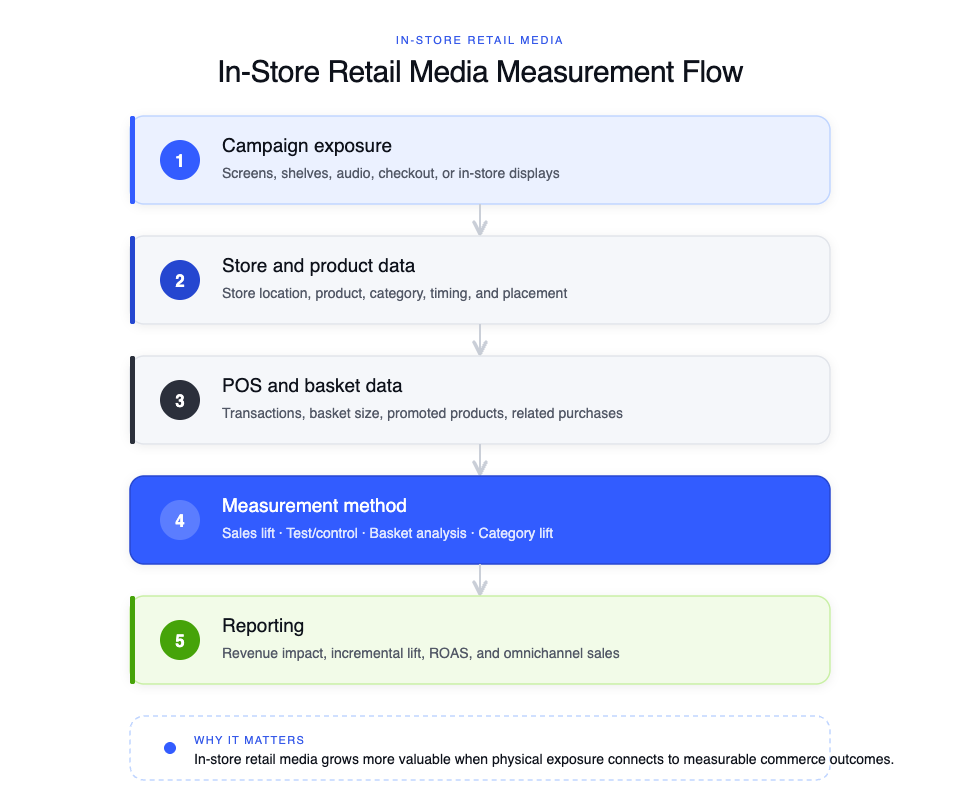
How to measure in-store retail media
In-store retail media measurement can include several approaches.
Store-level sales lift
Compare sales in stores with the campaign against stores without the campaign.
Test and control groups
Use similar stores or shopper groups to estimate incremental impact.
POS data
Connect campaign timing and promoted products to point-of-sale transactions.
Loyalty or first-party data
Where privacy-compliant, loyalty data can help connect campaign exposure to purchase behavior.
Basket analysis
Measure whether promoted products or related categories appeared more often in baskets.
Category lift
Evaluate whether the campaign improved category-level sales or share.
Omnichannel attribution
Connect in-store campaigns to online sales, app engagement, or digital follow-up behavior where possible.
Incrementality testing
Measure whether the campaign caused additional sales beyond what would have happened anyway.
The strongest measurement approach depends on the retailer’s data, store footprint, campaign design, and advertiser goals.
Why closed-loop measurement matters
Closed-loop measurement is one of the biggest advantages retailers can bring to in-store media.
Retailers have access to transaction data. That means they can help brands understand whether campaigns influenced actual purchases, not just impressions.
But in-store closed-loop measurement is not automatic. Retailers need infrastructure that can connect:
- Campaign details
- Store locations
- Ad placements
- Product data
- Timing
- POS transactions
- Loyalty signals where available
- Sales outcomes
- Reporting
At Topsort, our POV is that in-store retail media should be connected to the same measurement discipline as digital retail media. Advertisers should understand what was shown, where it ran, what products were promoted, and what business outcomes changed.
In-store retail media and omnichannel strategy
In-store retail media becomes more powerful when it is connected to omnichannel strategy.
A shopper may discover a product in-store and later purchase online. Another shopper may see a digital ad online and then buy in-store. A brand may run onsite sponsored products, offsite campaigns, and in-store screens at the same time.
Retailers need to help brands understand how these touchpoints work together.
An omnichannel retail media strategy can connect:
- Onsite ads
- Offsite ads
- In-store placements
- App engagement
- Loyalty activity
- POS transactions
- Online purchases
- Store-level sales
- Incrementality measurement
This helps brands see retail media as a business growth channel, not a collection of disconnected placements.
Challenges of in-store retail media
In-store retail media has strong potential, but it also creates challenges.
Measurement complexity
It can be harder to connect exposure to purchase in physical environments.
Inventory standardization
Retailers need consistent definitions for screens, placements, store groups, and campaign delivery.
Operational execution
Store-level media requires coordination across marketing, store operations, merchandising, and technology.
Reporting expectations
Brands increasingly expect digital-style reporting, even for physical media.
Privacy and data governance
Retailers need to use first-party data responsibly and comply with privacy requirements.
Creative and placement quality
In-store ads must fit the shopping environment and avoid disrupting the customer experience.
What retailers need to build in-store retail media
To build in-store retail media successfully, retailers need:
- Clear inventory definitions
- Store-level campaign planning
- Product and category data
- POS data connection
- Measurement methodology
- Reporting dashboards
- Advertiser-facing insights
- Sales lift analysis
- Omnichannel attribution where possible
- Operational workflows
- Shopper experience standards
Retailers should start with a focused set of high-value placements and clear measurement before expanding.
How Topsort helps
Topsort helps commerce businesses build measurable retail media programs with API-first infrastructure for ad serving, attribution, reporting, and optimization.
While in-store media has different activation mechanics from onsite digital media, the same principle applies: advertisers need trusted measurement that connects campaigns to commerce outcomes.
Topsort’s commerce-native approach helps retailers and marketplaces think beyond impressions by connecting media activity to product, campaign, and sales performance.
For retailers building omnichannel retail media, the goal is to create a unified measurement foundation across digital and physical commerce touchpoints.
Final takeaway
In-store retail media is becoming an important part of the retail media opportunity.
Physical stores offer shopper attention, product proximity, purchase intent, and transaction data. But to unlock meaningful advertiser investment, retailers need to connect in-store media to measurable business outcomes.
The future of in-store retail media is not just more screens or signage. It is measurable, omnichannel commerce media that helps brands understand impact across the full shopper journey.
Retailers that can combine in-store activation with transparent measurement will be better positioned to grow advertiser trust and retail media revenue.
FAQ
What is in-store retail media?
In-store retail media refers to advertising or sponsored experiences inside physical retail stores, such as digital screens, shelf displays, checkout media, audio ads, signage, or sampling.
Why is in-store retail media important?
In-store retail media helps brands reach shoppers close to purchase decisions and helps retailers monetize physical store environments.
How do retailers measure in-store retail media?
Retailers can measure in-store retail media using store-level sales lift, test and control groups, POS data, loyalty data, basket analysis, category lift, and omnichannel attribution.
What is the difference between in-store retail media and digital retail media?
In-store retail media appears in physical store environments. Digital retail media appears on websites, apps, offsite media channels, and other digital surfaces.
What metrics matter for in-store retail media?
Important metrics include reach, store sales lift, product sales, category lift, basket impact, new customers, incremental revenue, and omnichannel sales impact.
Can in-store retail media be measured with closed-loop attribution?
Yes, but it requires strong campaign, store, product, and transaction data connections. Retailers need clear methodology to connect in-store exposure to sales outcomes.
Want to connect in-store media to commerce outcomes? See how Topsort helps retailers build measurable retail media programs across commerce channels.
.png)
.png)