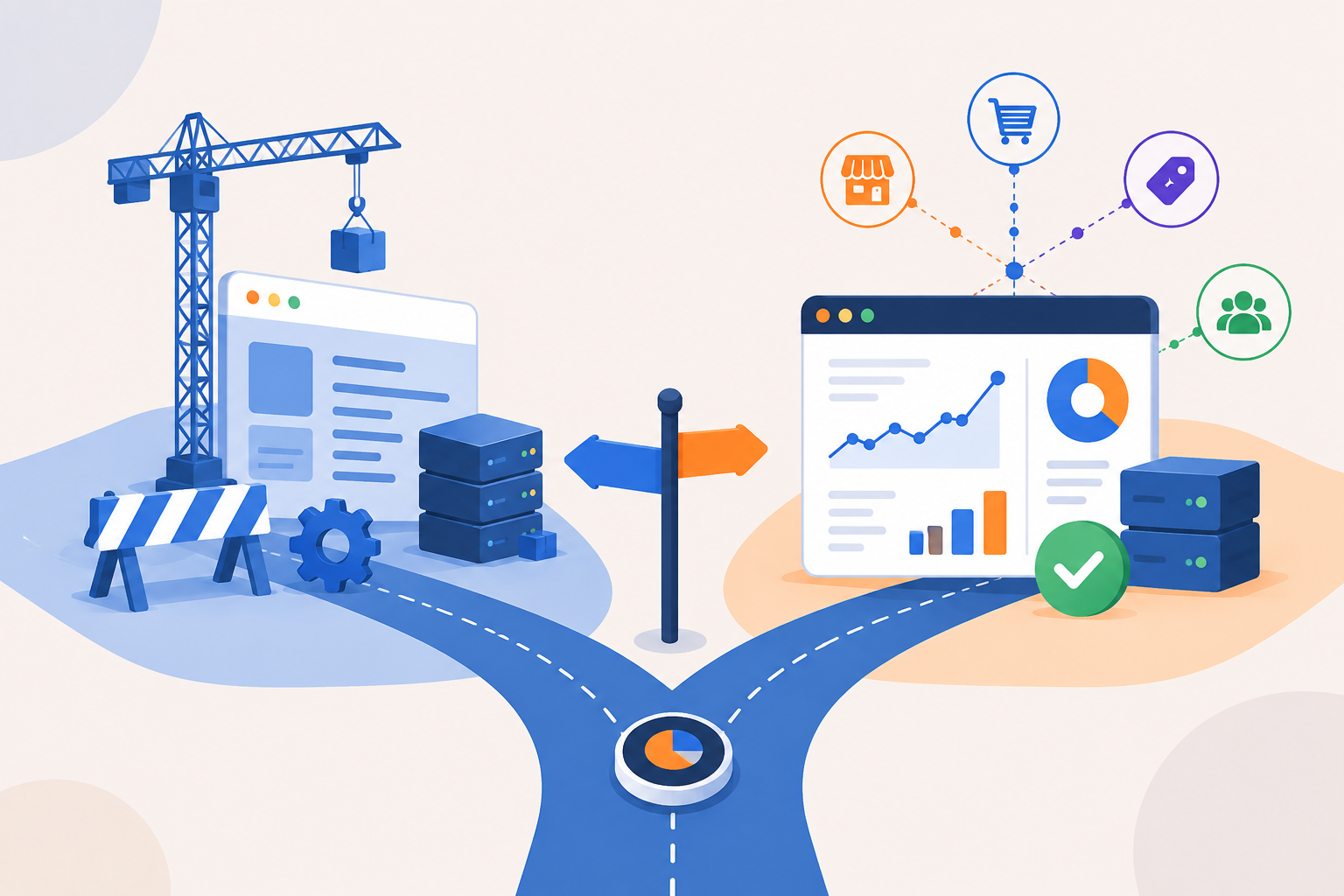
What Is Commerce AI? Retail Media’s Next Operating Layer
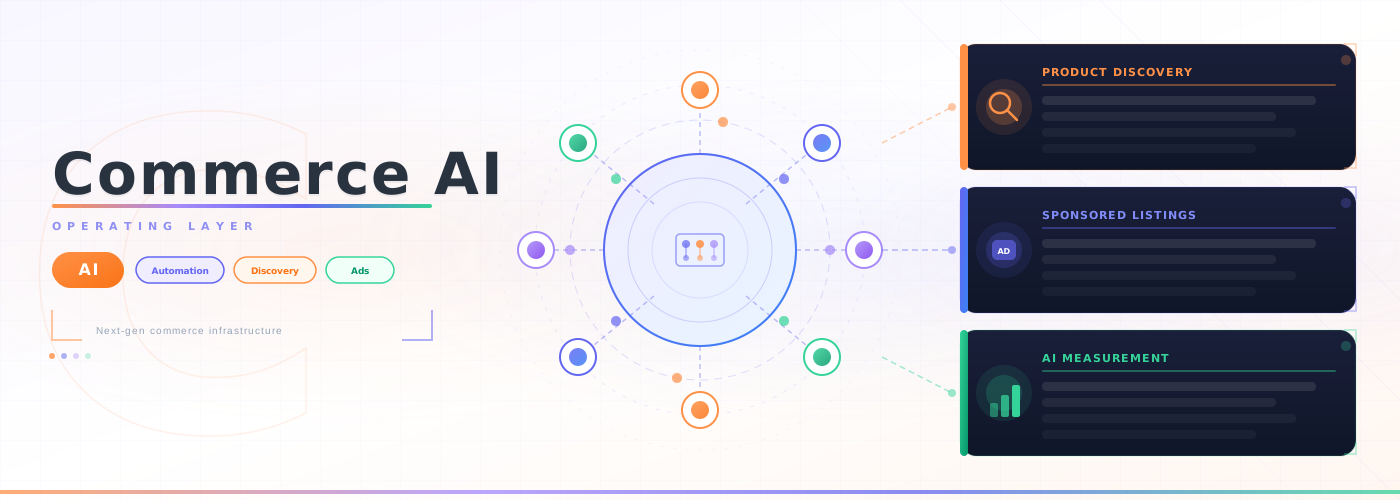
Commerce AI is the use of artificial intelligence to make commerce smarter, faster, and more connected. It helps retailers, marketplaces, delivery apps, and commerce platforms improve product discovery, retail media, campaign automation, measurement, and advertiser demand activation.
It is more than a chatbot or a product recommendation tool. Commerce AI connects the systems behind modern commerce: product data, shopper intent, inventory, advertising campaigns, auctions, reporting, and monetization.
This matters because retail media is entering a new era. The next stage will not be defined only by selling more ad placements or sponsored listings. It will be defined by how well commerce companies can connect media, merchandising, product discovery, AI automation, and demand in real time.
At Topsort, we believe Commerce AI is where commerce, AI, and network power come together.
Commerce is the foundation: understanding products, sellers, shoppers, inventory, transactions, and monetization.
AI is the intelligence layer: helping teams automate campaign creation, optimize auctions, improve discovery, simplify reporting, and reduce manual work.
Network power is the multiplier: helping retailers access more demand, advertisers activate more easily, and commerce platforms connect supply, demand, and measurement more efficiently.
That is why Commerce AI is not just another AI feature. It is becoming the operating layer for the next era of commerce growth.
What Is Commerce AI?
Commerce AI refers to the use of AI to make commerce systems more intelligent, automated, and connected.
In practical terms, Commerce AI helps retailers and marketplaces answer questions like:
- Which products should be promoted for this shopper intent?
- Which campaign should win this placement?
- How should bids, budgets, and recommendations adjust in real time?
- How can advertisers launch and optimize campaigns with less manual work?
- How can product discovery become more relevant across search, browsing, recommendations, and AI shopping assistants?
- How can retailers connect onsite, offsite, and agentic commerce experiences without fragmenting their infrastructure?
A simple definition:
Commerce AI is the AI-powered operating layer that connects retail media, product discovery, commerce data, campaign automation, marketplace monetization, and advertiser demand.
That definition is important because commerce is becoming more complex. Retailers are no longer managing only a website, an app, a search bar, and a few ad placements. They are managing an ecosystem of sellers, advertisers, product feeds, fulfillment signals, inventory constraints, shopper journeys, brand budgets, offsite channels, and increasingly, AI-powered shopping interfaces.
Commerce AI is how those systems begin to work together.
Why Commerce AI Matters Now
AI is changing how consumers discover, compare, and buy products.
OpenAI has introduced Instant Checkout in ChatGPT, powered by the Agentic Commerce Protocol, as an early step toward agentic commerce. Google has introduced Universal Cart and agentic shopping capabilities designed to help AI agents support shopping across surfaces. McKinsey has described agentic commerce as a shift where AI shopping agents can support discovery, comparison, decision-making, and more automated transactions. Microsoft has framed agentic commerce as a new “front door” to retail, where the entry point is no longer only a homepage, search box, or category page, but a conversation.
These changes point to the same direction: commerce discovery is becoming more dynamic, conversational, and AI-mediated.
That creates a challenge for retail media.
Traditional retail media was built around familiar surfaces: search results, category pages, product detail pages, display placements, sponsored listings, and audience extension. These surfaces are still important. But they are no longer the whole picture.
In an AI-driven commerce journey, the shopper may not start with a keyword. They may start with a prompt:
“I need a compact coffee maker under $150 for a small apartment.”
“I’m buying dorm essentials for my daughter, who likes minimalist green decor.”
“What are the best skincare products for sensitive skin under $40?”
These are not simple keywords. They are complex expressions of intent. They include budget, use case, preference, context, category, and sometimes urgency.
To respond well, a commerce system needs more than an ad slot. It needs an operating layer that can understand intent, connect product data, respect inventory and business rules, optimize monetization, and preserve shopper trust.
That is where Commerce AI becomes important.
Commerce AI vs. Traditional Retail Media AI
Retail media AI often refers to specific AI-powered features inside an advertising platform: bidding automation, campaign optimization, audience targeting, recommendation models, or reporting insights.
Commerce AI is broader.
It includes retail media AI, but it also connects it to the wider commerce system.
.png)
This distinction matters because retail media is no longer only a media channel. It is becoming part of how commerce platforms organize discovery, monetization, and growth.
Retailers and marketplaces need AI that does more than optimize an auction. They need AI that can support the entire commerce loop: intent, product, placement, bid, budget, conversion, attribution, and learning.
This is why a flexible real-time auction engine matters. The system must be able to make fast, relevant, and measurable monetization decisions across different commerce surfaces.
Why Retail Media Needs an Operating Layer
Retail media started as a monetization layer on top of commerce traffic.
A retailer had shoppers. Brands wanted to reach those shoppers. Sponsored products and onsite display helped retailers monetize high-intent moments.
That model worked. But it also created fragmentation.
Many retailers now manage separate systems for:
- Product catalog data
- Search and recommendations
- Sponsored listings
- Display ads
- Campaign management
- Seller or advertiser portals
- Reporting and attribution
- Offsite activation
- Inventory and availability
- Agency or brand workflows
When these systems do not communicate, the shopper experience suffers. Advertisers get unclear measurement. Retailers struggle to scale operations. Teams spend too much time stitching together dashboards, workflows, and manual fixes.
Commerce AI changes the expectation.
Instead of treating retail media as a siloed ad channel, it treats retail media as part of a larger commerce operating layer.
That operating layer should help answer:
- What does the shopper want?
- Which products are eligible and available?
- Which advertiser has budget and relevance?
- What placement creates value without hurting shopper experience?
- What outcome should be optimized: revenue, margin, conversion, relevance, or long-term customer value?
- How should the system learn from results?
This is the shift from retail media as “ads on a retailer site” to retail media as an intelligent commerce growth system.
For commerce companies building or upgrading their monetization stack, this shift makes retail media infrastructure more important than ever. The infrastructure has to support ad serving, auctions, reporting, advertiser workflows, measurement, and future AI-driven discovery surfaces without forcing teams to stitch together disconnected tools.
The Four Layers of Commerce AI: Data, Intelligence, Activation, and Network Power
Commerce AI works best when it is not treated as a single feature or dashboard. It needs to connect four layers of the commerce system: data, intelligence, activation, and network power.
Data gives AI the context to understand products, shoppers, sellers, campaigns, inventory, and transactions.
Intelligence turns those signals into decisions.
Activation turns decisions into campaigns, recommendations, auctions, reports, and workflows.
Network power expands the value of the system by making it easier for retailers and advertisers to connect, transact, and grow together.
This is where Commerce AI becomes more than automation. It becomes infrastructure.
1. Commerce Data
Commerce AI starts with data that is specific to commerce.
This includes product attributes, inventory, prices, margins, availability, seller data, campaign data, shopper behavior, search queries, purchase history, and attribution signals.
Without strong commerce data, AI cannot understand what to recommend, what to promote, or what outcome matters.
This is especially important in agentic commerce. AI shopping assistants need structured, accurate, and machine-readable product and commerce information to make useful recommendations.
2. Intelligence
The intelligence layer interprets signals and makes decisions.
This can include relevance models, bidding algorithms, recommendation systems, campaign optimization, budget pacing, forecasting, reporting insights, and AI-assisted campaign creation.
The goal is not just to automate tasks. The goal is to make better decisions faster.
For example, Commerce AI can help determine which sponsored product should appear for a complex shopper intent, how to balance monetization with user experience, or when an advertiser should adjust strategy based on performance.
For advertisers, AI should make campaign setup, optimization, and reporting easier through AI-powered campaign automation. For retailers, it should make monetization more scalable without making the shopper experience feel less relevant or less trusted.
3. Activation
Activation is where intelligence turns into action.
For retailers and marketplaces, this can include onsite sponsored listings, display ads, native placements, offsite media, self-service advertiser tools, automated campaign workflows, and AI-assisted reporting.
For advertisers, activation means being able to reach shoppers across relevant commerce moments without rebuilding campaigns for every surface.
In many commerce environments, sponsored listings remain one of the most important formats for connecting advertiser demand with high-intent shopper moments. But in the Commerce AI era, sponsored listings should not operate in isolation. They should connect with search, recommendations, auctions, measurement, and future AI-driven discovery experiences.
This is where AI-powered retail media becomes practical. It should reduce friction, not add another dashboard.
4. Network Power
The next stage of commerce will not be built only on isolated tools or isolated inventory.
Retailers need better ways to access demand. Advertisers need easier ways to activate across commerce environments. Commerce platforms need infrastructure that can connect supply, demand, data, and measurement.
Network power is the ability to create more value as more participants connect.
In Commerce AI, network power means helping retailers and advertisers grow together through more accessible demand, more standardized workflows, better measurement, and smarter connections across the ecosystem.
This matters because the future of retail media is not only about what happens on one retailer’s website. It is also about how demand, supply, audiences, products, campaigns, and measurement can work together across a more connected commerce ecosystem.
What Commerce AI Means for Retailers
For retailers, Commerce AI is a way to move from manual retail media operations to intelligent commerce monetization.
It can help retailers:
- Launch and scale retail media programs faster
- Make advertising easier for brands and sellers
- Improve relevance across search, browse, and recommendations
- Connect onsite and offsite monetization
- Reduce operational complexity
- Make campaign creation and reporting more self-service
- Protect shopper experience while growing ad revenue
- Prepare for AI shopping assistants and agentic commerce
The key is control.
Retailers should not lose control of their commerce experience as AI platforms become more powerful. They need infrastructure that helps them make their product, inventory, and advertising systems ready for AI-driven discovery while still preserving their own rules, relationships, and monetization strategy.
That control will become more important as shoppers use AI to discover, compare, and evaluate products. Retailers need to make their commerce data understandable to AI systems, but they also need to protect the quality of their shopper experience, their advertiser relationships, and their monetization model.
Commerce AI helps retailers prepare for that future by connecting the systems that matter: product data, ad serving, auctions, measurement, campaign workflows, demand activation, and shopper relevance.
What Commerce AI Means for Marketplaces
Marketplaces have a unique opportunity in Commerce AI because they already sit at the intersection of buyers, sellers, products, and transactions.
For marketplaces, Commerce AI can help:
- Improve seller monetization
- Automate campaign setup for long-tail advertisers
- Match shopper intent with relevant promoted products
- Support self-service advertising
- Optimize auctions in real time
- Provide better reporting to sellers
- Create new demand pathways across the marketplace ecosystem
Marketplaces also face a specific challenge: many sellers do not have large teams, agencies, or advanced media knowledge.
Commerce AI can make advertising more accessible by simplifying campaign creation, recommending budgets, automating optimization, and turning complex performance data into clear next steps.
This is important because marketplace monetization only scales when more sellers can participate. If advertising remains too manual, too technical, or too dependent on managed service teams, the long tail of sellers will be left behind.
Commerce AI gives marketplaces a way to make monetization more self-service, more automated, and more accessible.
What Commerce AI Means for Brands and Advertisers
For brands, Commerce AI changes how product discovery works.
In traditional ecommerce, brands optimized for keywords, retail search rankings, product detail pages, and sponsored placements.
In AI-driven commerce, brands also need to think about how their products are understood by AI systems.
That means product data matters more. Attributes matter more. Content quality matters more. Availability and fulfillment signals matter more. Reviews, pricing, and relevance may influence whether a product appears in an AI-generated recommendation or comparison.
Brands will need to ask:
- Is our product data complete and structured?
- Can AI systems understand our value proposition?
- Are our campaigns ready for conversational and intent-based discovery?
- Are we measuring influence beyond last-click performance?
- Can we activate demand across multiple commerce environments?
Commerce AI does not remove the need for retail media. It expands what retail media must support.
As AI changes product discovery, retailers and advertisers will also need stronger closed-loop attribution to understand how discovery, ads, and purchases connect. The shopper journey may become less linear, but the need to measure business impact will only become more important.
Commerce AI and Agentic Commerce
Agentic commerce is one of the clearest reasons Commerce AI matters.
In a traditional ecommerce journey, the shopper navigates through search, category pages, filters, product detail pages, recommendations, and checkout. Retail media can be placed across those surfaces.
In an agentic commerce journey, the shopper may describe a need through a conversational interface. An AI agent may interpret the request, compare options, consider constraints, recommend products, and eventually support purchase.
That shift changes the role of retail media.
The question is no longer only, “Which sponsored product should appear for this keyword?”
The question becomes:
- Which product best matches this shopper’s full intent?
- Which advertiser is eligible and relevant?
- Which product is available, priced correctly, and suitable for the shopper’s context?
- How should sponsored placement work inside a conversational or AI-generated experience?
- How should brands measure influence when the path to purchase is no longer a simple click?
This is why Commerce AI must connect product discovery, ads, data, measurement, and automation.
Agentic commerce does not make retail media irrelevant. It raises the bar for retail media infrastructure.
Retail media needs to become more intelligent, more connected, and more adaptable to new discovery surfaces.
Topsort POV: Commerce AI Needs Infrastructure, Not Just Interface
The most visible part of Commerce AI may be the interface: the chatbot, the AI shopping assistant, the conversational search box, or the agentic checkout experience.
But the real transformation happens underneath.
AI shopping assistants can change how shoppers express intent, but they cannot create a better commerce experience on their own. To make AI useful in commerce, the systems behind it need to understand products, inventory, pricing, campaigns, budgets, auctions, attribution, and advertiser demand in real time.
That is why Commerce AI should not be treated as a side project or a thin AI wrapper on top of old systems.
The next era of retail media will not be won by adding AI language to legacy ad servers. It will be won by companies that build the infrastructure for commerce, AI, and network power to work together.
For retailers and marketplaces, that means building systems that are commerce-native, flexible, self-service, and intelligent. Systems that can support sponsored listings, auctions, campaign automation, reporting, offsite expansion, and future AI-driven discovery surfaces. Systems that help advertisers activate demand more easily while giving commerce companies control over their own monetization strategy.
Commerce AI is not about replacing retail media. It is about expanding what retail media can become.
The future of retail media is not just more ads on commerce surfaces. It is a more intelligent operating layer where commerce data, AI automation, product discovery, advertiser demand, and measurement work together.
How to Prepare for Commerce AI
Retailers, marketplaces, and commerce platforms can start preparing now.
1. Make product and commerce data AI-ready
AI systems need accurate, structured, and complete data. Product attributes, inventory, pricing, availability, seller information, and campaign data should be clean and accessible.
If AI cannot understand a product, it cannot recommend, rank, promote, or explain it effectively.
2. Reduce fragmented workflows
If campaign management, reporting, auctions, and product data all live in disconnected systems, AI will only add another layer of complexity.
Commerce AI needs connected systems. Consolidation and interoperability matter because AI can only act on the signals it can access.
3. Build self-service advertiser experiences
AI can help advertisers launch, optimize, and understand campaigns faster. But that requires self-service workflows that are easy to adopt.
The future of retail media will require more automation, but also more transparency. Advertisers need tools that help them act faster without turning performance into a black box.
4. Connect retail media to the broader commerce experience
Retail media should not be isolated from merchandising, search, recommendations, and shopper experience.
The next era requires more connected decision-making. Ads, organic discovery, product availability, margin, relevance, and shopper trust all need to be considered together.
5. Prepare for agentic discovery
AI shopping assistants will change how shoppers express intent. Retailers need infrastructure that can respond to complex, conversational, and context-rich discovery moments.
This does not mean every shopper will immediately buy through an AI agent. But even partial adoption can change how products are discovered, how brands compete for visibility, and how retailers monetize demand.
6. Strengthen measurement and attribution
As AI changes the discovery journey, measurement will need to evolve too.
Clicks will still matter, but they may not explain the full journey. Retailers and advertisers will need to understand assisted discovery, influenced consideration, incrementality, and closed-loop commerce outcomes.
Commerce AI should help make measurement clearer, not more fragmented.
The Future of Commerce AI
Commerce AI is still early, but the direction is becoming clearer.
Retail media is moving beyond isolated ad placements. Ecommerce AI is moving beyond recommendations and chatbots. Agentic commerce is creating new discovery interfaces. Advertisers are asking for easier activation and better measurement. Retailers are trying to grow monetization without damaging shopper trust.
These shifts are converging.
The next chapter will belong to commerce companies that can connect the pieces: product data, shopper intent, AI automation, retail media infrastructure, advertiser demand, auctions, measurement, and network power.
That is the promise of Commerce AI.
It is not AI for the sake of AI. It is AI built into the operating layer of commerce growth.
FAQ
What is Commerce AI?
Commerce AI is the use of artificial intelligence across commerce infrastructure, retail media, product discovery, campaign automation, marketplace monetization, and measurement. It helps commerce companies connect shopper intent, product data, advertising, and demand in real time.
How is Commerce AI different from AI in ecommerce?
AI in ecommerce often refers to specific use cases like product recommendations, chatbots, personalization, or pricing tools. Commerce AI is broader. It describes the operating layer that connects AI with retail media, product discovery, advertising workflows, commerce data, and marketplace growth.
How is Commerce AI related to retail media?
Commerce AI expands retail media from a siloed ad channel into a more intelligent commerce growth system. It connects sponsored listings, campaign automation, auctions, product data, attribution, shopper intent, and advertiser demand.
Why does Commerce AI matter for agentic commerce?
Agentic commerce changes how shoppers discover and buy products. Instead of relying only on keywords or category pages, shoppers may use AI agents and conversational interfaces. Commerce AI helps retailers and marketplaces make their products, ads, and commerce data ready for those AI-driven experiences.
What is the difference between Commerce AI and retail media AI?
Retail media AI usually focuses on improving ad performance, bidding, targeting, or reporting. Commerce AI includes those capabilities but also connects them to product discovery, inventory, marketplace monetization, advertiser demand, and the broader commerce ecosystem.
How should retailers prepare for Commerce AI?
Retailers should make product data machine-readable, reduce fragmented workflows, build self-service advertiser tools, connect retail media with commerce operations, prepare for AI-driven product discovery, and strengthen measurement.
Is Commerce AI only for large retailers?
No. Commerce AI is especially valuable for marketplaces, delivery apps, ecommerce platforms, and commerce companies that need to scale monetization without adding manual operational complexity.
Why does Commerce AI need infrastructure?
AI interfaces are only useful if the systems underneath can act on commerce signals. Commerce AI needs infrastructure that connects product data, auctions, campaigns, budgets, measurement, inventory, and demand in real time.
Does Commerce AI replace retail media?
No. Commerce AI does not replace retail media. It expands retail media into a more intelligent operating layer that connects product discovery, monetization, automation, measurement, and advertiser demand.
What is the role of network power in Commerce AI?
Network power helps retailers and advertisers create more value together. In Commerce AI, it means making demand easier to access, activation easier for advertisers, and measurement more connected across the commerce ecosystem.
.png)
.png)