AI in Ecommerce: How Commerce AI Is Changing Retail Media
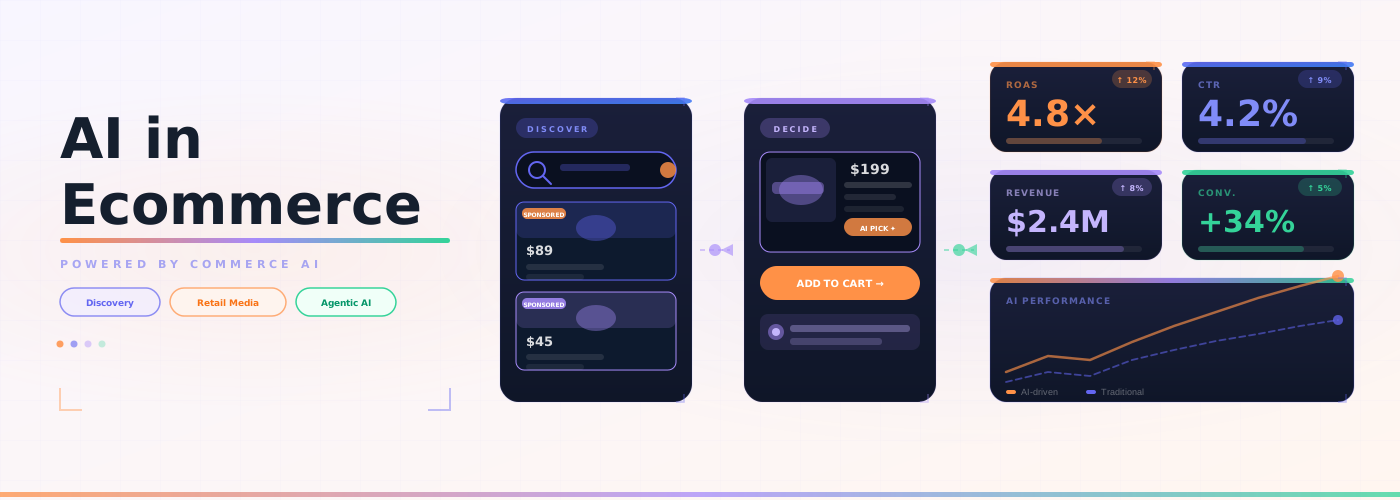
AI in ecommerce used to feel pretty simple. A retailer added a recommendation carousel, a chatbot, a personalized email, or a “you may also like” section, and that counted as using AI. That is no longer enough.
Shopping is starting to change at the discovery level. A shopper may not search for “coffee maker” anymore. They may ask an AI assistant to find a compact coffee maker under $150 for a small apartment. They may not browse a category page for dorm decor. They may ask for dorm essentials for a daughter who likes minimalist green design and needs everything delivered this week.
Those are not normal keyword searches. They are full shopping moments, with context, budget, preferences, timing, and intent all mixed together. For retailers, marketplaces, and commerce platforms, this creates a bigger challenge. The system needs to understand what the shopper means, know which products are available, decide which campaigns are relevant, connect advertiser demand, and measure whether the experience actually leads to growth.
That is where AI in ecommerce becomes more than a set of small tools.
At Topsort, we think this shift points to Commerce AI, an operating layer that connects ecommerce data, retail media, product discovery, campaign automation, advertiser demand, and measurement. It helps commerce companies move away from fragmented tools and toward smarter, more connected growth.
What Does AI in Ecommerce Mean Today?
AI in ecommerce usually refers to technologies that help online commerce companies improve the shopping journey or business operations.
Common examples include:
- Personalized product recommendations
- AI-powered search
- Chatbots and customer support automation
- Dynamic pricing
- Product feed optimization
- Demand forecasting
- Inventory planning
- Campaign optimization
- Automated reporting
- AI-assisted content generation
- Fraud detection
- Conversational shopping assistants
These use cases are valuable. But they are often treated separately.
One team may use AI for customer support. Another team may use AI for product recommendations. A marketing team may use AI for content. A retail media team may use AI for campaign optimization. A commerce team may use AI for search or merchandising.
The problem is that commerce does not work in isolated pieces.
A shopper’s product discovery journey connects search, product data, pricing, reviews, inventory, advertising, recommendations, checkout, and post-purchase signals. If AI only improves one piece of that journey, the full opportunity is limited.
That is why AI in ecommerce is evolving toward Commerce AI.
What Is Commerce AI?
Commerce AI is the application of AI across the systems that make commerce work: product discovery, retail media, marketplace monetization, campaign automation, measurement, and demand activation.
A simple definition:
Commerce AI is the AI-powered operating layer that helps retailers and marketplaces connect shopper intent, product data, advertising infrastructure, and commerce outcomes in real time.
This is different from using AI as a single feature.
Commerce AI is not just a recommendation model. It is not only a chatbot. It is not only campaign automation.
Commerce AI is the connective layer between:
- What shoppers want
- What products are available
- What advertisers want to promote
- What retailers need to monetize
- What marketplaces need to scale
- What AI systems need to understand
- What outcomes the business needs to measure
In other words, Commerce AI turns ecommerce AI from a set of isolated tools into a system for commerce growth.
Why AI in Ecommerce Is Entering a New Phase
For years, ecommerce AI was mostly associated with personalization and recommendations.
A shopper viewed a product. The site recommended similar products. A brand optimized a product feed. A retailer improved search relevance. A chatbot answered basic questions.
Those use cases still matter, but the market is moving quickly.
OpenAI has introduced Instant Checkout in ChatGPT, powered by the Agentic Commerce Protocol, starting with U.S. Etsy sellers and with Shopify merchants planned as an expansion. This is a sign that AI shopping experiences are moving closer to actual transaction flows.
Google introduced Universal Cart and agentic shopping capabilities at Google I/O 2026, including technology to support agents that can buy for users.
McKinsey describes agentic commerce as a shift where AI shopping agents can support product discovery, automation, and eventually more agent-mediated transactions.
Microsoft has described agentic commerce as a new front door to retail, where the shopper’s entry point becomes a conversation instead of only a homepage, category page, or search box.
The direction is clear: AI is not only helping ecommerce teams work faster. It is changing how commerce journeys are structured.
That matters for retail media because retail media depends on product discovery.
If shoppers discover products through AI assistants, conversational search, and agentic shopping experiences, then advertising infrastructure must also evolve.
From Ecommerce AI to Commerce AI
The phrase “AI in ecommerce” is broad. It can describe almost any AI use case inside online commerce.
Commerce AI is more specific.
It describes the infrastructure and intelligence needed to connect AI with the commercial systems that determine growth: product discovery, advertising, monetization, measurement, demand, and marketplace operations.
Here is the difference:
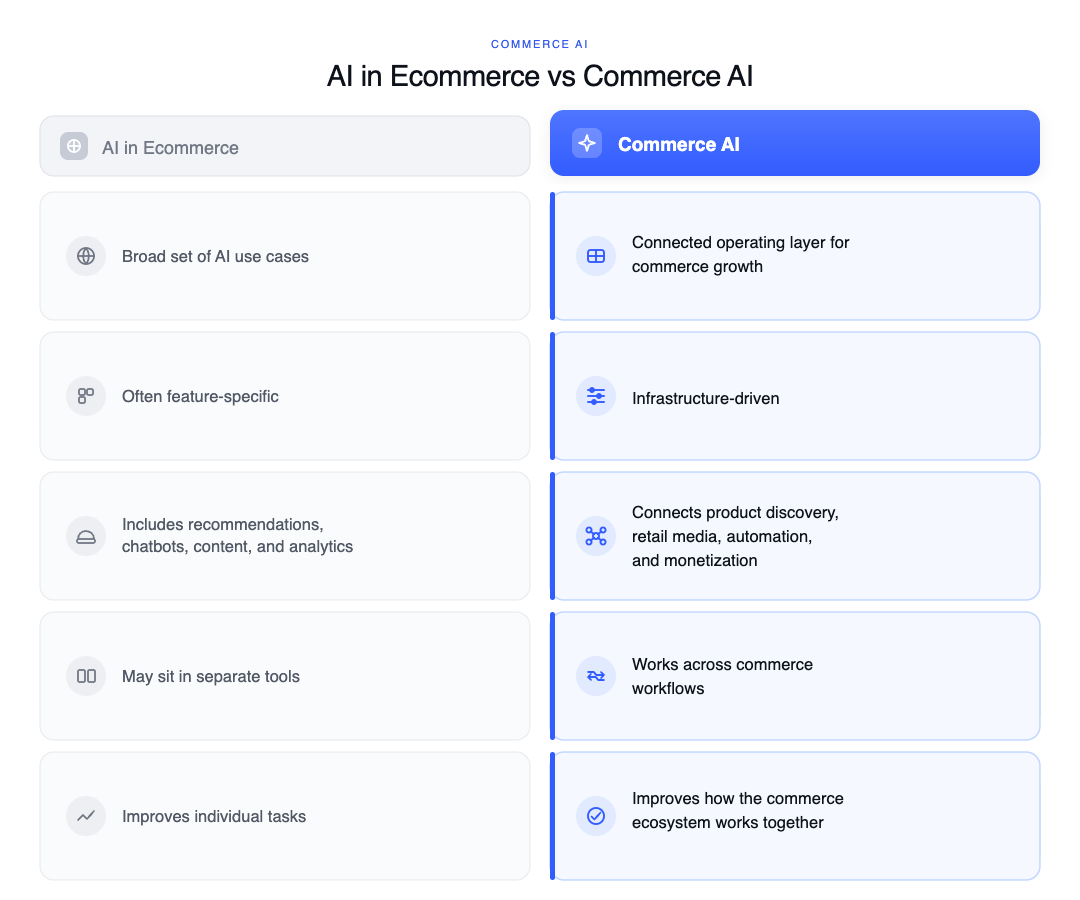
This distinction is important for retailers and marketplaces.
AI will not create business value just because it exists. It creates value when it is connected to the systems that drive revenue, relevance, and execution.
For commerce companies, that means AI must connect to product catalogs, search, ads, campaigns, budgets, sellers, brands, attribution, and demand.
How AI Is Changing Product Discovery
Product discovery used to be shaped mainly by search bars, category pages, filters, recommendation modules, and paid placements.
AI changes the discovery pattern.
Instead of typing a short keyword like “running shoes,” a shopper may ask:
“I need running shoes for marathon training, but I have narrow feet and want something lightweight.”
Instead of searching “coffee maker,” a shopper may ask: “What is the best compact coffee maker under $150 for a small apartment?”
Instead of searching “dorm decor,” a shopper may ask: “I’m shopping for back-to-school dorm accessories for my daughter. She likes green, minimalist design, and I need items that can arrive this week.”
These queries are not just keywords. They are expressions of intent.
They include category, context, budget, preferences, constraints, timing, and desired outcome.
For retail media, this creates a major shift.
The old model was built around matching keywords, placements, and bids. The new model needs to understand richer intent and respond with relevant, available, measurable, and monetizable product recommendations.
That requires AI. But it also requires infrastructure.
A commerce platform needs to know:
- Which products match the shopper’s intent
- Which products are in stock
- Which sellers or brands are eligible
- Which advertisers have active campaigns
- Which placements preserve shopper experience
- Which recommendation supports business goals
- Which action can be measured
This is why AI product discovery and retail media infrastructure are becoming more connected.
Why Retail Media Needs Commerce AI
Retail media has grown because retailers and marketplaces own high-intent shopping moments.
Brands want to reach shoppers close to purchase. Retailers want to monetize traffic. Marketplaces want to help sellers grow. Sponsored listings, native ads, and display placements help connect these interests.
But the next era of retail media will require more than ad placements.
Retailers are dealing with:
- More advertisers
- More products
- More sellers
- More campaign types
- More channels
- More reporting expectations
- More pressure to prove incrementality
- More demand for self-service tools
- More complexity across onsite and offsite media
At the same time, shoppers expect relevance, speed, and trust.
If retail media becomes too intrusive, shopper experience suffers. If it becomes too fragmented, advertisers lose confidence. If it becomes too manual, retailers cannot scale.
Commerce AI helps solve this by making retail media more intelligent and connected.
It can support:
- AI-assisted campaign creation
- Automated optimization
- Smarter auctions
- Better product relevance
- Real-time reporting
- Budget recommendations
- Self-service advertiser workflows
- AI-driven insights
- Connected onsite and offsite activation
- More adaptive product discovery
The goal is not to replace retail media teams. The goal is to help them scale with more precision.
Agentic Commerce Raises the Stakes
Agentic commerce refers to shopping experiences where AI agents help users discover, compare, select, and potentially purchase products.
This does not mean every shopper will immediately let an AI agent buy everything for them. Adoption will vary by category, country, trust level, and purchase complexity.
But even partial adoption matters.
If AI agents influence 10%, 15%, or 20% of product discovery journeys, that can change how brands compete for visibility and how retailers monetize demand.
Agentic commerce raises several strategic questions:
- Who controls the shopping interface?
- Who decides which products appear in AI-generated answers?
- How will sponsored products be surfaced in conversational journeys?
- How will retailers protect their own customer relationships?
- How will brands measure influence when there is no simple click path?
- How should product data be structured for AI comprehension?
Retailers and marketplaces need to prepare for these questions before AI-driven discovery becomes the default in their category.
Commerce AI is part of that preparation.
It gives commerce companies a way to connect product data, ads, demand, and measurement so they can participate in agentic discovery without losing control of their ecosystem.
What Retailers Need to Build for AI-Driven Commerce
Retailers do not need to chase every AI trend. But they do need to build the fundamentals.
1. Machine-readable product data
AI systems need clear, structured, accurate product information. Attributes, descriptions, dimensions, prices, availability, delivery windows, images, reviews, and category data all matter.
If AI cannot understand a product, it is less likely to recommend it well.
2. Connected advertising infrastructure
Retail media should not sit separately from search, recommendations, product data, and commerce analytics.
AI-driven retail media needs infrastructure that can connect campaigns, auctions, budgets, placements, attribution, and product relevance.
3. Self-service advertiser workflows
As retail media scales, advertisers need easier ways to launch and optimize campaigns.
AI can help generate campaign suggestions, recommend budgets, explain performance, and reduce manual setup.
4. Real-time optimization
AI in ecommerce becomes more powerful when it can respond to live signals: inventory, shopper intent, campaign performance, budget pacing, and conversion data.
5. Measurement beyond last click
AI-driven discovery may influence shoppers before a click happens. Retailers and advertisers will need better ways to measure assisted discovery, engagement, incrementality, and downstream commerce impact.
What Brands Need to Know About AI in Ecommerce
For brands, AI in ecommerce changes the rules of visibility.
In a traditional ecommerce journey, a brand might focus on search ranking, sponsored product bids, product detail page content, reviews, and promotions.
In an AI-driven journey, the brand also needs to be understandable to AI systems.
That means brands should invest in:
- Complete product attributes
- Clear product descriptions
- Strong product images
- Accurate availability data
- High-quality reviews
- Retail media campaigns connected to commerce outcomes
- Measurement that captures influence across the journey
The question is no longer only:
“How do we rank for this keyword?”
The question becomes:
“How do we make sure our product is understood, considered, and recommended when an AI system interprets shopper intent?”
That is a major shift.
How Commerce AI Helps Reduce Complexity
One of the biggest problems in ecommerce and retail media is tool fragmentation.
Retailers often have different systems for media, merchandising, reporting, demand, campaign management, and seller operations. Brands may have separate workflows for each retailer, each channel, and each measurement standard.
AI can make this worse if it becomes another disconnected layer.
Commerce AI should do the opposite.
It should reduce complexity by connecting the systems that already matter.
A strong Commerce AI layer can help teams:
- See clearer signals
- Act faster
- Automate repetitive work
- Improve campaign performance
- Make retail media easier to buy
- Improve shopper relevance
- Connect media performance with commerce outcomes
The best use of AI in ecommerce is not more dashboards. It is clearer decisions and faster execution.
AI in Ecommerce Needs Commerce Infrastructure
The future of AI in ecommerce will not be defined only by who has the best chatbot.
It will be defined by who has the infrastructure to connect intelligence with action.
AI shopping assistants may become the interface. But underneath that interface, commerce companies still need product data, campaign logic, auctions, budget pacing, advertiser workflows, reporting, attribution, and demand access.
That is why Commerce AI matters.
It brings AI closer to the systems that actually power commerce growth.
For retailers and marketplaces, this means the next generation of retail media must be more self-service, more automated, more connected, and more intelligent. It must support the realities of onsite, offsite, and agentic commerce. It must help advertisers activate demand more easily while helping retailers preserve control, transparency, and shopper trust.
AI in ecommerce is no longer just about making shopping more personalized.
It is about building the operating layer for the next era of commerce.
FAQ
What is AI in ecommerce?
AI in ecommerce refers to the use of artificial intelligence to improve online shopping, product discovery, campaign optimization, operations, customer support, pricing, recommendations, and measurement.
What is Commerce AI?
Commerce AI is the AI-powered operating layer that connects ecommerce data, retail media, product discovery, campaign automation, advertiser demand, and marketplace monetization.
How is Commerce AI different from AI in ecommerce?
AI in ecommerce is a broad term for many AI use cases. Commerce AI is more specific: it focuses on connecting AI with the infrastructure that drives commerce growth, including retail media, product discovery, ads, attribution, and demand activation.
How does AI affect retail media?
AI affects retail media by changing how shoppers discover products, how campaigns are optimized, how advertisers launch and measure campaigns, and how retailers connect ads with commerce outcomes.
What is agentic commerce?
Agentic commerce is a shopping experience where AI agents help users discover, compare, decide, and potentially purchase products through conversational or automated interactions.
Why does agentic commerce matter for retailers?
Agentic commerce matters because it may shift product discovery away from traditional search and category pages toward AI-powered conversations. Retailers need infrastructure that can make their products, ads, and data ready for those experiences.
How can brands prepare for AI shopping agents?
Brands should improve product data quality, make product attributes clear, invest in strong retail media campaigns, monitor AI-driven discovery, and measure influence beyond last-click conversions.
Why does AI in ecommerce need infrastructure?
AI can only act effectively when it connects to real commerce systems: product catalogs, inventory, pricing, campaigns, auctions, budgets, attribution, and demand. Without infrastructure, AI becomes a disconnected interface rather than a growth engine.
.png)
.png)