




Onsite vs Offsite Retail Media: What’s the Difference and When to Use Each?
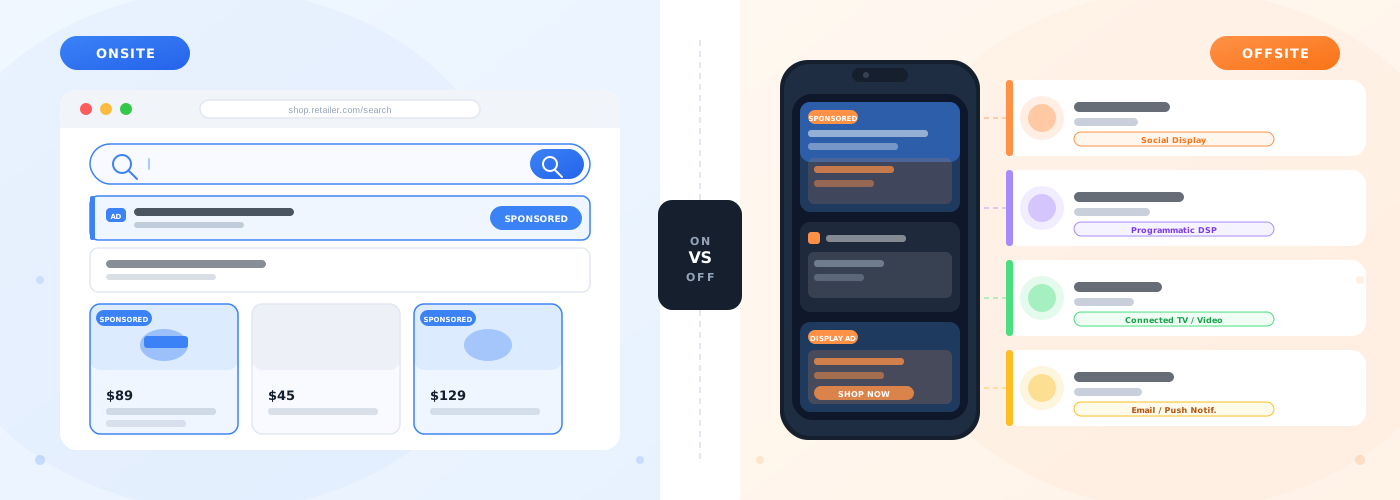
Retail media is no longer limited to sponsored products on a retailer’s website.
As retail media networks mature, advertisers are asking for more ways to reach shoppers across the full journey: while they search, browse, compare, buy, and continue engaging beyond the retailer’s owned properties.
That is why the difference between onsite retail media and offsite retail media matters.
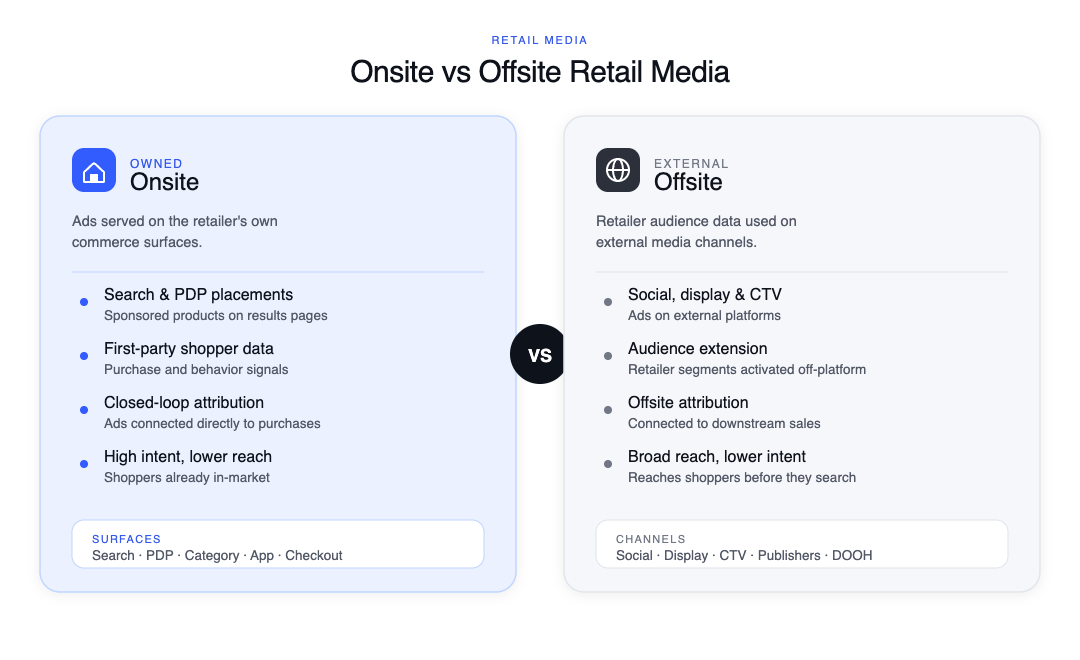
Onsite retail media helps brands reach shoppers inside a retailer’s owned commerce environment. Offsite retail media helps brands reach retailer audiences across external channels such as the open web, connected TV, social platforms, display networks, and other media environments.
Both can be valuable. But they serve different goals, require different infrastructure, and need different measurement approaches.
At Topsort, we see the strongest retail media strategies connecting onsite and offsite media through the same foundation: commerce data, ad serving, attribution, reporting, and optimization. Retail media works best when it is not treated as separate ad placements, but as a measurable commerce media system.
What is onsite retail media?
Onsite retail media refers to ads that appear within a retailer’s or marketplace’s owned digital properties.
These can include:
- Search results pages
- Category pages
- Product detail pages
- Homepage placements
- Cart or checkout pages
- App placements
- Recommendation modules
- Sponsored listings
- Sponsored products
- Sponsored brand placements
- Native display units
In simple terms, onsite retail media reaches shoppers while they are actively browsing or buying within a commerce environment.
Because onsite ads appear close to the point of purchase, they are often highly performance-oriented. They can help brands increase product visibility, influence purchase decisions, and connect ad engagement to sales.
What is offsite retail media?
Offsite retail media refers to ads that use a retailer’s first-party commerce data or audiences to reach shoppers outside the retailer’s owned properties.
Offsite retail media can include:
- Programmatic display
- Connected TV
- Social media campaigns
- Retailer audience extension
- Shoppable media
- Offsite video
- Digital out-of-home
- Publisher partnerships
- Open web campaigns
In simple terms, offsite retail media extends retail media beyond the retailer’s website or app.
Instead of only reaching shoppers when they are already on the commerce platform, offsite media helps brands reach relevant audiences earlier in the journey or across other channels.
Onsite vs offsite retail media: the key difference
The main difference between onsite and offsite retail media is where the ad appears.
Onsite retail media appears inside the retailer’s owned commerce environment. Offsite retail media appears outside the retailer’s owned environment, often using retailer data or commerce signals to target and measure campaigns.
Onsite is usually closer to purchase intent. Offsite is usually better for reach, awareness, retargeting, and full-funnel engagement.
A simple way to think about it:
- Onsite retail media captures demand.
- Offsite retail media can create, extend, or re-engage demand.
Both matter, but they should not be measured in exactly the same way.
Why onsite retail media matters
Onsite retail media is often the foundation of a retail media program.
It is valuable because shoppers are already in a commerce context. They are searching, comparing, filtering, browsing, or preparing to buy.
For retailers and marketplaces, onsite retail media can monetize high-intent moments without sending shoppers away from the platform.
For brands, onsite retail media can help:
- Increase product visibility
- Win share in search results
- Promote new products
- Defend category position
- Drive sales near the point of purchase
- Improve sponsored product performance
- Measure ad impact with commerce data
Onsite retail media is especially powerful for lower-funnel performance because it happens close to the transaction.
Common onsite retail media formats
The most common onsite retail media formats include:
Sponsored products
Sponsored products promote specific products in search results, category pages, or product discovery surfaces.
Sponsored listings
Sponsored listings are especially common in marketplaces, delivery apps, travel platforms, real estate platforms, service marketplaces, and product marketplaces.
Display ads
Display placements can appear on homepage, category, product detail, cart, or app surfaces.
Sponsored brands
Sponsored brand placements help advertisers promote a brand, product line, or campaign message inside the retailer’s environment.
Native placements
Native placements are designed to fit naturally into the commerce experience without disrupting shoppers.
At Topsort, we believe onsite formats should be built around relevance. The best onsite retail media systems do not simply show the highest bidder. They balance bids, product relevance, budgets, eligibility, shopper experience, and measurable outcomes.
Why offsite retail media matters
Offsite retail media helps retailers and brands move beyond owned commerce surfaces.
This matters because shoppers do not make every decision on one website or app. They discover products across social media, publisher content, video, connected TV, search engines, email, and other digital environments.
Offsite retail media can help brands:
- Reach retailer audiences outside the retailer’s site
- Build awareness before shoppers enter the store or app
- Retarget shoppers who browsed but did not purchase
- Support product launches
- Extend seasonal campaigns
- Drive upper-funnel and mid-funnel engagement
- Connect media investment to commerce outcomes
For retailers, offsite retail media can expand monetization opportunities beyond limited onsite inventory.
Common offsite retail media formats
Offsite retail media can include:
Audience extension
Retailers use first-party audience data to help brands reach relevant shoppers outside owned properties.
Programmatic display
Brands run display ads across external sites using commerce signals or retailer audience segments.
Connected TV
Retailers and brands use commerce data to support video campaigns across CTV environments.
Social campaigns
Retailer data or commerce insights can help brands reach audiences on social platforms.
Shoppable media
Ads appear in external environments but connect back to product discovery or purchase.
Offsite retargeting
Brands re-engage shoppers who viewed products, categories, or carts but did not buy.
Offsite retail media works best when it is connected back to commerce outcomes. Without measurement, offsite campaigns can become hard to evaluate.
When should brands use onsite retail media?
Brands should prioritize onsite retail media when the goal is to influence shoppers close to purchase.
Onsite retail media is especially useful for:
- Driving product sales
- Increasing product visibility
- Promoting specific SKUs
- Winning search and category placement
- Defending share against competitors
- Improving conversion
- Supporting marketplace sellers
- Launching performance-focused campaigns
If the advertiser’s main question is “How do we drive measurable sales inside this commerce platform?”, onsite retail media is usually the first place to start.
When should brands use offsite retail media?
Brands should use offsite retail media when they want to reach shoppers beyond the retailer’s owned surfaces.
Offsite retail media is especially useful for:
- Brand awareness
- Audience extension
- Retargeting
- Product launches
- Full-funnel campaigns
- Seasonal campaigns
- Driving traffic back to commerce pages
- Supporting campaigns when onsite inventory is limited
If the advertiser’s main question is “How do we reach relevant retail audiences across more touchpoints?”, offsite retail media can help.
Onsite vs offsite measurement
Measurement is one of the most important differences between onsite and offsite retail media.
Onsite campaigns are often easier to connect to commerce outcomes because the retailer controls the environment. Impressions, clicks, product views, add-to-cart events, and purchases can happen within the same system.
Offsite campaigns require more complex measurement because the ad exposure happens outside the retailer’s owned environment. Retailers need reliable ways to connect audience exposure, campaign activity, and downstream commerce outcomes.
Important measurement metrics can include:
- Impressions
- Clicks
- CTR
- Product views
- Add-to-cart events
- Attributed sales
- ROAS
- Conversion rate
- Incremental revenue
- New-to-brand customers
- Basket impact
- Store or omnichannel sales where available
The key is transparency. Advertisers need to understand what was measured, how attribution was calculated, and whether results show attributed activity or incremental impact.
Why onsite and offsite need shared infrastructure
Retailers sometimes treat onsite and offsite media as separate businesses. But advertisers increasingly want a connected view of performance.
They want to know:
- Which channels drove awareness?
- Which placements drove consideration?
- Which ads influenced purchase?
- Which campaigns created incremental value?
- Which products or categories performed best?
- How should budget shift next?
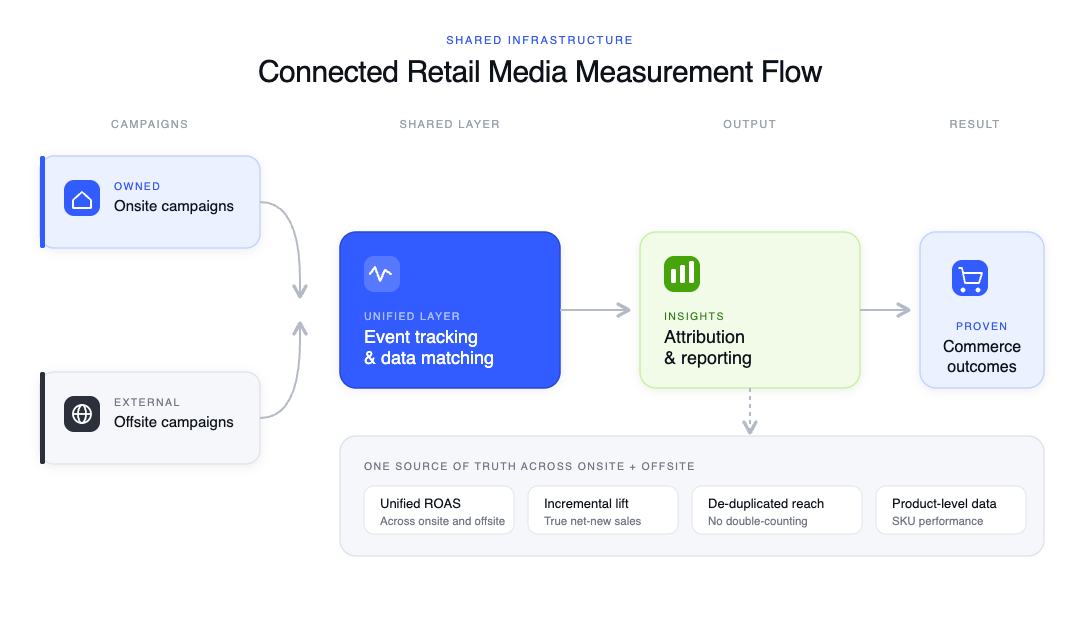
This requires infrastructure that connects ad serving, event tracking, attribution, reporting, and optimization.
At Topsort, our POV is that retail media should be built as commerce-native infrastructure, not as disconnected media placements. Whether a campaign is onsite or offsite, the value comes from connecting ads to commerce outcomes that brands can trust.
How retailers should choose between onsite and offsite
Retailers and marketplaces should not think of onsite and offsite as competing options. They should think of them as different parts of the same retail media strategy.
A practical approach:
- Start with onsite sponsored products or sponsored listings.
- Build reliable attribution and reporting.
- Add display or brand placements.
- Expand into offsite once measurement and audience strategy are clear.
- Connect onsite and offsite reporting into one advertiser experience.
This approach helps retailers build trust before expanding complexity.
How Topsort helps
Topsort helps retailers, marketplaces, delivery apps, travel platforms, and commerce businesses build measurable retail media programs with API-first infrastructure.
Topsort supports commerce-native ad serving, sponsored listings, auctions, attribution, reporting, and AI optimization. This helps platforms connect advertising activity to product-level, campaign-level, and revenue outcomes.
For retailers and marketplaces building onsite and offsite retail media strategies, the goal is not only to launch more ad formats. The goal is to build a trusted media business where advertisers can understand performance and scale investment.
Final takeaway
Onsite and offsite retail media both matter, but they play different roles.
Onsite retail media reaches shoppers inside owned commerce environments, often close to purchase. Offsite retail media extends retailer audiences across external channels, supporting reach, awareness, retargeting, and full-funnel engagement.
The best retail media strategies connect both through shared measurement, attribution, reporting, and optimization.
Retailers that can connect onsite and offsite campaigns to real commerce outcomes will be better positioned to win advertiser trust and grow long-term retail media revenue.
FAQ
What is onsite retail media?
Onsite retail media refers to ads that appear within a retailer’s or marketplace’s owned digital properties, such as search results, product pages, category pages, apps, and checkout surfaces.
What is offsite retail media?
Offsite retail media refers to ads that use retailer data or commerce signals to reach shoppers outside the retailer’s owned properties, such as programmatic display, connected TV, social, or publisher environments.
What is the difference between onsite and offsite retail media?
Onsite retail media appears inside the retailer’s owned commerce environment. Offsite retail media appears outside the retailer’s owned environment, often using retailer audiences or commerce data.
When should brands use onsite retail media?
Brands should use onsite retail media when they want to influence shoppers close to purchase, promote products, improve visibility, and drive measurable sales.
When should brands use offsite retail media?
Brands should use offsite retail media when they want to extend reach, build awareness, retarget shoppers, support full-funnel campaigns, or reach retailer audiences across external channels.
How should retailers measure onsite and offsite retail media?
Retailers should measure impressions, clicks, attributed sales, ROAS, conversion rate, incremental revenue, new-to-brand customers, basket impact, and other commerce outcomes where available.