
Marketplace Monetization: How to Turn Marketplace Traffic Into Ad Revenue
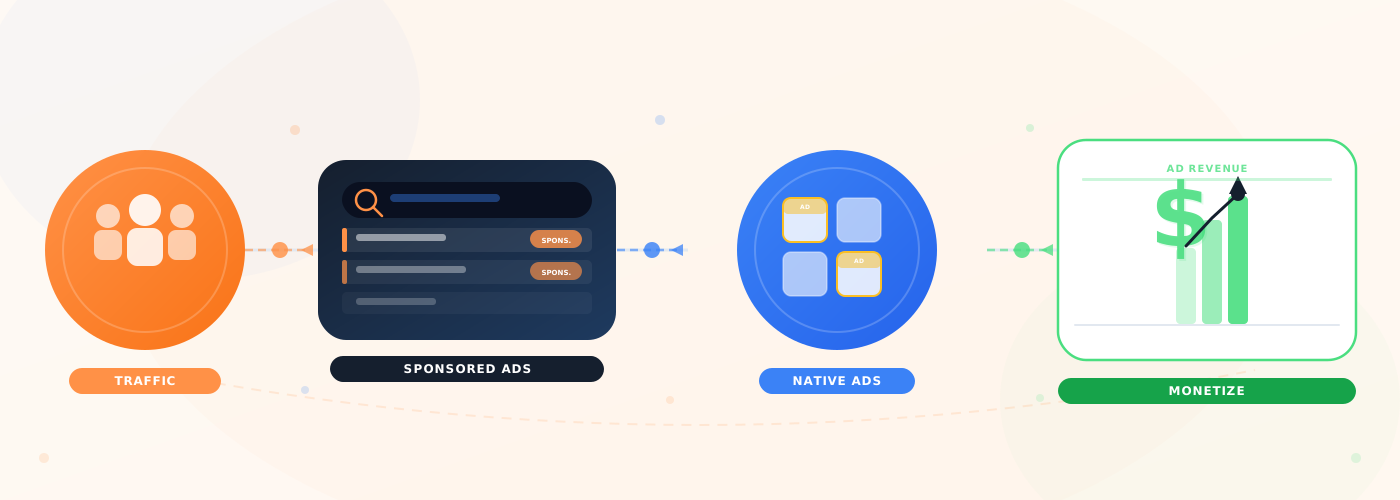
Marketplaces already have many of the ingredients needed to build a valuable advertising business.
They have shoppers actively searching for products. They have sellers competing for visibility. They have first-party data about browsing, purchasing, and product performance. Most importantly, they control the digital environment where buying decisions happen.
Marketplace monetization is the process of turning those assets into sustainable revenue without making the shopping experience worse.
For many marketplaces, the most scalable opportunity is advertising. Sponsored listings, display placements, sponsored brands, and offsite campaigns allow sellers and brands to reach shoppers closer to the point of purchase.
But launching ads is not as simple as placing promoted products at the top of a page. A successful marketplace advertising business requires relevant placements, fair auctions, advertiser tools, reliable measurement, and infrastructure that can grow with the marketplace.
What is marketplace monetization?
Marketplace monetization is the process of generating revenue from the traffic, transactions, sellers, products, and first-party data within a marketplace.
A marketplace may generate revenue through transaction fees, subscriptions, fulfillment services, financial products, or seller tools. Advertising adds another revenue stream by allowing sellers and brands to pay for greater visibility and access to high-intent shoppers.
In marketplace advertising, monetization can include:
- Sponsored product listings
- Display and native advertising
- Sponsored brand placements
- Offsite advertising
- Sponsored recommendations
- Seller-funded promotions
The strongest models create value for all three sides of the marketplace.
Advertisers gain access to shoppers with active purchase intent. The marketplace creates incremental revenue. Shoppers discover relevant products that match what they are already looking for.
Why is marketplace traffic so valuable?
Marketplace traffic is different from general web traffic.
A person reading an article or browsing social media may not be planning to purchase anything. A shopper searching for “running shoes,” visiting a product category, or comparing similar items on a marketplace is much closer to making a decision.
This high level of commercial intent makes marketplace traffic valuable to sellers and brands.
Marketplaces also understand the context around the shopping journey. Depending on their data and consent framework, they may know:
- What the shopper searched for
- Which categories and products they viewed
- What they added to their cart
- What they previously purchased
- Which products are available
- Which sellers can fulfill the order
- Which advertising interactions resulted in a sale
This gives marketplace advertising an important advantage. Ads can be shown within the shopping experience and measured against actual commerce outcomes.
The goal is not simply to sell impressions. It is to help advertisers influence product discovery and sales when shoppers are already considering a purchase.
Five ways to monetize marketplace traffic
There is no single advertising format that works for every marketplace.
The right starting point depends on the marketplace’s traffic, product catalog, seller base, user experience, and commercial goals. Most marketplace advertising businesses develop through a combination of the following formats.
1. Sponsored listings
Sponsored listings are promoted products that appear within search results, category pages, browse experiences, or other product feeds.
They usually match the appearance of organic listings but are clearly labeled as sponsored.
For many marketplaces, sponsored listings are the most natural place to begin because they fit directly into existing product discovery behavior. A seller pays to improve the visibility of an eligible product when it is relevant to the shopper’s search or browsing context.
Sponsored listings can help marketplaces:
- Create advertising revenue from existing search and browse traffic
- Give sellers a measurable way to increase product visibility
- Connect ad spend directly to clicks, orders, and sales
- Launch advertising without redesigning the entire shopper experience
The key is relevance. A promoted product should still be appropriate for the shopper’s query, category, and intent.
Learn more about sponsored listings for marketplaces.
2. Display and native advertising
Display ads give brands additional ways to reach shoppers beyond individual product listings.
These placements may appear on:
- Marketplace homepages
- Category pages
- Search result pages
- Product detail pages
- Checkout or post-purchase experiences
- Mobile apps
Native placements follow the design and structure of the surrounding marketplace experience. Traditional display ads may use banners, images, or rich media.
Display advertising can be especially useful for brands that want to build awareness, promote a launch, or reach shoppers across a broader category.
However, marketplaces need to manage frequency, placement quality, page performance, and shopper experience carefully. Adding more ad inventory does not automatically create more value.
3. Sponsored brands
Sponsored brand placements allow advertisers to promote a brand, seller storefront, collection, or group of products rather than a single listing.
A sponsored brand unit might include:
- A brand logo
- A short message
- Several products
- A link to a seller page or branded collection
- A promotional image or video
These placements help advertisers tell a broader story and are particularly useful in categories where shoppers compare multiple brands before choosing a product.
They can also give marketplaces a higher-value advertising product for larger sellers and established brands.
4. Offsite advertising
A marketplace’s advertising business does not need to end on its own website or app.
With appropriate data controls and advertising partnerships, marketplaces can help sellers and brands reach relevant audiences across external channels. These may include publisher inventory, connected television, social platforms, or other digital environments.
Offsite advertising allows marketplaces to extend their first-party commerce insights beyond their owned properties.
It can help advertisers:
- Re-engage previous shoppers
- Reach new audiences
- Promote products outside the marketplace
- Connect offsite exposure with marketplace sales
- Run broader full-funnel campaigns
Offsite media is generally more complex than onsite sponsored listings. It requires audience activation, identity and privacy controls, external media access, and closed-loop measurement.
For this reason, many marketplaces begin with onsite advertising before expanding offsite.
5. AI shopping and sponsored recommendations
As AI-powered shopping experiences become more common, product discovery may move beyond traditional keyword search and category navigation.
Shoppers may ask conversational questions, compare options through an assistant, or receive personalized product recommendations based on their goals.
This creates new opportunities for sponsored discovery.
A marketplace might allow eligible sponsored products to appear within:
- Conversational shopping results
- Personalized recommendation feeds
- Product comparison tools
- AI-generated shopping guides
- Complementary product suggestions
The same principle should still apply. Commercial participation should not override relevance.
A sponsored recommendation should be clearly identified and should only appear when it is useful to the shopper. Marketplaces will need systems that can balance advertiser demand, product relevance, shopper context, and commercial value in real time.
How do sponsored product auctions work?
Most scalable sponsored product programs use an auction to determine which eligible ads appear and how much advertisers pay.
When a shopper visits a search, category, or product page, the marketplace sends information about the available placement and eligible products to an auction system.
The system then evaluates factors such as:
- Advertiser bid
- Product relevance
- Predicted click-through rate
- Predicted conversion rate
- Product availability
- Campaign budget
- Targeting rules
- Marketplace policies
The highest bid should not automatically win.
A high bid for an irrelevant or unavailable product may create short-term advertising revenue but damage shopper trust and long-term marketplace performance.
Modern auction systems therefore combine commercial signals with quality and relevance signals. The objective is to select an ad that creates value for the advertiser, marketplace, and shopper.
This is one reason marketplaces need more than a basic ad-serving tool. They need commerce-aware infrastructure that understands products, sellers, budgets, auctions, and transaction outcomes.
For a more technical explanation, read Topsort’s ad server API integration guide for marketplaces.
How can marketplaces protect organic relevance?
One of the biggest concerns when introducing advertising is that paid products will displace better organic results.
If shoppers begin seeing irrelevant or low-quality sponsored products, they may lose confidence in search and recommendations. Conversion can decline even as short-term advertising revenue increases.
Marketplaces can protect organic relevance by establishing clear rules for ad eligibility and ranking.
These may include:
- Minimum relevance thresholds
- Product availability requirements
- Quality score requirements
- Limits on the number of ads per page
- Separate rules by placement
- Clear sponsored labels
- Frequency controls
- Category and keyword restrictions
Marketplaces should also measure more than ad revenue.
Important guardrail metrics can include:
- Organic click-through rate
- Overall conversion rate
- Search abandonment
- Product engagement
- Repeat visits
- Customer satisfaction
- Organic product displacement
A/B testing is especially valuable here. Marketplaces can test changes to ad density, ranking logic, relevance thresholds, or placement design on a controlled portion of traffic before rolling them out more broadly.
The best monetization strategy is not the one that puts the most ads on a page. It is the one that grows advertising revenue without weakening the marketplace’s core shopping experience.
What infrastructure does a marketplace need?
A sustainable marketplace advertising business requires several connected capabilities.
Auction and ad-serving infrastructure
The marketplace needs a system that can receive advertising opportunities, identify eligible campaigns, run an auction, and return the winning products or creatives quickly.
The system must support the marketplace’s product catalog, placements, sellers, and business rules.
Campaign management
Advertisers need a way to create campaigns, select products, set budgets, define targeting, and monitor performance.
This may be provided through a self-service interface, managed-service workflow, API, or a combination of all three.
Budget pacing and optimization
Campaign budgets need to be distributed across the selected period.
An effective bidding system must avoid spending the entire budget too early while also reducing unnecessary underspend. It may adjust bids and auction participation based on campaign performance, available opportunities, and advertiser goals.
Reporting and attribution
Advertisers need to understand what happened after their ads were shown.
Reporting may include:
- Impressions
- Clicks
- Advertising spend
- Orders
- Attributed sales
- Conversion rate
- Cost per click
- ROAS
- New-to-brand customers
- Incremental sales
The marketplace must also define its attribution methodology clearly. This includes attribution windows, click-through spend
- Orders
- Attributed sales
- Conversion rate
- Cost per click
- ROAS
- New-to-brand customers
- Incremental sales
The and view-through rules, deduplication, and how orders are connected to advertising interactions.
Billing and financial operations
As the advertising business grows, the marketplace needs reliable processes for invoicing, advertiser balances, campaign charges, refunds, taxes, and revenue reconciliation.
APIs and marketplace integrations
Advertising cannot operate as a completely separate system.
The infrastructure needs to connect with product catalogs, seller accounts, inventory, orders, search experiences, analytics, and marketplace applications.
Explore how Topsort supports marketplace monetization and retail media infrastructure.
How should a marketplace onboard sellers and advertisers?
Technology alone will not create an active advertising marketplace.
Sellers need to understand why they should advertise, how to launch a campaign, and how to measure success.
A marketplace can begin by segmenting its advertiser base.
Smaller sellers
Smaller sellers generally need a simple self-service experience.
Useful features include:
- Recommended products
- Suggested budgets
- Automatic bidding
- Simple campaign objectives
- Clear performance reporting
- Low minimum spend requirements
Larger sellers and brands
Larger advertisers may require more control and support.
They may expect:
- Campaign APIs
- Custom targeting
- Multiple advertising formats
- Account-level reporting
- Agency access
- Billing controls
- Managed-service support
- Incrementality measurement
Education also matters.
Marketplaces can support adoption through launch webinars, seller newsletters, campaign recommendations, promotional credits, case studies, and in-product guidance.
The objective is to make advertising feel like a natural seller growth tool rather than an additional operational burden.
How should marketplace ad revenue be measured?
Advertising revenue is an important metric, but it should not be evaluated on its own.
A marketplace should track the overall health of the advertising business.
Important marketplace-level metrics include:
- Total advertising revenue
- Ad revenue as a percentage of marketplace revenue
- Advertising revenue per active seller
- Advertiser adoption
- Repeat advertiser rate
- Budget utilization
- Fill rate
- Cost per click
- Average ROAS
- Incremental sales
- Organic displacement
- Shopper conversion
ROAS shows how much attributed sales value an advertiser generates for each dollar spent. It is useful for understanding campaign efficiency, but it does not prove that all attributed sales were caused by the advertising.
Incrementality asks a different question.
Would the purchase have happened without the ad?
As a marketplace advertising program matures, controlled experiments can help distinguish attributed sales from truly incremental outcomes. This gives advertisers stronger evidence of value and helps the marketplace improve its ranking and bidding systems.
Should a marketplace build its own advertising platform?
Some marketplaces consider building advertising infrastructure internally.
This can offer complete control over product design, data flows, auction rules, and integrations. For companies with large engineering teams and highly specialized requirements, internal development may make sense.
However, the scope is often larger than expected.
A marketplace may need to build and maintain:
- Real-time auctions
- Campaign management
- Seller interfaces
- Budget pacing
- Bidding algorithms
- Attribution
- Reporting
- Billing
- Experimentation
- Fraud prevention
- APIs
- Privacy and access controls
The engineering work also continues after launch. Advertising systems require ongoing optimization, feature development, model improvements, monitoring, and operational support.
Using retail media infrastructure allows the marketplace to maintain control over its customer experience, product catalog, advertiser relationships, and business rules without building every advertising component from the ground up.
The decision is not simply build versus buy.
It is deciding which capabilities are strategic for the marketplace to own and which infrastructure can be provided by a specialized technology partner.
See how different options compare in our guide to the best retail media platforms.
How Topsort supports marketplace monetization
Topsort helps marketplaces launch and scale advertising businesses across sponsored listings, native ads, display, and other commerce media placements.
The infrastructure connects real-time auctions, campaign management, bidding optimization, reporting, attribution, and advertiser workflows.
Marketplaces maintain control over:
- Advertising placements
- Product eligibility
- Relevance rules
- Auction configuration
- Seller and advertiser access
- First-party data
- Reporting experiences
- Shopper-facing design
This allows a marketplace to introduce monetization within its existing shopping experience rather than forcing its products, sellers, and workflows into a publisher-focused advertising model.
As the program grows, marketplaces can expand from initial sponsored listing placements into broader onsite and offsite commerce media opportunities.
Poshmark shows how this model can work in practice. By building a seller advertising experience around sponsored listings, real-time reporting, and automated bidding, the marketplace supported more than 1,000 sellers and reported a 43% increase in seller sales. Read now.
Turning traffic into a sustainable advertising business
Marketplace monetization begins with a valuable asset that many platforms already have: shoppers with active purchase intent.
But traffic alone does not create a successful advertising business.
Marketplaces need advertising formats that fit naturally into product discovery, auction systems that balance bids with relevance, tools that make participation easy for sellers, and measurement that proves value to advertisers.
The goal is not to place an ad wherever there is available space.
It is to build a system where advertisers can grow, shoppers can discover relevant products, and the marketplace can create a durable new revenue stream.
When those interests are aligned, marketplace traffic becomes more than an audience.
It becomes the foundation of a scalable commerce media business.
Frequently asked questions
What is marketplace monetization?
Marketplace monetization is the process of generating revenue from a marketplace’s traffic, transactions, sellers, products, and data. Advertising is one monetization method and may include sponsored listings, display ads, sponsored brands, and offsite campaigns.
How can I monetize marketplace traffic?
A marketplace can monetize traffic by introducing relevant advertising products such as sponsored listings, native ads, sponsored brand placements, offsite media, and sponsored recommendations. Sponsored listings are often the simplest starting point for product-based marketplaces.
What are sponsored listings?
Sponsored listings are promoted products that appear within search results, category pages, or other product discovery experiences. Sellers or brands pay to increase product visibility, while the marketplace uses relevance and auction rules to decide which ads appear.
How do marketplaces make money from advertising?
Marketplaces may charge advertisers based on clicks, impressions, or campaign outcomes. Advertising revenue is generated when sellers and brands pay to reach shoppers across marketplace-owned or external media placements.
Does marketplace advertising hurt organic search results?
It can if ads are poorly controlled. Relevance thresholds, placement limits, quality rules, clear labeling, and A/B testing help marketplaces introduce advertising while protecting organic discovery and shopper experience.
Should a marketplace build its own ad platform?
Building internally provides control but requires significant engineering and operational investment. Many marketplaces use specialized retail media infrastructure while retaining control over their data, placements, auction rules, and advertiser relationships.
.png)
.png)