
How to Prove Retail Media ROI to Brands
Retail media has become one of the fastest-growing opportunities for retailers, marketplaces, delivery apps, and commerce platforms. It gives commerce businesses a new revenue stream and gives brands access to high-intent shoppers close to the point of purchase.
But as brand investment grows, expectations are changing.
Brands no longer want to know only how many impressions or clicks a campaign received. They want to know whether retail media is creating real business value.
They are asking questions like:
- Did the campaign drive sales?
- Did it increase new customers?
- Did it grow category share?
- Did it create incremental revenue?
- Was the return strong enough to justify more budget?
In other words, brands want proof of ROI.
For retail media networks, proving ROI is now a competitive advantage. The platforms that can clearly connect ads to commerce outcomes will be better positioned to win budgets, retain advertisers, and scale long-term media revenue.
What does retail media ROI mean?
Retail media ROI measures the business return a brand receives from its retail media investment.
At a basic level, ROI compares the value generated by a campaign with the cost of running that campaign.
In retail media, ROI can include:
- Attributed sales
- Incremental revenue
- Return on ad spend
- New customer acquisition
- Repeat purchase behavior
- Basket growth
- Category share growth
- Product discovery
- In-store or omnichannel sales impact
The most common metric brands use is ROAS, or return on ad spend.
ROAS = attributed revenue / ad spend
For example, if a brand spends $20,000 on a campaign and the platform attributes $160,000 in sales, the campaign has an 8x ROAS.
ROAS is useful, but it is not the full picture. A strong retail media ROI story should go beyond attributed revenue and show whether campaigns created measurable business impact.
Why proving ROI matters for retail media networks
Retail media networks compete for brand budgets against search, social, marketplaces, programmatic, CTV, and other retail media platforms.
Brands have many options. They need to know where their next dollar will create the most value.
If a retailer or marketplace cannot prove ROI clearly, brands may hesitate to increase spend. They may run short-term tests but avoid long-term commitments. They may compare the network unfavorably with platforms that provide stronger reporting and measurement.
Proving ROI helps retail media networks:
- Increase advertiser trust
- Win larger budgets
- Improve advertiser retention
- Justify premium placements
- Support annual planning conversations
- Show value beyond impressions and clicks
- Differentiate from less transparent media networks
For brands, ROI proof creates confidence. For retail media networks, it creates growth.
Start with the brand’s business goal
The first step in proving ROI is understanding what the brand actually wants to achieve.
Not every campaign should be measured the same way.
A brand launching a new product may care about awareness, product discovery, and new-to-brand customers. A mature brand defending category share may care about incremental revenue and competitor conquesting. A seller on a marketplace may care about immediate sales and product-level ROAS.
Before launching a campaign, retail media teams should align with the brand on the primary objective.
Common brand goals include:
- Drive sales for a specific product
- Increase category share
- Launch a new product
- Grow new-to-brand customers
- Improve repeat purchase rate
- Increase basket size
- Promote seasonal products
- Defend branded search terms
- Conquest competitor demand
- Drive online and in-store sales
Once the goal is clear, the measurement strategy becomes much stronger.
Use the right ROI metrics
Retail media ROI should not depend on one metric alone. Brands need a balanced view of performance.
Here are the most important metrics to include.
Attributed revenue
Attributed revenue shows how much sales revenue was connected to a campaign within the attribution window.
This is one of the most familiar retail media metrics and is useful for day-to-day reporting.
ROAS
ROAS shows how much attributed revenue was generated for each dollar of ad spend.
It is useful for comparing campaign efficiency across products, placements, or sellers.
Incremental revenue
Incremental revenue estimates how much additional revenue was caused by the campaign, beyond what would have happened without advertising.
This is one of the strongest ways to prove true ROI.
Incremental ROAS
Incremental ROAS measures incremental revenue divided by ad spend.
Incremental ROAS = incremental revenue / ad spend
This helps brands understand whether retail media is creating real business growth, not just receiving credit for existing demand.
Conversion lift
Conversion lift compares the conversion rate of an exposed group with a comparable control group.
It helps show whether advertising changed shopper behavior.
New-to-brand or new-to-seller customers
For many brands, new customer growth is more valuable than sales from existing buyers. Retail media reporting should show whether campaigns are expanding the customer base.
Basket impact
Retail media can influence more than one product. Basket-level reporting helps brands understand whether campaigns increased total order value, cross-sell behavior, or category-level purchases.
Placement-level performance
Brands want to know which surfaces work best. Reporting by search, product page, category page, homepage, offsite, or in-store placement helps advertisers optimize future investment.
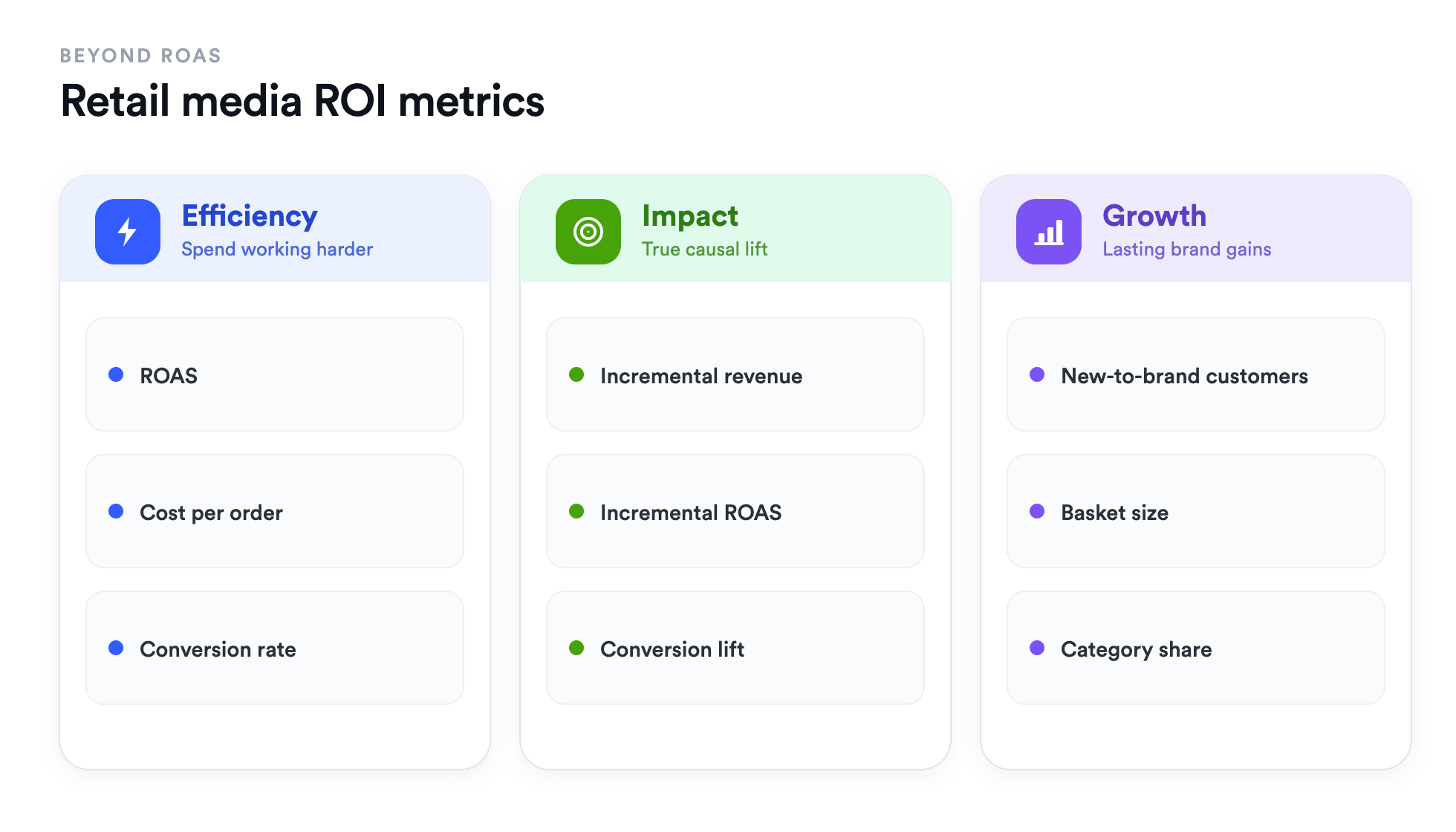
The best ROI reports combine efficiency metrics, outcome metrics, and incrementality metrics.
Connect ads to sales with closed-loop attribution
Closed-loop attribution is one of retail media’s biggest advantages.
It connects ad exposure or engagement to downstream commerce outcomes such as purchases, orders, revenue, or basket activity.
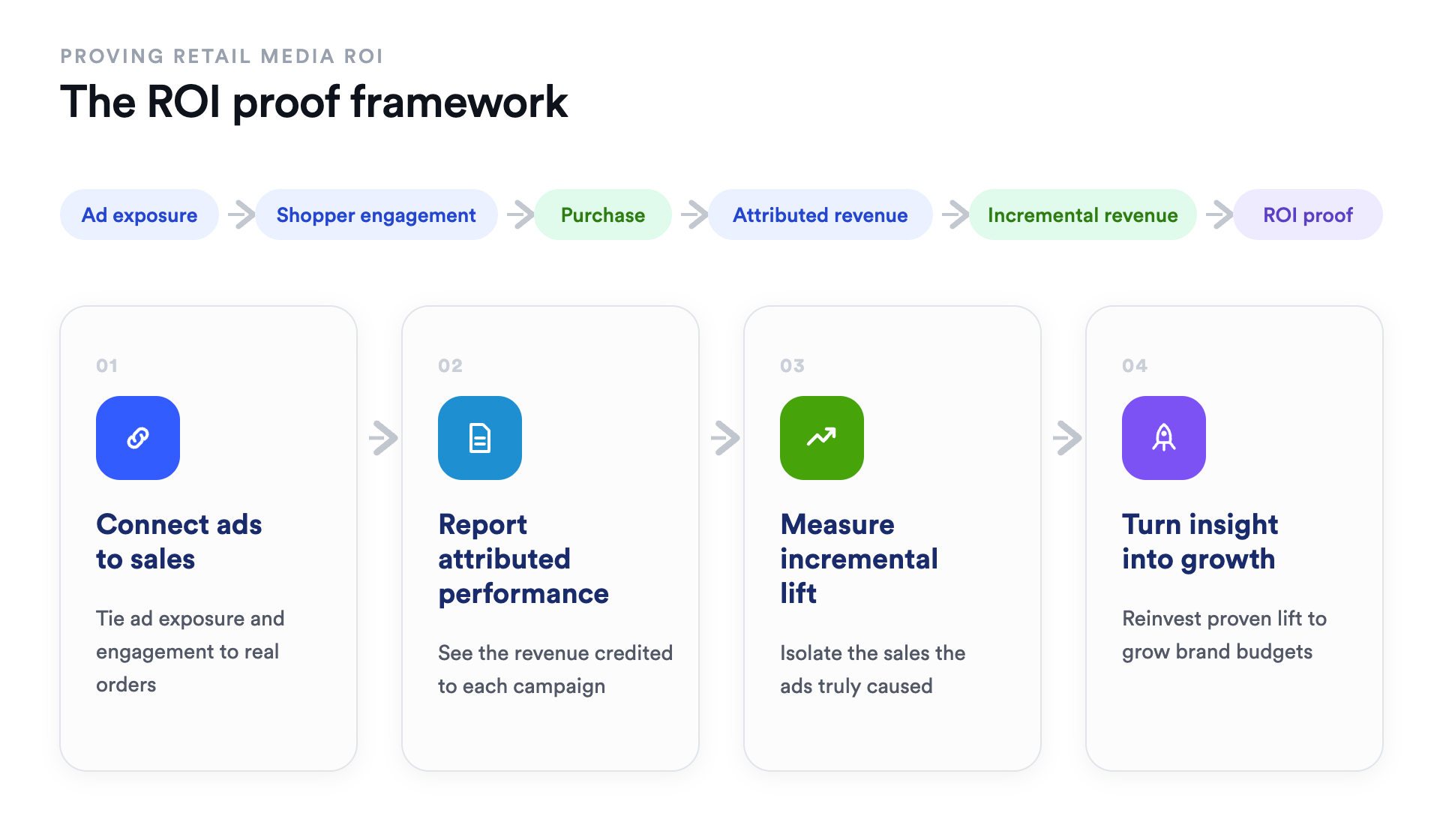
A simple closed-loop attribution flow looks like this:
Ad shown → shopper engages → product viewed → purchase happens → sale attributed to campaign
This gives brands visibility into which campaigns, products, and placements are connected to sales.
Closed-loop attribution helps answer:
- Which campaigns drove attributed revenue?
- Which products converted?
- Which placements performed best?
- Which audiences or shopper segments responded?
- Which sellers or brands saw the strongest return?
For retailers and marketplaces, closed-loop attribution is essential for proving ROI because it links media activity to actual commerce outcomes.
But attribution alone is not enough.
Add incrementality to prove true impact
Attribution shows which sales were connected to a campaign. Incrementality shows which sales were caused by the campaign.
This distinction is important.
A shopper may click a sponsored product and buy it. The sale can be attributed to the campaign. But the shopper may have already planned to buy the product. In that case, the campaign receives credit, but the true incremental impact may be lower.
Incrementality helps brands understand whether retail media created new value.
Retail media teams can measure incrementality using methods such as:
- Test and control groups
- Holdout testing
- Geo or store-level experiments
- Time-based analysis
- Modeled incrementality
The goal is to compare what happened with advertising against what likely would have happened without advertising.
For brands, this is one of the strongest forms of ROI proof.
Explain ROAS and incremental ROAS clearly
Many brands already understand ROAS. Fewer brands have a clear understanding of incremental ROAS.
Retail media networks should explain both.
Attributed ROAS shows revenue credited to a campaign.
Incremental ROAS shows revenue caused by a campaign.
Both are useful, but they answer different questions.
A campaign can have high ROAS but low incrementality if it mostly reaches shoppers who were already likely to buy.
A campaign can have lower ROAS but strong incremental impact if it brings in new customers, shifts demand from competitors, or grows category share.
Retail media teams should help brands understand this difference so performance conversations become more strategic.
Make reporting transparent
Brands are more likely to trust ROI when they understand how results are calculated.
A strong retail media report should clearly explain:
- Attribution windows
- Click-through attribution rules
- View-through attribution rules
- Product-level attribution logic
- Basket-level attribution logic
- How duplicate credit is handled
- Whether results are attributed or incremental
- What data is included
- What limitations exist
Transparency does not weaken the ROI story. It makes it more credible.
When brands understand the methodology, they are more likely to trust the results and increase investment.
Show ROI at the right level of detail
High-level campaign results are useful, but brands often need more detail to make decisions.
Retail media reporting should support breakdowns by:
- Campaign
- Product
- SKU
- Brand
- Seller
- Category
- Placement
- Audience
- Search query
- Device or channel
- Time period
- Online vs in-store outcomes
This level of detail helps brands answer practical questions:
- Which products should receive more budget?
- Which placements are worth premium pricing?
- Which campaigns should be paused or scaled?
- Which audiences are most valuable?
- Which categories are responding to investment?
ROI reporting should not only prove value. It should help brands take action.
Prove ROI across the full funnel
Retail media is often associated with lower-funnel sponsored products, but brands increasingly use retail media across the full funnel.
That means ROI should be measured differently depending on the campaign type.
Lower-funnel campaigns
For sponsored products and search placements, brands may focus on:
- Click-through rate
- Conversion rate
- Attributed sales
- ROAS
- SKU-level performance
- Incremental revenue
Mid-funnel campaigns
For category page, product discovery, and consideration campaigns, brands may focus on:
- Product views
- Add-to-cart rate
- Basket impact
- Category lift
- New-to-brand customers
Upper-funnel campaigns
For display, video, offsite, or awareness campaigns, brands may focus on:
- Reach
- Engagement
- View-through conversions
- Brand or category lift
- New customer acquisition
- Incremental impact over time
The key is to match the measurement approach to the campaign objective.
Include online, offline, and omnichannel impact when possible
Many brands care about total sales, not only online conversions.
For omnichannel retailers, retail media ROI may include:
- Online purchases
- In-store purchases
- Buy online, pick up in-store behavior
- Store-level sales lift
- Regional performance
- Loyalty-linked transactions
Connecting online ad exposure to offline or in-store outcomes can make the ROI story much stronger.
This is especially important for grocery, pharmacy, convenience, home improvement, beauty, and other categories where many purchases still happen in physical stores.
Even when offline measurement is not perfect, clear methodology and directional insights can help brands understand broader impact.
Use case studies and benchmarks
Brands trust real examples.
Retail media networks should build ROI stories using:
- Campaign case studies
- Product launch results
- Category growth examples
- Seller success stories
- Incrementality test results
- Before-and-after performance comparisons
- Placement-level benchmarks
- Repeat advertiser growth
A good case study should include:
- Brand goal
- Campaign setup
- Target audience or placement
- Measurement method
- Key results
- Business takeaway
Avoid only reporting vanity metrics. Strong case studies should connect media activity to business outcomes.
Turn ROI proof into budget growth
Proving ROI is not only about reporting past performance. It should help brands decide what to do next.
A strong ROI review should answer:
- What worked?
- Why did it work?
- What should the brand scale?
- What should change next time?
- Which products or placements deserve more budget?
- Which audiences should be tested?
- Where is there room for growth?
Retail media networks can use ROI reporting to support:
- Quarterly business reviews
- Annual planning
- Budget renewal conversations
- New placement launches
- Upsell opportunities
- Cross-channel media expansion
When ROI reporting is actionable, it becomes a revenue growth tool.
Common mistakes when proving retail media ROI
Retail media teams should avoid these common mistakes.
Reporting only impressions and clicks
Impressions and clicks are useful, but they do not prove business impact. Brands need sales, revenue, lift, and customer outcomes.
Treating attributed revenue as incremental revenue
Attributed sales are not always caused by advertising. Brands need clarity on the difference between attribution and incrementality.
Using unclear attribution windows
If advertisers do not understand the attribution window, they may not trust the results.
Over-crediting campaigns
Overly broad attribution can inflate performance and weaken trust over time.
Ignoring campaign objectives
A product launch campaign and an always-on sponsored products campaign should not be measured the same way.
Hiding methodology
Brands are more likely to trust reporting when the rules are clear.
How Topsort helps prove retail media ROI
Topsort helps retailers, marketplaces, delivery apps, travel platforms, and commerce businesses build retail media programs with API-first ad serving, auctions, sponsored listings, attribution, reporting, and AI optimization.
Because Topsort is built for commerce media, it helps connect ad delivery to the commerce outcomes brands care about: product views, clicks, purchases, revenue, sellers, categories, and campaign performance.
With the right infrastructure, retail media teams can:
- Launch sponsored listings and commerce-native ad placements
- Track impressions, clicks, and purchase events
- Connect campaigns to sales outcomes
- Report product-level and campaign-level performance
- Support more transparent attribution
- Optimize media investment based on commerce signals
- Build stronger advertiser trust
For brands, better measurement means more confidence. For retailers and marketplaces, better measurement means stronger media revenue growth.
Final takeaway
To prove retail media ROI to brands, retailers and marketplaces need to go beyond impressions, clicks, and basic attributed sales.
They need to connect ads to commerce outcomes, explain attribution clearly, measure incrementality where possible, and report results in a way that helps brands make better decisions.
The strongest retail media ROI story combines:
- Closed-loop attribution
- Transparent reporting
- ROAS and incremental ROAS
- Product-level and placement-level insights
- Incrementality measurement
- Actionable recommendations
Brands will continue to invest in retail media when they can see clear evidence of business impact.
Retail media networks that can prove ROI clearly will be better positioned to win budgets, grow revenue, and build long-term advertiser trust.
FAQ
What is retail media ROI?
Retail media ROI measures the business return a brand receives from retail media investment. It can include attributed sales, ROAS, incremental revenue, new customers, basket growth, and category impact.
How do you prove retail media ROI to brands?
Retail media networks can prove ROI by connecting ad activity to sales with closed-loop attribution, reporting ROAS, measuring incrementality, showing product-level performance, and making methodology transparent.
What metrics should retail media networks use to prove ROI?
Important metrics include attributed revenue, ROAS, incremental revenue, incremental ROAS, conversion lift, new-to-brand customers, basket impact, and placement-level performance.
Why is ROAS not enough to prove retail media ROI?
ROAS shows attributed revenue compared with ad spend, but it does not always prove that advertising caused new sales. Incrementality helps show true lift.
What is the difference between attributed revenue and incremental revenue?
Attributed revenue is revenue connected to an ad interaction. Incremental revenue is revenue caused by the campaign that likely would not have happened without advertising.
Why is closed-loop attribution important for retail media ROI?
Closed-loop attribution connects ad exposure or engagement to purchases, orders, and revenue. This helps brands see how campaigns are connected to commerce outcomes.
How can retail media networks build advertiser trust?
Retail media networks can build trust by using clear attribution rules, transparent reporting, incrementality testing, detailed performance breakdowns, and actionable recommendations.
Want to prove retail media ROI with clearer attribution and commerce outcomes? See how Topsort helps retailers and marketplaces build API-first retail media programs with transparent reporting and performance measurement.
.png)
.png)