How to Build a Retail Media Network: A Practical Guide for Retailers and Marketplaces
Retail media has become one of the most important growth opportunities for retailers, marketplaces, delivery apps, travel platforms, and commerce businesses.
The reason is simple: commerce platforms own valuable shopper intent.
Every search query, product view, category visit, add-to-cart event, and purchase creates a signal that brands and sellers care about. When these signals are connected to advertising, retailers and marketplaces can create a new revenue stream while helping advertisers reach shoppers closer to the point of purchase.
But building a retail media network is not just about adding ads to a website.
A successful retail media network needs the right ad formats, auction logic, data infrastructure, campaign tools, attribution, reporting, billing, and advertiser experience. It also needs to protect the shopper experience and prove measurable value to brands.
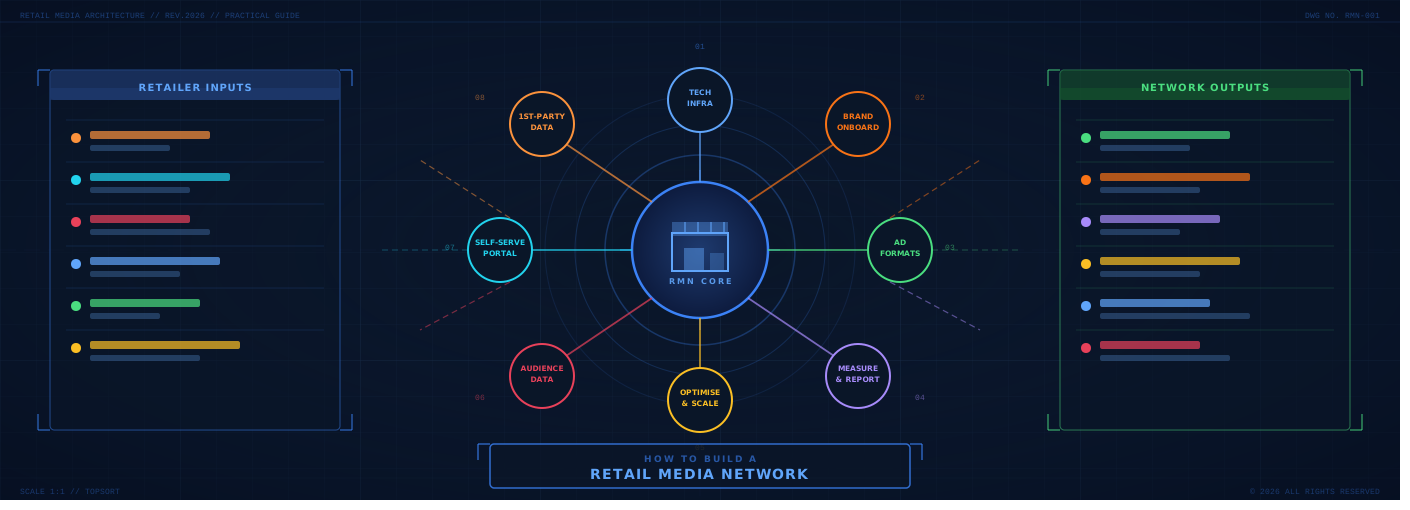
This guide explains how to build a retail media network from the ground up, what infrastructure is required, and how retailers and marketplaces can scale retail media into a trusted business line.
What is a retail media network?
A retail media network is an advertising business built on top of a retailer, marketplace, or commerce platform’s owned channels and first-party commerce data.
It allows brands, sellers, or advertisers to promote products and reach shoppers across commerce surfaces such as:
- Search results
- Category pages
- Product detail pages
- Homepage placements
- Checkout or cart pages
- Email or app placements
- Offsite channels
- In-store media
In simple terms, a retail media network helps commerce platforms monetize shopper attention and purchase intent.
For example, a marketplace can let sellers promote sponsored listings in search results. A grocery retailer can let brands buy display placements on category pages. A delivery app can let restaurants promote listings when users search for nearby food. A travel platform can monetize hotel or destination discovery pages with sponsored placements.
The strongest retail media networks create value for all sides:
- Shoppers discover more relevant products or offers.
- Brands and sellers reach high-intent audiences.
- Retailers and marketplaces create new, high-margin revenue.
- Media teams can optimize campaigns based on real commerce outcomes.
Why build a retail media network?
Retail media is attractive because it turns existing commerce traffic into a monetizable media business.
Retailers and marketplaces already have:
- Shopper traffic
- Product catalogs
- Search and browsing behavior
- Purchase data
- Seller or brand relationships
- Owned digital surfaces
- High-intent moments close to conversion
A retail media network helps turn those assets into advertising revenue.
Building a retail media network can help commerce businesses:
- Create a new revenue stream
- Increase seller or brand investment
- Improve product discovery
- Monetize search and category pages
- Support sponsored listings and display ads
- Build stronger vendor or seller relationships
- Offer brands measurable campaign performance
- Compete with larger retail media platforms
But launching retail media requires more than inventory. It requires infrastructure.
Step 1: Define your retail media strategy
Before choosing technology or ad formats, define the business goal.
A retail media network can serve different types of commerce businesses:
- Retailers monetizing brand demand
- Marketplaces helping sellers promote products
- Delivery apps promoting restaurants or merchants
- Travel platforms monetizing hotels, destinations, or experiences
- Classifieds platforms promoting listings
- Financial or commerce platforms monetizing commercial intent
Each business has different advertisers, inventory, measurement needs, and user experience constraints.
Start by answering these questions:
- Who will buy ads: brands, sellers, agencies, merchants, or partners?
- What surfaces can be monetized without hurting the shopper experience?
- Which ad formats make sense for your platform?
- What campaign goals will advertisers care about?
- What data can be used for targeting, relevance, and measurement?
- How will success be measured?
- Will the platform be self-serve, managed-service, or both?
- What level of control do advertisers need?
- How will pricing, billing, and reporting work?
A clear strategy prevents the retail media network from becoming a collection of disconnected ad placements.
Step 2: Choose the right ad formats
Retail media networks usually start with a few core ad formats, then expand over time.
The right formats depend on the platform, advertiser demand, and shopper journey.
Sponsored products or sponsored listings
Sponsored products are one of the most common retail media formats.
They allow brands or sellers to promote products in high-intent placements such as search results, category pages, or recommendation modules.
Sponsored products work well because they are native to the shopping experience. They look and feel close to organic product listings, while giving advertisers more visibility.
Sponsored products are especially useful for:
- Marketplaces
- Retailers
- Grocery platforms
- Delivery apps
- Travel platforms
- Classifieds platforms
- Any platform with searchable listings or product catalogs
They are often a strong first format because advertisers can connect spend directly to product views, clicks, and purchases.
Display ads
Display ads help brands reach shoppers with banners, rich media, or visual placements across commerce surfaces.
They can appear on:
- Homepages
- Category pages
- Product detail pages
- Search pages
- App screens
- Email placements
- Offsite media
Display ads are useful for product launches, seasonal campaigns, brand awareness, category promotion, and upper-funnel retail media.
They often require stronger creative management and view-through attribution.
Sponsored brands or brand placements
Sponsored brand placements help advertisers promote a brand, collection, or campaign instead of one specific product.
These can include:
- Brand tiles
- Sponsored shelves
- Category takeovers
- Search header placements
- Collection pages
- Sponsored storefronts
These formats are useful when advertisers want to drive brand discovery, not only product-level conversions.
Offsite retail media
Offsite retail media extends a retailer or marketplace’s data and advertiser demand beyond owned properties.
For example, a retailer may help a brand reach shoppers across external display, social, programmatic, or connected TV inventory, while using first-party commerce signals for targeting and measurement.
Offsite can increase scale, but it also adds complexity around data, privacy, identity, attribution, and partner integrations.
In-store retail media
For omnichannel retailers, in-store media can include:
- Digital screens
- Smart carts
- Audio ads
- In-store displays
- Point-of-sale placements
- Loyalty-linked offers
- Shelf-edge media
In-store retail media can be powerful, but it requires careful measurement design to connect exposure to sales outcomes.
Step 3: Build commerce-native ad serving infrastructure
Ad serving is the foundation of a retail media network.
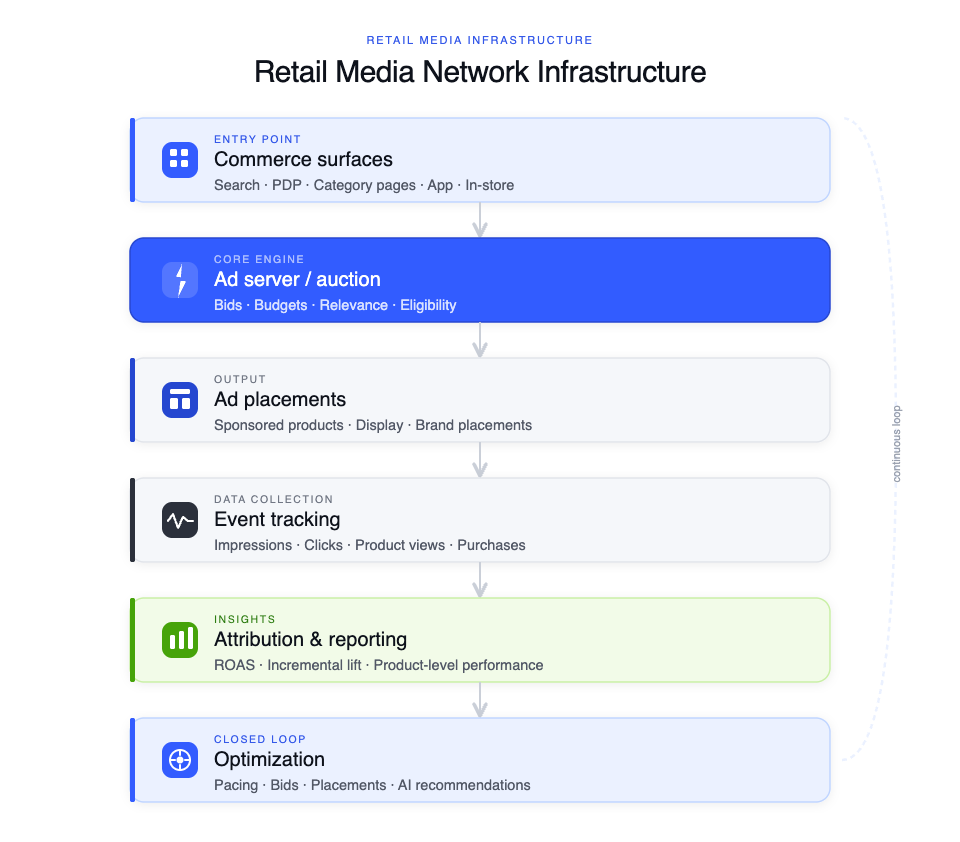
A retail media ad server decides which ad to show, where to show it, when to show it, and how to track performance.
Retail media ad serving is different from generic ad serving because it needs to understand commerce context.
A commerce-native ad server should be able to process signals such as:
- Search query
- Product or SKU ID
- Category
- Seller or vendor
- Brand
- Placement
- Inventory status
- Price
- Promotion
- User or session context, where privacy-compliant
- Campaign budget
- Bids
- Relevance
- Purchase events
Without commerce-native infrastructure, it becomes difficult to deliver relevant ads, protect the shopper experience, and report meaningful outcomes.
For retailers and marketplaces, the ad server should not be disconnected from the product catalog, auction logic, attribution, or reporting. These systems need to work together.
Step 4: Design the auction and ranking logic
Many retail media networks use auctions to decide which ads appear.
In a sponsored products auction, eligible advertisers compete for placements based on bids, budgets, relevance, and campaign rules.
But retail media auctions should not be based on bid alone.
If the highest bidder always wins, the shopper experience may suffer. Irrelevant ads can reduce trust, lower conversion rates, and hurt long-term performance.
A strong retail media auction should balance:
- Bid
- Relevance
- Product quality
- Campaign budget
- Placement context
- Expected engagement
- Conversion likelihood
- Seller or brand constraints
- Shopper experience
The goal is to show ads that are both valuable to advertisers and useful to shoppers.
For example, if a shopper searches for “running shoes,” a sponsored listing for running shoes should generally rank above a loosely related product with a higher bid. Relevance protects the shopping experience and improves advertiser outcomes.
Step 5: Connect product catalog and event data
Retail media depends on clean commerce data.
At a minimum, the platform needs to connect:
- Product catalog data
- Seller or brand data
- Campaign data
- Placement data
- Impression events
- Click events
- Add-to-cart events, if available
- Purchase events
- Revenue data
- Order data
This data powers targeting, relevance, attribution, reporting, and optimization.
For marketplaces, seller and product data are especially important. Advertisers need to know which products are eligible, which products are promoted, and which sales are connected to campaigns.
For retailers, brand, category, SKU, and inventory data are important for measurement and campaign planning.
A retail media network cannot scale without reliable event tracking. If impressions, clicks, and purchases are not captured cleanly, reporting becomes difficult and advertisers lose trust.
Step 6: Build advertiser campaign tools
Advertisers need a way to create, manage, and optimize campaigns.
Retail media networks can offer:
- Self-serve campaign tools
- Managed-service workflows
- API-based campaign management
- Agency-facing tools
- Seller portals
- Brand portals
The right approach depends on the advertiser base.
A marketplace with many sellers may need a self-serve experience so advertisers can create campaigns directly. A large retailer working with enterprise brands may start with managed service and later add self-serve tools.
Campaign tools should support:
- Campaign creation
- Product selection
- Budget setup
- Bidding
- Targeting
- Placement selection
- Creative management
- Pacing
- Reporting
- Billing
- Optimization recommendations
Advertisers should be able to understand what they are buying, how much they are spending, and what results they are getting.
Step 7: Set up targeting and relevance
Retail media targeting should be built around commerce intent.
Common targeting signals include:
- Search queries
- Product categories
- Product attributes
- Shopper behavior
- Purchase history, where privacy-compliant
- Contextual placement
- Brand or seller eligibility
- Audience segments
- Geographic or store context
- Device or channel context
However, targeting should not make ads feel intrusive or irrelevant.
In many retail media environments, contextual relevance is extremely powerful. A shopper searching for a product or browsing a category is already showing intent. Ads that match that context can perform well without needing overly complex targeting.
Strong retail media networks use targeting to improve relevance, not just to increase ad load.
Step 8: Build closed-loop attribution
Attribution is one of the biggest reasons brands invest in retail media.
Retailers and marketplaces can often connect ad exposure or engagement to downstream commerce outcomes such as purchases, orders, revenue, or basket activity.
A simple closed-loop attribution flow looks like this:
Ad shown → shopper clicks or engages → product viewed → purchase happens → sale attributed to campaign
Closed-loop attribution helps advertisers understand:
- Which campaigns drove attributed sales
- Which products converted
- Which placements performed best
- Which sellers or brands saw return
- Which audiences responded
- How much revenue was connected to media spend
Retail media networks should define attribution rules clearly, including:
- Attribution windows
- Click-through attribution
- View-through attribution
- SKU-level attribution
- Basket-level attribution
- Halo attribution
- Duplicate credit rules
Transparent attribution is essential for advertiser trust.
Step 9: Measure incrementality and ROI
Attribution connects sales to ads. Incrementality helps prove which sales were caused by ads.
This distinction matters because retail media campaigns often appear close to the point of purchase. A shopper may already be likely to buy. If an ad receives credit for that purchase, the campaign may show strong attributed performance even if the true lift is lower.
Incrementality helps advertisers understand the real impact of their investment.
Retail media teams can measure incrementality using:
- Test and control groups
- Holdout testing
- Geo or store-level tests
- Time-based analysis
- Modeled incrementality
- Conversion lift analysis
For advertisers, incrementality helps answer:
- Did the campaign create new revenue?
- Did it increase conversion rate?
- Did it bring in new customers?
- Did it justify more budget?
- Which placements created the most true lift?
A strong retail media network should support both attribution and incrementality. Attribution helps with campaign reporting. Incrementality helps with budget confidence.
Step 10: Create reporting brands can trust
Reporting is one of the most important parts of the advertiser experience.
Brands and sellers need clear, timely, and actionable performance data.
A strong retail media report should include:
- Spend
- Impressions
- Clicks
- Click-through rate
- Attributed sales
- Attributed revenue
- ROAS
- Incremental revenue, where available
- Incremental ROAS, where available
- Conversion lift
- Product-level performance
- Placement-level performance
- Seller or brand-level performance
- Basket impact
- New-to-brand customers, where available
Reporting should not only show numbers. It should help advertisers decide what to do next.
Good reporting answers:
- What worked?
- Why did it work?
- Which products should receive more budget?
- Which placements should scale?
- Which campaigns should change?
- Which audiences should be tested next?
Retail media networks that provide transparent reporting are more likely to earn repeat investment from advertisers.
Step 11: Protect the shopper experience
A retail media network should not damage the core commerce experience.
If ads are irrelevant, excessive, or disruptive, they can reduce trust and hurt conversion.
To protect the shopper experience, retail media teams should define rules around:
- Ad load
- Placement quality
- Relevance thresholds
- Sponsored labeling
- Frequency
- Creative quality
- Product eligibility
- Landing page quality
- Inventory availability
- Pricing and promotion accuracy
The best retail media networks do not just maximize short-term ad revenue. They balance monetization with shopper trust and long-term marketplace health.
This is especially important for marketplaces, where buyers, sellers, and the platform all need to benefit.
Step 12: Decide whether to build, buy, or partner
One of the biggest decisions is whether to build retail media infrastructure internally or work with a retail media platform.
Building in-house
Building in-house gives maximum control, but it requires significant engineering, product, data, and ad operations investment.
Teams need to build and maintain:
- Ad serving
- Auctions
- Campaign tools
- Targeting
- Event tracking
- Attribution
- Reporting
- Billing
- Fraud controls
- Brand safety
- Optimization systems
- APIs and integrations
This can take significant time and resources.
Buying or partnering
Working with a retail media platform can help teams launch faster and avoid building every component from scratch.
This can be especially useful for retailers, marketplaces, delivery apps, travel platforms, and commerce businesses that want to monetize quickly while keeping flexibility.
The right partner should support:
- API-first integration
- Commerce-native ad serving
- Sponsored listings and display
- Auction logic
- Event tracking
- Attribution and reporting
- Advertiser tools
- Optimization
- Flexibility for custom commerce experiences
The best option depends on internal resources, launch timeline, revenue goals, and platform complexity.
Step 13: Launch with a focused MVP
A retail media network does not need every feature on day one.
Many successful programs start with a focused MVP.
A practical MVP may include:
- One or two ad formats
- A few high-value placements
- Basic campaign setup
- Sponsored products or sponsored listings
- Impression and click tracking
- Purchase attribution
- Basic reporting
- A small group of advertisers or sellers
The goal is to prove demand, validate performance, protect the user experience, and learn what advertisers need.
After launch, the platform can expand into:
- More placements
- More ad formats
- Self-serve tools
- Advanced targeting
- Display ads
- Offsite media
- Incrementality measurement
- AI optimization
- In-store or omnichannel measurement
Start focused, then scale based on advertiser demand and performance data.
Step 14: Scale with automation and AI optimization
As a retail media network grows, manual campaign management becomes harder.
Advertisers want better performance. Operators need to manage more campaigns, placements, budgets, and sellers. The platform needs to optimize delivery while protecting relevance and shopper experience.
Automation and AI can help with:
- Campaign pacing
- Bid optimization
- Budget allocation
- Relevance scoring
- Placement optimization
- Product recommendations
- Forecasting
- Anomaly detection
- Reporting insights
- Creative or catalog recommendations
AI is especially useful when it is connected to commerce signals such as product performance, shopper behavior, purchase outcomes, and campaign goals.
The goal is not just to automate tasks. The goal is to help advertisers achieve better outcomes with less manual complexity.
Common mistakes when building a retail media network
Retail media can be highly valuable, but many programs struggle because they skip key foundations.
Common mistakes include:
Adding ads before defining the strategy
Without clear goals, ad formats, and advertiser needs, the network can become fragmented.
Prioritizing monetization over relevance
Too many irrelevant ads can hurt the shopper experience and reduce long-term value.
Using generic ad serving infrastructure
Retail media needs commerce-native logic, including product data, seller data, inventory, purchases, and attribution.
Reporting only impressions and clicks
Advertisers need commerce outcomes, not only activity metrics.
Ignoring incrementality
Attributed revenue is important, but brands increasingly want proof of true lift.
Launching too many formats too early
A focused MVP is usually better than a complex launch with weak execution.
Treating retail media as only a sales channel
Retail media is also a data, product, measurement, and infrastructure business.
How Topsort helps build retail media networks
Topsort helps retailers, marketplaces, delivery apps, travel platforms, and commerce businesses build and scale retail media programs with API-first infrastructure.
Topsort supports commerce-native ad serving, real-time auctions, sponsored listings, display ads, attribution, reporting, and AI optimization. This helps platforms connect ad delivery to the commerce outcomes advertisers care about: impressions, clicks, product views, purchases, revenue, ROAS, and campaign performance.
Because Topsort is built for commerce media, it helps connect the key pieces of a retail media network:
- Ad requests
- Auctions
- Placements
- Products
- Sellers
- Campaigns
- Budgets
- Bids
- Impressions
- Clicks
- Purchase events
- Attribution
- Reporting
- Optimization
For commerce platforms, the goal is not just to serve ads. The goal is to build a trusted media business where advertisers can launch campaigns, understand performance, prove ROI, and confidently increase investment.
With the right infrastructure, retailers and marketplaces can launch faster, protect the shopper experience, and scale retail media into a durable revenue stream.
Final takeaway
Building a retail media network is one of the biggest opportunities for retailers, marketplaces, and commerce platforms.
But success requires more than placing ads on a website or app.
A strong retail media network needs commerce-native infrastructure, relevant ad formats, auction logic, event tracking, closed-loop attribution, transparent reporting, and a clear advertiser experience.
The most successful programs will be the ones that can answer the questions advertisers care about:
- Can I reach high-intent shoppers?
- Can I promote the right products in the right placements?
- Can I measure sales and ROI?
- Can I understand what is incremental?
- Can I trust the reporting?
- Can I scale investment over time?
Retail media works best when it creates value for shoppers, advertisers, and the commerce platform.
That requires more than media inventory. It requires the right infrastructure.
FAQ
What is a retail media network?
A retail media network is an advertising business built on top of a retailer, marketplace, or commerce platform’s owned channels and first-party commerce data. It allows brands, sellers, or advertisers to promote products to shoppers across commerce surfaces.
How do you build a retail media network?
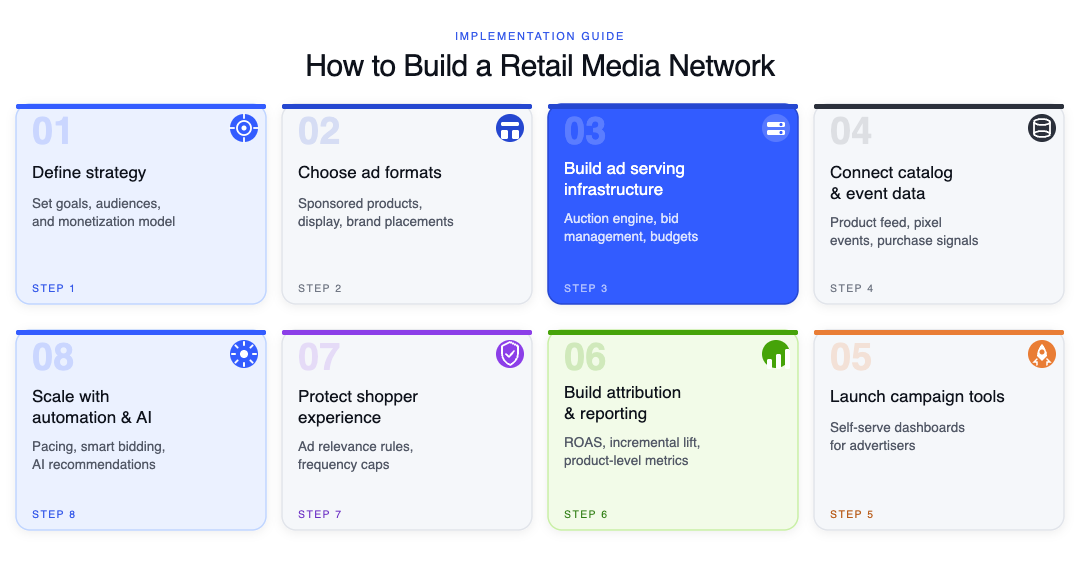
To build a retail media network, start by defining your strategy, choosing ad formats, building ad serving infrastructure, setting up auctions, connecting catalog and event data, enabling campaign tools, measuring attribution, reporting results, and protecting the shopper experience.
What technology is needed for a retail media network?
A retail media network typically needs ad serving, auction logic, campaign management, product catalog integration, event tracking, attribution, reporting, billing, advertiser tools, and optimization infrastructure.
What are the most common retail media ad formats?
Common retail media ad formats include sponsored products, sponsored listings, display ads, sponsored brand placements, offsite ads, and in-store media.
Why is ad serving important for retail media?
Ad serving is important because it decides which ad appears, where it appears, and how performance is tracked. Retail media ad serving needs to understand commerce context such as products, sellers, categories, bids, budgets, and purchase events.
What is the difference between a retail media network and a retail media platform?
A retail media network is the advertising business operated by a retailer or commerce company. A retail media platform is the technology used to power ad serving, campaigns, attribution, reporting, and optimization.
Should retailers build or buy retail media technology?
It depends on resources, timeline, and control requirements. Building in-house offers control but requires significant engineering investment. Working with a retail media platform can help teams launch faster and scale with proven infrastructure.
How do retail media networks measure performance?
Retail media networks measure performance using metrics such as impressions, clicks, attributed sales, ROAS, product-level performance, placement-level performance, incremental revenue, incremental ROAS, and new-to-brand customers.
Why does incrementality matter in retail media?
Incrementality matters because it helps advertisers understand which sales were caused by advertising, not just which sales were connected to ads. This helps prove true campaign impact and supports budget growth.
How can a marketplace build a retail media network?
A marketplace can build a retail media network by launching sponsored listings, connecting seller campaigns to product catalog data, using auction-based ad serving, tracking impressions and clicks, attributing purchases, and giving sellers clear reporting.
Ready to build a retail media network? See how Topsort helps retailers and marketplaces launch API-first retail media programs with ad serving, auctions, attribution, reporting, and AI optimization.
.png)
.png)