Retail Media Is Transitioning from Tools to Infrastructure

Retail media is going through a structural shift.
For the past decade, most platforms in the space were built as tools—dashboards, campaign managers, reporting layers, ad servers, or keyword bidding systems. They solved immediate problems. They unlocked early budgets. They helped retailers test monetization.
But tools don’t build categories. Infrastructure does.
Retail media is now moving beyond a feature layered on top of e-commerce. It is becoming something much deeper: a core economic engine embedded in how retailers operate, price, forecast, and grow.
This is the transition from tools to infrastructure.
Phase One: Retail Media as a Tool Layer
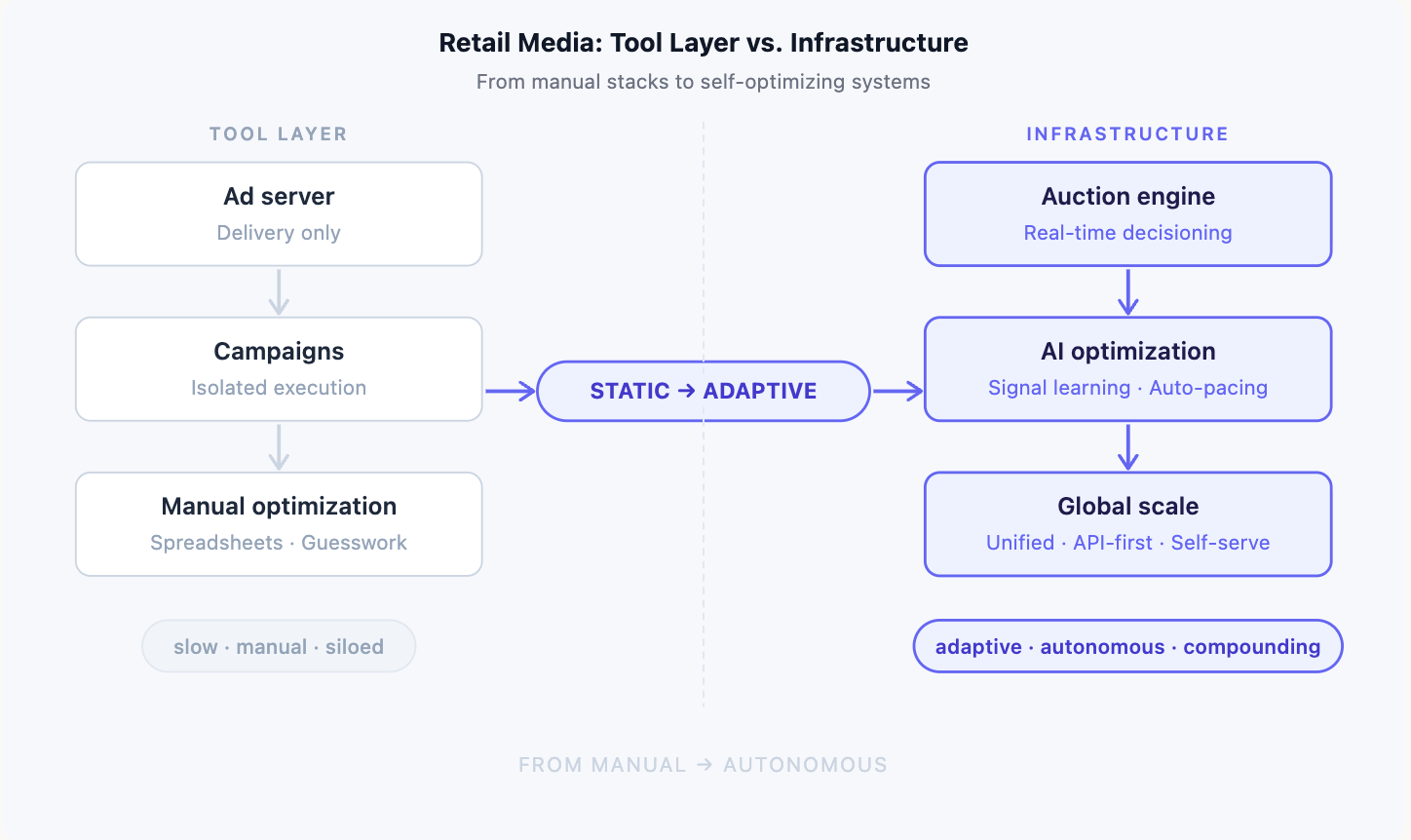
The first generation of retail media platforms looked a lot like traditional SaaS products. They focused on campaign management, basic ad serving, sponsored product placements, reporting dashboards, and audience targeting integrations.
Most of these systems sat adjacent to commerce platforms rather than inside them. As a result, operating retail media often required significant manual work behind the scenes. Teams relied on spreadsheets, constant adjustments, and operational oversight to keep campaigns performing. Scaling across multiple ad formats, regions, or seller ecosystems was difficult.
This phase was necessary. It allowed retailers to experiment and validate the opportunity.
But tools are replaceable. Infrastructure is not.
What Infrastructure Actually Means
When retail media becomes infrastructure, it stops being a product you simply use and becomes a system that runs continuously underneath the business.
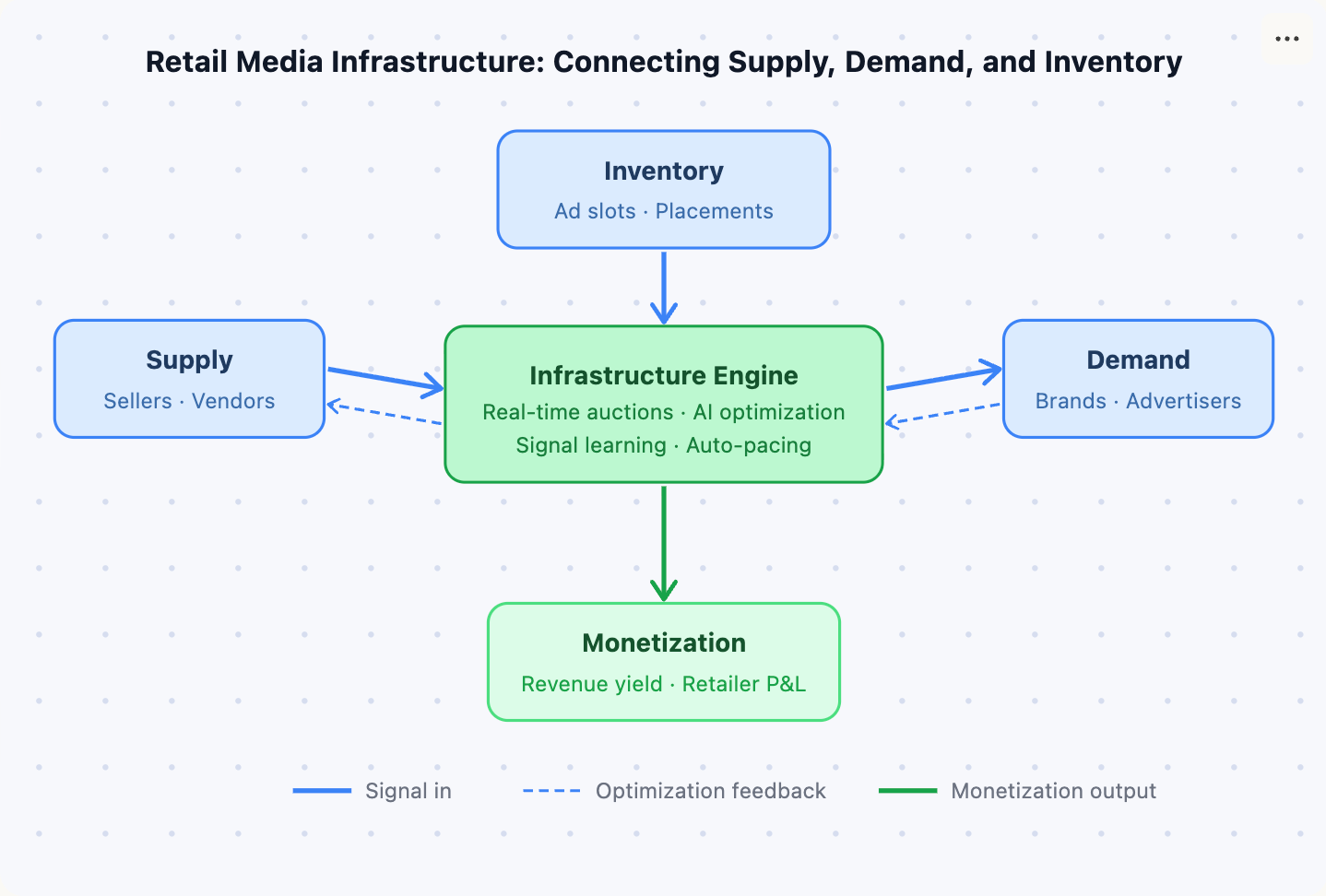
1. It moves to the economic core. Infrastructure doesn’t just manage campaigns—it shapes the economics of the marketplace. It processes every auction request, learns from every bid signal, influences pricing floors, and optimizes revenue yield. Over time, it becomes the system connecting supply, demand, and inventory across the platform.
At that point, advertising becomes part of the retailer’s operating model— the monetization brain. We’ve already seen this dynamic with companies like Amazon and Google, where auction systems are deeply embedded into the economics of the platform itself.
2. It Is AI-native, not feature-native. Early retail media tools were largely feature-driven: add reporting, add targeting, add new ad formats. Infrastructure systems are different. They are model-driven.
Instead of focusing on interfaces, they focus on how the system learns. How signals improve long-term revenue yield. How auctions continuously optimize themselves. How budgets and pacing adjust automatically. And how performance scales without adding operational overhead.
A tool executes instructions. Infrastructure makes economic decisions.
3. It scales globally without fragmentation. Modern retailers operate in complex environments—multiple countries, currencies, tax systems, seller ecosystems, and ad formats. Tool-based systems tend to fracture under that level of complexity. Infrastructure systems are designed to unify it. They provide consistent auction logic across regions, unified billing architecture, enterprise-grade reporting, and API-first extensibility. Vendors and advertisers can operate through self-service layers while the system handles the underlying optimization.
The result is less operational drag and significantly greater monetization leverage.
Why This Shift Is Happening Now
Several forces are accelerating this transition.
Budget Reallocation Toward Performance. Advertising budgets are increasingly moving toward performance-driven channels. Brands want media that sits close to the point of purchase, and retail media offers exactly that. But larger budgets require predictable systems for measurement, optimization, and yield management. That level of reliability requires infrastructure, not tools.
AI Is Compressing Tool Moats. AI is rapidly eroding the differentiation of feature-based SaaS. If a feature can be replicated with enough engineering, it will be eventually. Infrastructure is much harder to replicate. AI-driven auction systems depend on large-scale data flows, reinforcement loops, economic modeling, and deep integration with retailer workflows. These systems compound over time.
This isn’t a dashboard problem. It’s a systems problem.
Retailers Are Thinking Like Platforms. Modern retailers are no longer just merchants. They operate marketplaces, data platforms, and increasingly, advertising networks. Retail media has moved from experimentation to becoming a meaningful driver of retailer P&L, and systems that impact P&L require infrastructure-grade reliability.
From Ad Server to Ad Engine
Historically, much of the industry focused on the ad server. But serving ads is not where the value lies. Optimization is.
An ad server ensures delivery. An ad engine focuses on revenue maximization—learning from signals, improving auctions, and continuously increasing yield across the platform. That’s where infrastructure lives.
What This Means for the Next 5 Years
As the industry matures, expect:
- Consolidation of fragmented point solutions as retailers move toward unified systems
- AI-native retail media engines that manage auctions, pricing, and optimization as continuous systems rather than isolated tools
- Tighter integration between commerce data and advertising auctions
- Enterprise-grade systems for billing, compliance, and operations becoming standard
- Retail media as a default layer inside digital commerce stacks, not a bolt-on product
Retailers will evaluate partners differently as well. Architectural depth, AI capability, and global scalability will matter far more than feature checklists.
Where Topsort Stands
At Topsort, we believe retail media should be treated as infrastructure from the start.
That means building systems that power monetization at scale:
- Machine-learning-driven auction optimization
- Global-ready monetization engines
- API-first architecture
- Self-service access for vendors.
- AI agents that assist campaign operations and optimization
Our goal is simple. Retail media shouldn’t feel like an add-on. It should feel like the invisible economic layer helping retailers grow.
Infrastructure is quieter than tools, but it scales further, compounds longer, and ultimately defines categories.
Retail media is moving from tools to infrastructure. The companies building for that shift will shape the next decade.