How Topsort Built AI Insights: Agentic AI for Retail Media Analytics

AI Insights, now live in the Analytics section of the Topsort platform, flips that model. Instead of asking people to hunt for anomalies, the platform reads the data itself and tells you what changed, why it matters, and how urgent it is.
This is the story of how it works under the hood, and of the technology choices that make it trustworthy enough to run automatically for every marketplace on the platform.
What AI Insights does
Open the Insights tab and you’ll see the most prominent findings for your marketplace, each one a single, data-backed sentence: a metric, a direction, a magnitude, and the dates it happened. Every insight is classified along two dimensions:
- Business domain: Monetization, Demand, Engagement, or Conversion, so teams know which lever moved.
- Severity: Info, Med, or High, so teams know what needs attention today versus what’s worth a glance.
Insights accumulate into a historical record, which makes recurring patterns visible. The seasonal dip that happens every quarter looks very different from a structural decline once you can see both side by side. And because every insight is a starting point rather than a conclusion, each one connects to Tomi, our conversational assistant, so users can dig into the “why” behind any finding and discuss what to do about it.
For non-English-speaking marketplaces, insights are delivered in the marketplace’s own language. Localization is built into the generation pipeline, not bolted on afterward.
The technology: an AI agent, not a dashboard with adjectives
The easy way to build “AI insights” is to compute a few statistics and have a language model paraphrase them. We didn’t do that, because paraphrased dashboards inherit all the limitations of dashboards: they only describe what someone thought to pre-compute.
Instead, AI Insights is built as an autonomous AI agent: a system where a frontier large language model is given analytical tools and a goal, and decides for itself what to investigate.
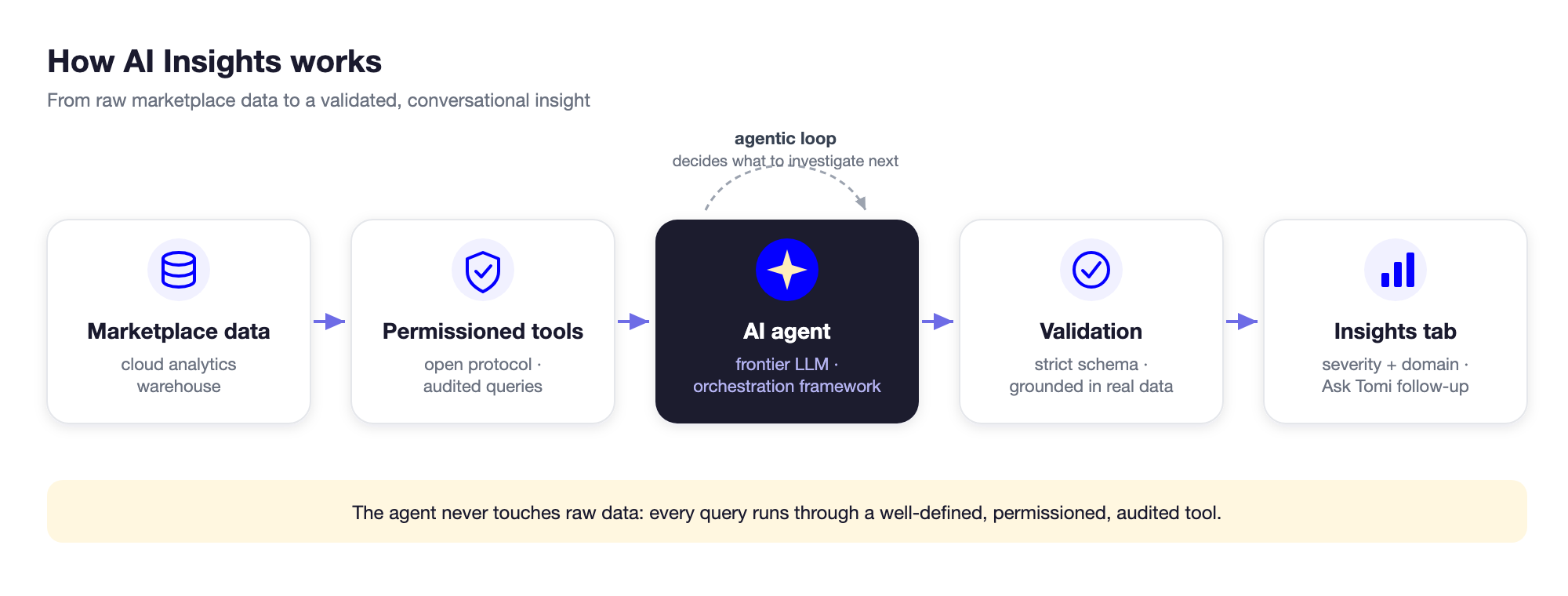
Agentic analysis. The agent works the way a good analyst does. It starts by understanding the marketplace’s context (currency, timezone, and attribution settings), then examines performance trends week-over-week, month-over-month, and year-over-year. It hunts for daily anomalies, structural change-points, and shifts in auction dynamics, choosing which question to ask next based on what it has already found. This is built on a modern agent orchestration framework, the same category of technology powering the current generation of AI agents across the industry.
An open protocol between AI and data. The agent doesn’t get raw database access. It reaches marketplace analytics through a set of purpose-built analytical tools, exposed over an open protocol designed for connecting AI agents to data and tools. This boundary matters: every query the agent makes is a well-defined, permissioned, audited operation. The agent can explore freely within those tools and nowhere else.
Enterprise-scale data foundation. Behind those tools sits Topsort’s cloud analytics warehouse, the same petabyte-scale foundation that powers our reporting. It covers ROAS, CTR, conversion rates, cost per click, spend, and auction volume across the full history of each marketplace, so the agent analyzes the real, complete data rather than a sample or summary.
Frontier models, with resilience built in. Generation runs on frontier large language models, with multiple model tiers available so the pipeline degrades gracefully rather than failing if a provider has an off day.
Making AI output trustworthy
Language models are famously good at sounding right. For a product that tells marketplace operators where to focus, sounding right isn’t enough, so the engineering effort went disproportionately into reliability:
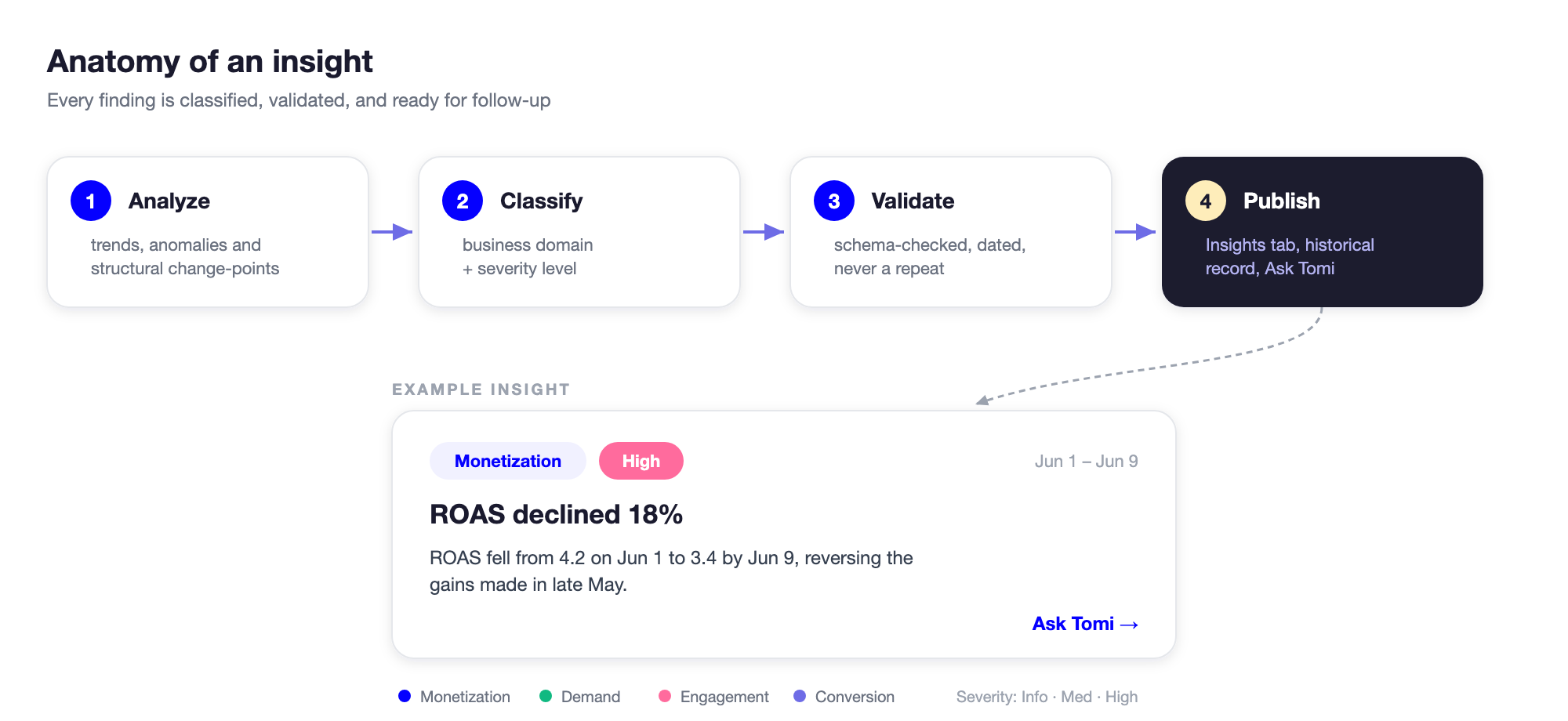
- Structured, validated output. Insights aren’t free text. Every insight is generated against a strict schema and validated before it’s stored. If the output doesn’t conform, it doesn’t ship.
- Grounded in real numbers. Each insight must cite specific metrics, dates, and magnitudes drawn from the agent’s own queries. The format forces specificity: “ROAS declined 18% between June 1 and June 9” rather than “performance seems down.”
- Memory against repetition. The system knows what it has already told you. Prior insights feed into each new analysis so the platform surfaces what’s new, instead of re-announcing last week’s finding.
- Production-grade observability. Every analysis run is traced, logged, and monitored with the same distributed tracing and error-tracking infrastructure as the rest of Topsort’s platform. AI features get held to production engineering standards, not demo standards.
Why this architecture matters
Three properties fall out of these choices, and they’re the reason we’d make the same choices again:
- It scales with zero marginal analyst effort. Every marketplace on the platform gets the same depth of analysis a dedicated analyst would provide, automatically.
- It’s auditable. Because the agent works through a permissioned tool layer and every insight is schema-validated and stored, there is a complete record of what was analyzed and what was claimed.
- It compounds. The historical insight record, the conversational follow-up through Tomi, and the agentic foundation are one architecture. Each new analytical tool added to the protocol layer makes the agent smarter, along with every future AI feature built on it.
AI Insights is automatically enabled for all clients in production. It’s also a statement about how we build: AI at Topsort isn’t a chatbot stapled to a dashboard. It’s an agentic layer over the most complete retail media dataset in the industry.
Learn more in the AI Insights changelog.