How Europe’s Home Improvement Giant OBI Improved ROAS by 93% with AI-Powered Auctions
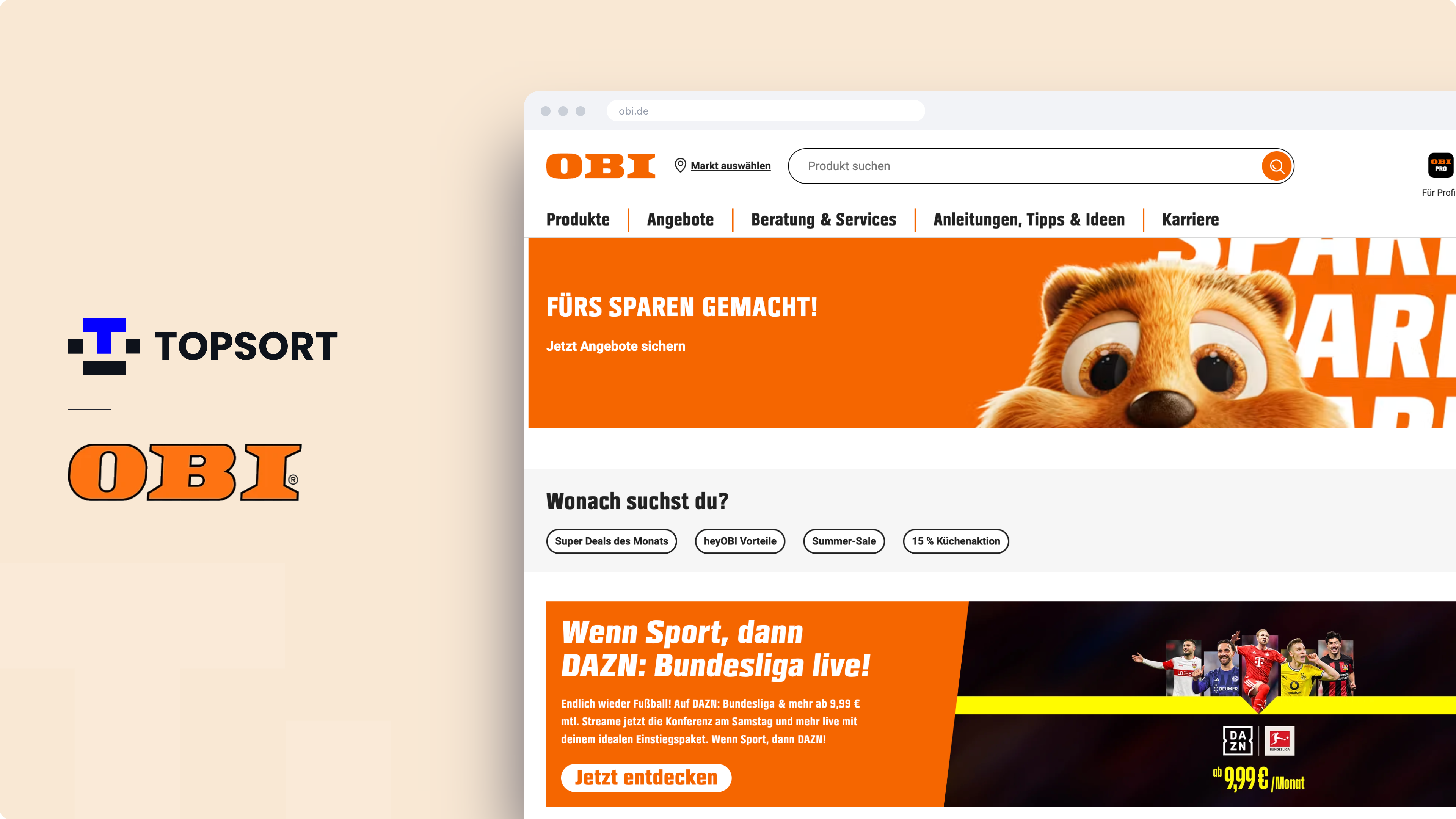
OBI, one of Europe’s largest home improvement retailers, modernized its retail media infrastructure with Topsort after evaluating 15 providers. By combining real-time auction decisioning, relevance-driven sponsored product selection, and AI-powered bidding, OBI increased attributed sales by 136%, purchases by 127%, and ROAS by 93% from December 2025 through June 2026.
The transformation shows how retailers with large, complex catalogs can move beyond static retail media rules toward infrastructure that continuously learns from shopper intent and campaign performance.
The Challenge: Relevance and Scalability in a Project-Driven Retail Environment
OBI is one of Europe’s largest home improvement retailers, operating more than 600 stores across 10 countries and serving millions of shoppers working on DIY, renovation, maintenance, and outdoor projects.
That creates a different commerce environment from a conventional ecommerce catalog.
A shopper looking for a drill, garden equipment, building materials, or outdoor furniture is often not simply browsing a product category. They are working toward a specific project or outcome. Their intent can vary by season, product combination, stage of the project, and the context of the shopping journey. For retail media, that makes relevance especially important.
As OBI’s retail media business expanded, so did the complexity of managing it. More advertisers, more campaigns, thousands of products, diverse categories, and seasonal demand meant that static targeting and manually managed bidding would become increasingly difficult to scale.
OBI needed infrastructure capable of answering two questions continuously: Which sponsored product is most relevant to this shopper right now?
And: How should the campaign bid for that opportunity to maximize performance within its goals and budget?
The Solution: Real-Time, AI-Powered Auctions
After evaluating 15 providers, OBI partnered with Topsort to modernize its retail media program with real-time auction infrastructure.
The goal was to improve how sponsored products were selected and optimized across a large, complex catalog. Topsort combined relevance-driven decisioning with automated bidding, helping OBI match more relevant products to shopper intent while reducing the need for manual campaign optimization.
Topsort’s decisioning combines three layers:
Relevance: Shopper context, search behavior, product interactions, and historical performance help determine which sponsored products are eligible to compete.
Real-time auctions: Eligible products are evaluated for each ad opportunity based on relevance, campaign goals, and commercial signals.
AI-powered autobidding: BIDLESS™ automatically adjusts how campaigns compete based on predicted performance, budget constraints, and advertiser objectives.
Together, the system creates a continuous feedback loop: shopper intent → auction decision → performance signals → better future optimization. This keeps the architecture concrete without slowing down the case before readers reach the results.
The Results: More Sales, Stronger ROAS, and Growing Advertiser Participation
The impact extended across both marketplace performance and advertiser adoption.
From December 2025 through June 2026, OBI achieved:
The results show an important effect of stronger auction decisioning: improvements do not have to come from a single metric.
When sponsored products become more relevant and bidding becomes more efficient, shoppers can encounter more useful ads, advertisers can generate better returns, and the retailer can make more productive use of its media inventory.
Strong Performance Across High-Intent Categories
Several OBI categories demonstrated particularly strong returns:
Garden Electromestics: 27x ROAS
Strong performance reflected the opportunity to reach shoppers actively preparing, improving, and maintaining outdoor spaces.
Technic: 18x ROAS
Technical and project-specific products benefited from matching advertising to shoppers researching concrete home improvement tasks.
Grills: 17x ROAS
Seasonal outdoor-living demand created high-intent moments where relevant sponsored products could connect brands with shoppers close to purchase.
These results reinforce an important characteristic of OBI’s retail environment: shopper intent often revolves around a project rather than an isolated product. The better the platform understands that context, the more intelligently it can decide which sponsored products deserve each impression.
The Takeaway: Relevance Scales Better Than Rules
OBI’s experience reflects a broader change taking place in commerce media. As retail media programs grow, simply adding more campaigns, targeting rules, and manual optimization creates increasing operational complexity. The alternative is infrastructure that can make those decisions continuously.
By combining relevance-driven product selection with real-time auctions and AI-powered bidding, OBI created a retail media system capable of adapting to shopper intent at the moment each ad opportunity occurs.
Instead of asking teams to anticipate every possible shopping context in advance, the platform can learn from behavior and performance and optimize accordingly. For retailers with large catalogs, seasonal demand, and varied customer missions, that turns complexity from something teams have to manually manage into information the system can use to make better decisions.
What’s Next: Expanding a More Intelligent Retail Media Foundation
With scalable auction infrastructure in place, OBI can continue expanding the reach and capabilities of its retail media program.
Potential areas of growth include broader advertiser self-service, additional advertising formats, new inventory, and omnichannel opportunities extending beyond traditional onsite sponsored placements.
As advertiser participation grows, the same underlying decisioning infrastructure can support a larger ecosystem without requiring OBI to rebuild the foundation beneath it.
That is the larger shift this case represents: retail media is evolving from a collection of ad placements into intelligent commerce infrastructure capable of deciding, learning, and optimizing in real time.
Frequently Asked Questions
Why did OBI choose Topsort?
OBI selected Topsort after evaluating 15 retail media providers. The company wanted infrastructure capable of supporting relevance-driven advertising, real-time auctions, automated optimization, and long-term retail media growth.
What technology does OBI use to optimize sponsored products?
OBI uses Topsort’s real-time auction infrastructure together with relevance-driven decisioning and BIDLESS™, Topsort’s AI-powered autobidding technology.
What results did OBI achieve with Topsort?
Between December 2025 and June 2026, OBI recorded 136% growth in attributed sales, 127% growth in purchases, a 93% improvement in ROAS, a 77% increase in conversion rate, and 34% growth in active advertisers.
How does AI-powered autobidding work?
Instead of requiring advertisers to continuously manage fixed bids, AI-powered autobidding adjusts how campaigns compete based on predicted performance, campaign objectives, budgets, and other auction signals.
Why is relevance particularly important for home improvement retail media?
Home improvement purchases are often driven by specific projects or tasks. Understanding the shopper’s context helps the platform identify sponsored products that are more relevant to what the shopper is trying to accomplish.
Can real-time auctions support large and complex retail catalogs?
Yes. Real-time auction infrastructure allows retailers to evaluate individual advertising opportunities dynamically, making it possible to optimize across large product catalogs, different categories, seasonal patterns, and changing shopper intent.